
Custom Software Development vs Off-the-Shelf Software: Which One is Better?
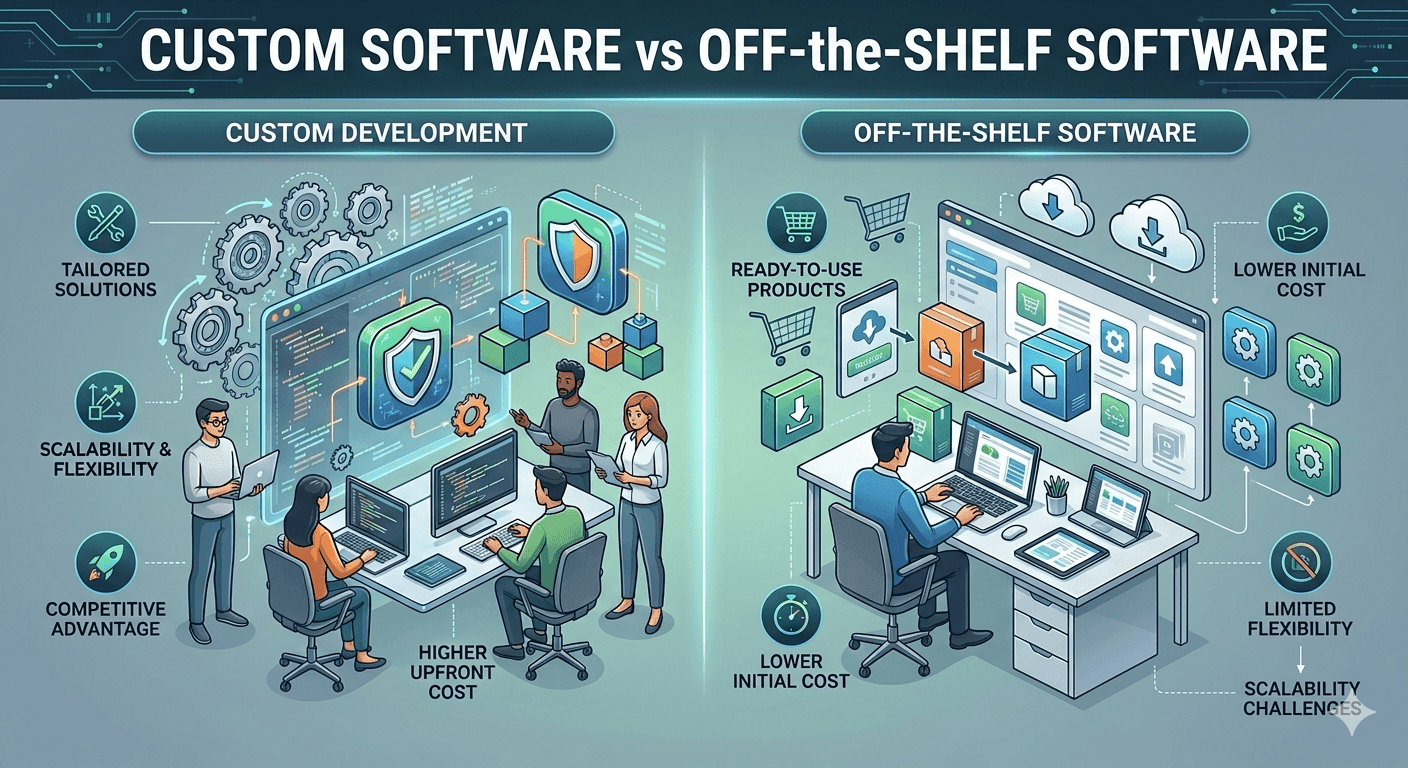
Companies waste an average of 37% of their software budget on tools that don't fit their workflows. The reason? Choosing the wrong type of software from the start.
Picking the right software for your business isn't just a tech decision; it's a business strategy decision. Go with the wrong option, and you'll either end up paying for features you don't need or struggling with a rigid system that doesn't fit how you actually work.
Most business owners find themselves torn between these two options: off-the-shelf solutions and custom software development. Concrete answers are hard to come by. But they do exist. What matters isn’t understanding what each option actually offers and which one aligns with where your business is headed.
Let's walk through it properly.
What is an Off-The-Shelf Approach?
Off-the-shelf refers to ready-made solutions built for a broad audience, think tools like Salesforce, QuickBooks, or Microsoft 365. You buy (or subscribe to), install, and you're up and running quickly.
These off-the-shelf software solutions are made around common use cases. The developer then polishes and tests them for specific use cases, with input from existing support communities. For businesses with standard workflows, they can absolutely get the job done.
But here's the thing: they're built for everyone, which means they're perfectly tailored for no one.
What Do You Mean By Customized Development?
Custom development refers to a development solution specifically made for a business. It is software built specifically for your business, your team, and your processes. No compromises, no unnecessary modules, no paying for a dashboard you'll never open.
When you partner with a bespoke software development company, everything is built around the way your business actually works. Whether you need a custom CRM, an internal workflow tool, or a full-scale enterprise platform, every feature is there for a reason because you needed it.
At Tech Reforms, we do this every day, helping businesses translate operational challenges into software that genuinely solves them.
The Real Differences Between Your Given Choices
Here is a given differentiation between the two options:
1. Flexibility
Off-the-shelf tools come with fixed features, so you end up adjusting your processes to fit them. With custom business software solutions, it’s the other way around: the end product is built to match how you work.
This shows that no matter what processes you have, they aren’t one-size-fits-all. Maybe you have:
- A customized pricing model
- A multi-step approval flow
- A data setup
All of these things can be root causes of disruption and explain why off-the-shelf tools can’t handle it properly. That’s where custom solutions come in, as they’re built to support the way you already work. In the end, software customization vs standard software is really about control, and that control matters when your business doesn’t fit a template.
2. Scalability
One of the prevalent advantages of custom software is that it grows alongside your business. Off-the-shelf tools, by contrast, scale on the vendor’s terms, not yours. So, when you need something new, you wait on their roadmap or move to a higher-tier plan before it really fits.
Software scalability solutions built into a custom product let you add modules, users, and capabilities as the business changes. For enterprise software development, that matters: the cost of hitting a ceiling can be very high.
3. Integration
Most modern businesses run on five, ten, sometimes fifteen different tools. Getting them to talk to each other is a constant headache with ready-made outputs. Software integration capabilities in custom-built products are designed from day one; your ERP, CRM, and analytics tools can all be wired together cleanly without workarounds or third-party connectors.
That matters most where integrations are heavy. ERP software customization and custom CRM software development are good examples: a lot of data flows between systems, so the wrong setup shows up fast.
4. Total Cost
This is an oversimplified software development cost comparison: off-the-shelf software tends to look cheaper upfront, and it often is. You still have to stack the cost of development against the long-term math, subscriptions, workarounds, and what you give up.
Licensing fees compound. Seats scale. Workarounds consume developer hours. And when you eventually outgrow the product, migration costs are steep.
According to Gartner's research on enterprise software spending, companies frequently underestimate the total cost that comes with ownership of packaged software when factoring in customization, licensing, and integration overhead.
Bespoke software is a long-term software investment with a higher upfront cost and software ROI, lower ongoing friction, and is built to serve you for years.
5. Security and Data Control
Off-the-shelf software, particularly SaaS products, stores your data on shared infrastructure. You're dependent on the vendor's security posture, their breach response, and their compliance certifications.
Software security and data control stay in your hands with bespoke software. You can:
- Choose the hosting environment
- Configure the access controls
- Determine who sees what
6. Maintenance and Support
Limitations of ready-made software include that bugs are fixed on the vendor's schedule. Features get deprecated. Entire products get sunset (anyone remember the chaos around legacy CRM migrations?).
With custom software, software security and data control sit with you: you pick the hosting environment, set access controls, and decide who sees what. If you touch sensitive data such as finance, healthcare, or legal, that isn’t a nice-to-have; it’s the baseline. This means less software maintenance cost and more benefits.
- Update schedules: You control when updates ship, with no forced upgrades that break existing workflows or require emergency re-testing.
- Bug fix timelines: Critical fixes go to the top of your queue immediately, rather than waiting on a vendor's release cycle that may be weeks or quarters away.
- Support SLAs: You define response and resolution standards, rather than being bound to a vendor tier that may not align with your business's actual urgency.
Vendor dependency risks: There's no exposure to a vendor being acquired, pivoting, or sunsetting the product; your software roadmap stays in your hands.
When Should You Go for Custom?
These are the cases where custom development usually pays for itself:
- Specialized workflows, weak fit from off-the-shelf products
- Regulated industry + non-negotiable data control
- Grow fast: you need a foundation that won’t cap you
- Constant patching and manual workarounds hide bigger problems
- Cloud-based custom software as part of a broader digital transformation initiative
If any of this sounds familiar, the investment in a tailored solution will almost always pay off faster than you expect.
A Quick Comparison
| Factor | Off-the-Shelf | Custom Software |
|---|---|---|
| Upfront Cost | Lower | Higher |
| Long-Term Cost | Can escalate | More predictable |
| Fit for Your Needs | Partial | Exact |
| Scalability | Vendor-controlled | You control it |
| Integration | Limited/workarounds | Built-in |
| Security | Shared infrastructure | Full control |
| Support | Vendor's timeline | Direct and specific |
| Time to Deploy | Fast (off-the-shelf | Longer initial build |
| Customization Level | Minimal | Unlimited |
| Vendor Dependency | High | None |
| Who Controls Updates | Vendor | You |
What We Bring to the Table?
We build software for businesses, not for slide decks. If the thing ships and your team still reaches for spreadsheets, we did it wrong.
Sometimes that’s a custom CRM. Sometimes it’s a boring internal tool that keeps orders, inventory, or approvals out of email. Sometimes it’s bigger, an enterprise system that has to hold up under real load. Either way, we ask a lot of questions first: what’s annoying today, what’s non-negotiable, and what happens when someone is out sick. Code comes after that.
You can hire people who only execute tickets. We’re aiming to be the kind of partner who notices when the request doesn’t match the actual problem, and says so before you pay for the wrong build.
If you're at the point where your current tools are slowing you down more than helping, it's worth having a conversation. Explore the wide array of technologies for which we offer high-end development services, and see how we approach them.
The Final Verdict:
Custom software development vs off-the-shelf solutions isn’t a purity contest. It’s a fit question: what matches how you operate today, what you’re trying to do next, and how fast you expect to move.
Off-the-shelf can be the right call, especially early, or when the problem is common and boring in a good way. If you’re tired of bending your process around a product, though, custom software tends to pay off as the work gets more specific and the stakes get higher.
At Tech Reforms, we try to keep projects practical, with a clear scope, fewer surprises, and no “innovation theater.” If packaged software has you stuck with more workarounds than workflow, email us. A few sentences are fine:
- What’s painful today?
- What would make the next quarter easier?
- Are there any hard lines (budget, timeline, compliance, whatever)?
We’ll help you cut through the wish list, agree on what actually needs to ship first, and build from there.