
What is Game Design and Development? A Beginner-Friendly Step-by-Step Explanation
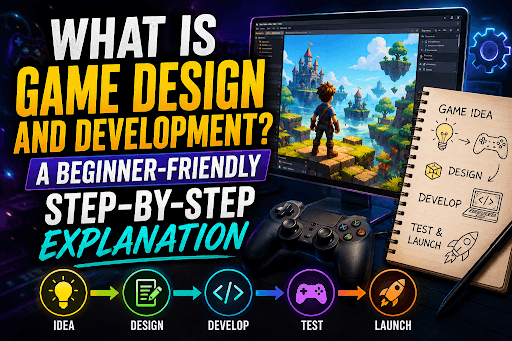
You've probably played a mobile game on your commute, spent hours in an open-world RPG, or watched someone stream a brand-new indie hit and thought: "How does something like this actually get built?" That question is exactly what this guide is here to answer.
Game design and development is a topic that sounds complicated at first, but gets simpler as you try to understand it layer by layer. It's really a creative and structured process that every business owner with a vision should be aware of.
That’s why this guide explains all the intricacies of custom game development services you should know before even thinking about partnering with a studio. This breakdown is for you.
Let's go step by step, without the jargon.
Game Design vs. Game Development: Are They the Same Thing?
A lot of people use these two terms interchangeably. They're related, but they're actually different roles with different responsibilities.
Design of the Game
Game design is about the what and why. It covers the rules, the player experience, the objectives, the story, and the flow of the game. A game designer answers questions like: What does the player do? How do levels progress? What makes it fun?
Development of the Game
Game development is about the how aspect, which includes:
- Programming
- Engineering
- Technical execution
In practice, both roles are deeply connected. On larger teams, designers and developers sit side by side. On smaller teams or solo projects, one person simply does it all, and honestly, that's where some of the most creative games come from. What matters is knowing which hat you're wearing at any given moment, because confusing the two early on is one of the fastest ways to end up with a half-baked idea and a half-built game.
A Step-by-Step Breakdown of Game Design and Development Process
The game design and development process is not a single action. It's a series of connected stages, each building on the last. Here's how it looks from start to finish.
Step 1: Understand the Concept of the Game
Every successful game you play in your leisure time was once a small part of imagination in someone's head. Maybe it's a mechanic you've never seen before, a story you want to tell, or a genre you want to put a fresh spin on. At this stage, the team defines the core concept: the genre, the target audience, the platform, and the overall experience.
This is where you might notice even the bigger agencies overlooking the game design basics for beginners. People tend to rush to the coding phase, thinking that clarity of the game concept is a mere additional step. Sooner or later, you realize that a strong concept up front saves enormous time later. Simple documents, sketches, and reference games are enough to shape your vision at this point.
Step 2: Pre-Production Phase of the Game
After the concept is set and ready to go, the next step in the process is pre-production, along with detailed design documentation. This is where our experts structure and align everything before a single line of code is written. Designers create a Game Design Document (GDD), essentially the blueprint of the entire game.
The GDD Process
- The overall game mechanics.
- The level design of the game.
- The character design of the game.
- The player progression.
- The win/loss conditions
- The user experience (UX) in games.
Think of it as the architect's plan before construction begins.
According to Game Developer Magazine, a well-structured design document is one of the most important factors in keeping a development team aligned and avoiding costly revisions mid-build.
This stage also consists of these base tasks:
- User interface (UI) design Wireframes.
- Early character sketches.
- Worldbuilding notes for interactive storytelling.
Step 3: Game Development and Programming
Now the actual building begins. Developers use game engine software like Unity or Unreal Engine developer to turn design documents into working systems. The game engine handles rendering, game physics, collision detection, lighting, and much more without requiring developers to build everything from scratch.
During this phase, programmers code the gameplay design systems: player controls, enemy AI, scoring, inventory, quests, and every other interactive feature the player will encounter. This is the longest phase of the game development lifecycle and requires close collaboration between developers and designers.
Step 4: Create Graphics and Visual Appeal of Your Game
A game might feel great to play, but if it doesn’t look visually aesthetic, people won’t stick around. That’s where the art and animation phase really shines; it’s when the game finally starts to look like something.
This is the stage where the artists focus their energy on creating memorable:
- Character
- The landscapes
- Everyday objects
Character design and level design both happen here in their final visual forms. Concept sketches get turned into polished 3D models, rigged for movement. Game animation brings these models to life, with walking cycles, attack animations, facial expressions, and environmental motion like rustling leaves or flowing water.
This phase is also where the visual tone of the game is locked in. Stylized, realistic, cartoon, pixel art: every choice here shapes how players emotionally connect with your game world.
Step 5: Audio Design and Sound Engineering
Sound is one of the most underrated elements of gameplay design. The right audio can build tension, signal danger, reward achievement, and create emotional attachment to a character or world.
Audio designers work on three layers: sound effects (footsteps, weapon sounds, environmental audio), background music and score, and voice acting when applicable. Games without strong audio feel flat and disconnected, regardless of how good the visuals are.
Step 6: Quality Assurance and Playtesting
Before any game is released, it goes through rigorous QA testing process. Testers play through every part of the game looking for bugs, broken mechanics, performance issues, and user experience (UX) problems in games that developers may have missed.
As IGDA's best practices guide highlights, quality assurance is not just a technical step. It's a key part of designing an experience that players will return to.
Step 7: Launch and Post-Launch Support
The game goes live on its target platform, App Store, Google Play, Steam, console stores, or a web browser. But launch isn't the end; it's the beginning of the next phase.
Post-launch includes monitoring player feedback, fixing reported bugs, releasing updates, and expanding content. Games that grow strong communities are almost always the ones with dedicated post-launch support.
Surface View: The Game Development Lifecycle
| Stage | What Happens | Key Elements |
|---|---|---|
| Concept & Ideation | Game vision defined | Genre, audience, platform |
| Pre-Production | Planning roadmap created | GDD, UI/UX, level design |
| Development | Core game built | Engine, coding, mechanics |
| Art & Animation | Visual assets produced | Characters, 2D/3D art, animation |
| Audio Integration | Sound layers added | Music, effects, voiceovers |
| QA & Testing | Bugs and issues fixed | Playtesting, optimization, checks |
| Launch & Support | Game released and maintained | Updates, patches, community |
Game Design Basics for Beginners: What Actually Makes a Game Fun?
This is the question every new designer wrestles with. Fun is subjective, but it's also predictable when you understand the core pillars of good game design basics for beginners.
Your game should possess clear goals.
All the presented challenges should be designed to be moderately difficult but doable.
Meaningful feedback
Player agency
Progression
Conclusion
The video game development process, explained simply, comes down to a singular fact. The fact is that a great game needs to be built through a structured, creative, and iterative process. That's why even the dreamer who dreams about having their own game in the market must understand each stage of the development process. It will help you:
Make better decisions.
Communicate more effectively with a development team.
Set realistic expectations for timelines and budgets.
If you have a game concept and want to understand exactly what turning it into reality looks like, Tech Reforms is here to walk you through every step. From early concept planning to full custom development, our team combines design thinking with technical expertise to build games that actually work and games that players actually love.