
Future of ERP Software Development Services: AI, Automation, and Cloud Integration Trends
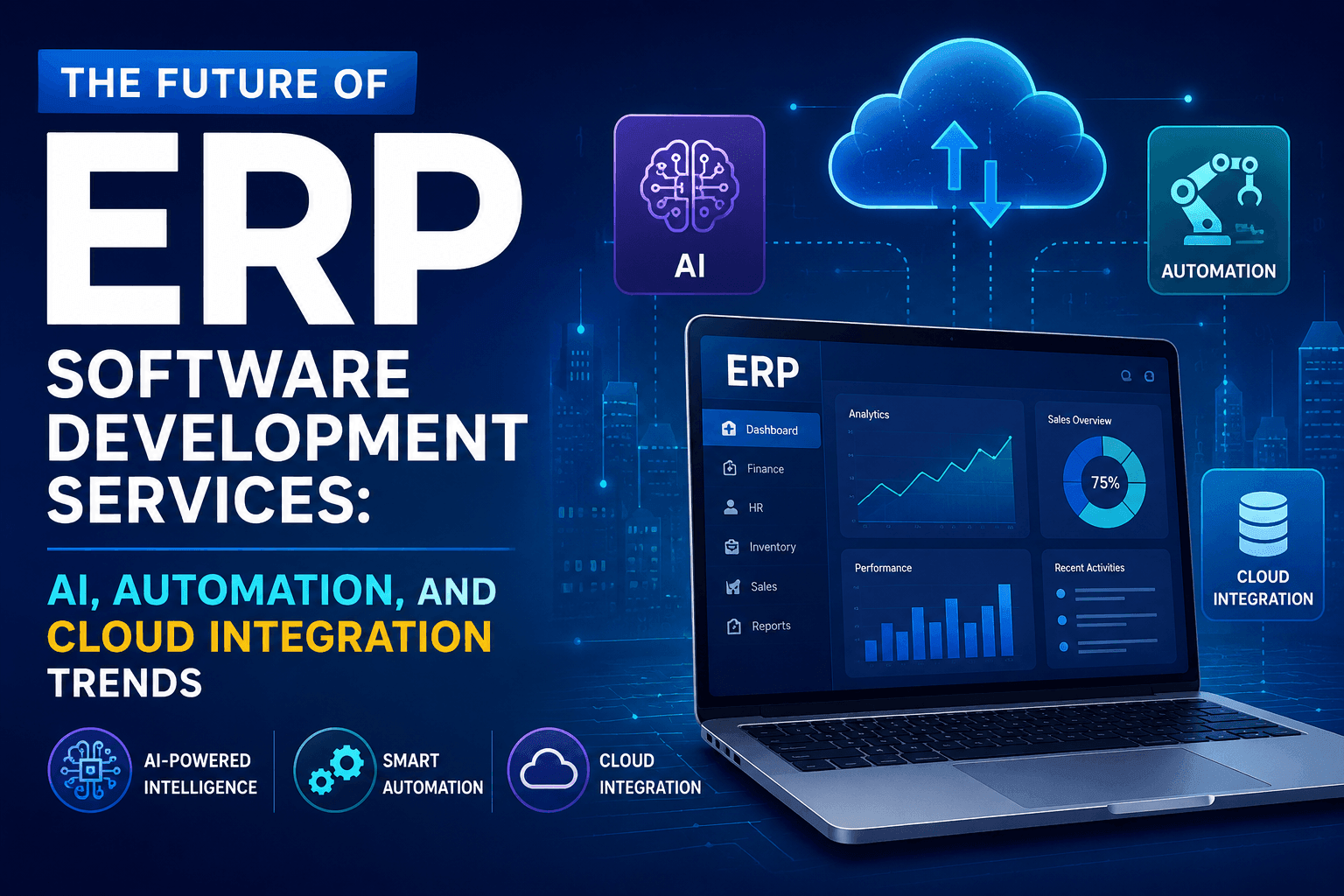
If you've been watching how businesses are evolving, one thing is clear: companies that run on outdated systems are falling behind, fast. The demand for custom ERP software development services has skyrocketed over the last few years, and it's not hard to see why. Enterprises are no longer just looking for software that manages their operations. They want systems that think, adapt, and grow alongside them. At Tech Reforms, we've had front-row seats to this shift, and we want to walk you through exactly where things are headed.
From AI in ERP software development to cloud-based ERP systems and everything in between, the landscape has changed faster than most teams can keep up. This blog breaks it all down in plain terms, so you know what to prioritize and what to expect.
Why ERP Systems Are Getting a Major Overhaul
Traditional ERP platforms were built to consolidate data and streamline operations. They did that job well, but they weren't built for the speed, complexity, or volume of data modern enterprises handle. Today's businesses need enterprise ERP solutions that go beyond just storing information. They need platforms that surface insights in real time, automate repetitive workflows, and integrate seamlessly with the broader tech stack.
That's exactly what is driving the overhaul of ERP Solutions.
Nowadays, companies are rethinking ERP system architecture from the ground up. These businesses have moved away from traditional operational systems.
Monolithic and On-Premise Setups 🡪 Flexible and Modular Systems
These new systems can be updated incrementally without disrupting the entire operation. This shift is one of the biggest erp software development company trends we're seeing right now, and it's only going to accelerate.
The reason businesses gravitate towards ERP is due to one simple reason: Poor ERP implementation services led to:
- Data silos
- Workflow bottlenecks
- Compliance risks
AI is No Longer a “Bonus Option”
A few years ago, artificial intelligence in ERP systems was just used to market businesses, products, and services. Now it has become the baseline expectation. Businesses want their ERP platforms to do more than record transactions. They want systems that can successfully detect patterns, securely flag anomalies and issues before things get worse. They also recommend actions to mitigate issues for optimal operations.
Machine learning in enterprise software has proven to be a powerful move for many businesses. AI has assisted the ERP model and made things possible on such a large scale. ML models can continuously analyze operational data and surface meaningful signals, instead of relying entirely on human input to interpret reports. Then there's predictive analytics in ERP, which takes this a step further. Rather than just describing what happened, predictive tools tell you what's likely to happen next.
How Automation Saves Time and Money?
One of the most tangible returns from modern ERP automation services is the elimination of manual, repetitive work. Finance teams are spending hours reconciling invoices. HR teams are manually updating employee records across five different systems. Procurement teams are chasing approvals through email chains. All of this can be automated and should be.
Robotic process automation (RPA) has become a powerful addition to the enterprise software frameworks that underpin modern ERP systems. RPA bots can handle structured, rule-based tasks with speed and accuracy. This fastens the process as humans can match that speed effectively. When integrated directly into the ERP layer, these bots operate within the same data environment, meaning they update records in real time, trigger downstream workflows automatically, and log everything with a full audit trail.
Bots are the only agents that drive automation for businesses. Intelligent workflow systems are changing the game completely.
They have changed how companies handle:
- Approvals
- Escalations
- Exceptions
All of this makes business process automation genuinely adaptive, not just faster. As a result, leaner teams are doing higher-value work. Fewer errors. Faster cycle times. And significantly lower operational costs. These are the outcomes that make ERP automation services one of the most ROI-positive investments a business can make right now.
Cloud Integration and ERP Deployment
Cloud ERP integration services are no longer just about moving your ERP to the cloud. Unlike the old days when it was only used to reduce infrastructure costs, now it offers:
- On-demand Scalability
- Global Accessibility
- Faster Updates
- Tighter Integration
Alongside cloud-based systems, SaaS ERP platforms have changed how mid-sized businesses access enterprise-grade capabilities. That too, without any upfront investment required for traditional deployments.
At the same time, larger enterprises are seen using hybrid ERP solutions. Such solutions keep sensitive data or legacy processes on-premise while migrating other functions to the cloud. This gives them flexibility without sacrificing control.
For businesses that are spread across multiple regions or use several cloud providers, they tend to gravitate towards multi-cloud integration. The ability to run workloads across AWS, Azure, or Google Cloud while maintaining consistent performance and data synchronization gives enterprises resilience and helps avoid vendor lock-in. But it also adds complexity, which is why the underlying scalable cloud infrastructure needs to be designed thoughtfully from the start.
You can read more about how cloud infrastructure decisions affect long-term ERP performance in Gartner's research on cloud ERP adoption trends, which provides a solid external benchmark for enterprise planning.
Modular Design and API-First Architecture are the New Standard
One of the more consequential shifts in ERP system architecture is the move toward modular, API-first design. Legacy ERP systems were built as tightly coupled monoliths; everything was interconnected, which made them stable but incredibly hard to update. If you needed to change one piece, you risked breaking something else entirely.
Modular ERP design solves more than one issue.
Instead of one massive application, you build the ERP as a collection of independent modules, finance, HR, supply chain, and CRM that can be updated, replaced, or extended individually. This makes the system far more maintainable and allows businesses to adopt new capabilities without a full-scale re-implementation.
API integration in ERP is the leading factor that makes it work practically. Well-designed APIs connect ERP with:
Third-party tools
Your CRM, e-commerce platform
Analytics stack
Payment gateway
This reduces real-time data-processing bottlenecks for the better.
For a deeper look at why API-first design matters for enterprise systems, the IBM blog on enterprise integration patterns is a useful reference point.
How Real-Time Data Dictates Decision-Making?
There's a significant difference between having data and having timely data. Most traditional ERP systems are built around batch processing, where data gets collected, processed overnight, and made available the next morning. That cadence no longer works for businesses that need to respond to market changes, supply chain disruptions, or shifts in customer behavior in near real time.
Real-time data processing in modern ERP systems means:
Transaction + Inventory Movement + Customer interaction 🡪 updates 🡪 The Central System immediately.
Pair this with strong database-driven ERP systems and well-architected data synchronization systems, and you get a platform that doesn't just store your business data, it actively turns it into a competitive asset. That's the standard we hold ourselves to when building ERP solutions at Tech Reforms.
The Final Point
The trajectory is clear. AI in ERP software development, cloud-native architecture, automation, and API-first design are not future trends anymore.
They are the present.
They're happening right now.
So much so that businesses have already moved forward with and adjusted to them.
If you also move to pick up the pace and catch up to them, you may move past them. Then Tech Reforms can help you rethink and rebuild your ERP infrastructure with high-quality design and development.
Talk to the Tech Reforms team today, and let's figure out what the right solution looks like for you.