
How to Find and Hire a Skilled AR Developer for Your Project?
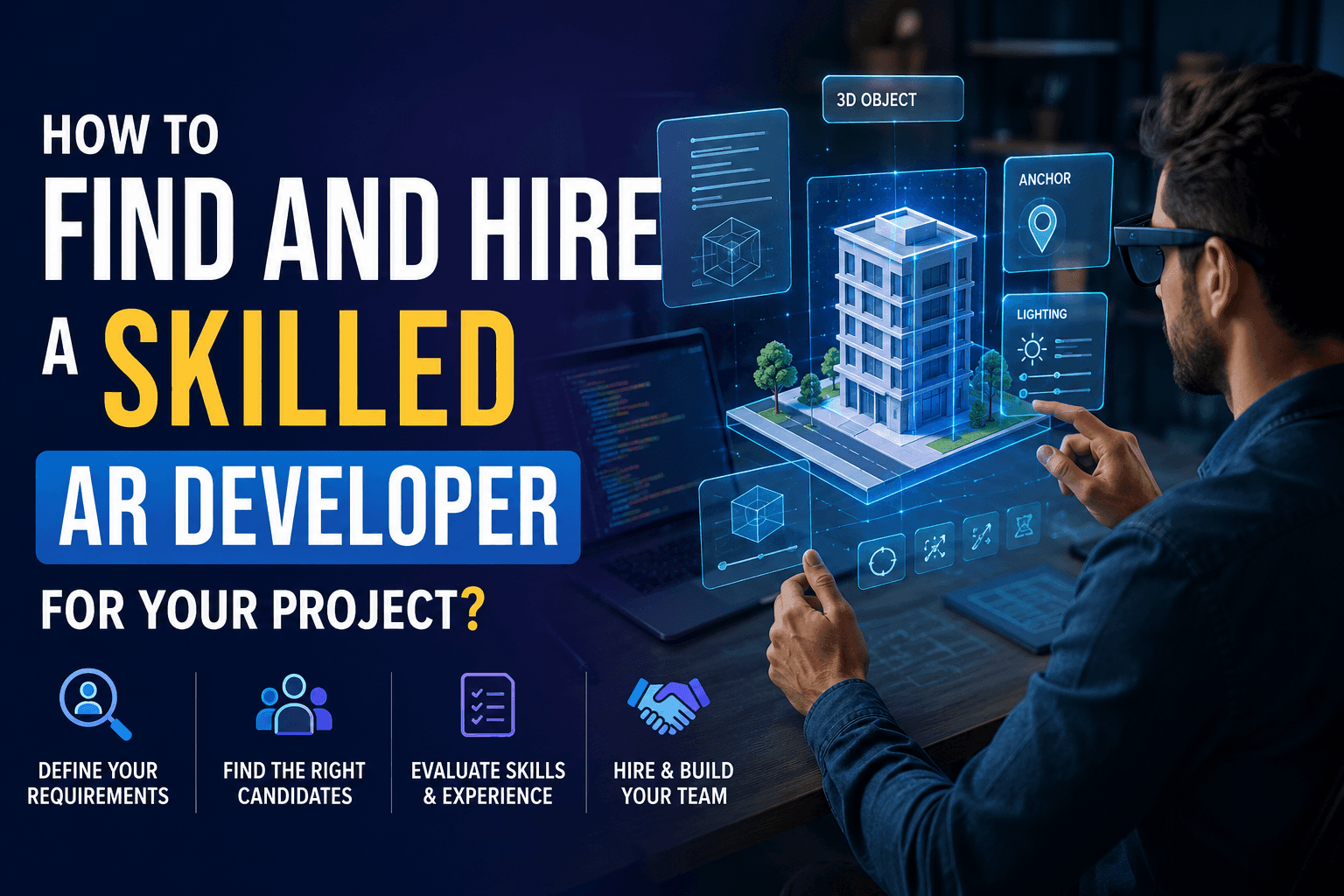
If you've been searching for how to hire AR developer talent or explore augmented reality app development services, you've probably realized one thing quickly: not all developers are built the same. Building an AR experience isn't like building a standard mobile app. It requires a very specific mix of skills, tools, and real-world project experience. And if you pick the wrong person or team, you'll feel it in your timeline, your budget, and your final product.
At Tech Reforms, we've helped businesses across industries find the right augmented reality solutions from retail to healthcare to enterprise tools. So, let's break down exactly what you should look for, where to find it, and how to avoid the most common mistakes people make when hiring for AR.
What Does an AR Developer Actually Do?
Before you post a job or reach out to an agency, it helps to understand what's actually involved in AR mobile app development. A skilled AR developer isn't just someone who knows how to code. They must understand:
- 3D space
- Real-time rendering
- Device capabilities
User behavior in immersive environments
It totally depends on your project. In some cases, you might need someone with experience in AR Kit development, for example, for iOS-based apps and sites. But if your project is Android-based, you might want to look into AR Core development services. Similarly, if cross-platform, you might look for a Unity AR developer.
Some projects also call for web AR development services, where the AR experience runs directly in the browser without requiring an app download. Each of these is its own specialization, which is why hiring the right fit matters so much.
A good AR developer should also be comfortable with 3D AR application development, including working with 3D models, textures, anchors, and real-world surface detection. If your project involves spatial computing solutions or mixed reality development, the technical bar goes up even further.
Where Can You Find a Credible AR Development?
There are a few routes you can take when you're ready to move forward.
Freelance platforms like Upwork do have freelance AR developer listings, but the quality varies a lot. You might find someone great, or you might waste three weeks on revisions. It really depends on how well you vet candidates and how clearly you define your project scope upfront.
In-house hiring makes sense if AR is going to be a long-term part of your product strategy. But it's expensive and slow, especially for a niche skill like immersive app development or smart glasses app development.
The third option and often the smartest one is working with a dedicated AR developer team or an augmented reality app development company that already has the infrastructure, tools, and experience in place. You skip the ramp-up time, you get a full team instead of one person, and you typically get better accountability.
What to Look for When You Hire?
Whether you're going freelance or working with an AR software development company, here are the things worth evaluating:
The Portfolio of the Candidate
Ask to see real projects. Look for variety marker-based AR development, location-based AR apps, virtual try-on app development, or AR ecommerce solutions as signals that they've worked across different use cases and know how to handle different technical challenges.
Their Expertise in Your Chosen Platform
Make sure they know the platforms your users are on. Cross-platform VR app development is great in theory, but your developer needs to genuinely understand the differences between how iOS and Android handle AR, not just say they do.
Their Preferred Collaborative Route for Communication
This may sound textbook or obvious, but it indeed is one of the deciding factors, and yet many businessmen tend to ignore it. Here, you need to understand that custom AR app development projects are demanding and complex; the clarity of information directly translates into clarity in requirements.
AR involves a lot of back-and-forth between design, development, and testing. If your developer goes quiet for days at a time or can't clearly explain technical tradeoffs, that's a red flag.
How Well Do They Understand Your Industry?
An AR game development specialist may not be the best fit for an enterprise AR development services project. Please look for someone whose experience overlaps with your use case.
Questions You Should Ask Before You Sign Anything
Just like every collaboration, communication is key, and expert advice is always offered to offer clarity at the beginning. A simple understanding of the requirement is always a plus. A simple Q&A session can go a long way for your projects.
Here, you must be wondering, “What should I ask?” Then here is a list of a few practical questions worth asking any team or individual before you commit:
Have you built interactive AR experiences with real user testing built into the process?
Can you handle performance optimization? Especially at the lower-end devices? If yes, then how?
How do you manage scope changes mid-project?
Do you have experience with augmented reality technology integrations like CRM, inventory, or ERP systems?
Can you show me a project where something went wrong and how you handled it?
That last question is one of the most telling. Good developers have stories about things going sideways and how they solved them. If someone has a perfect track record with zero challenges, they either haven't done much or aren't being honest.
Why Companies Choose Us for AR Development?
We've been building digital products long enough to know that augmented reality solutions aren't one-size-fits-all. Every client comes in with a different problem; some need a virtual try-on app for their e-commerce store, others need location-based AR apps for field teams, and others are exploring spatial computing solutions for training simulations.
Our team is the best one out there. Our expert developers have worked across:
- Industries
- Platforms
- Full product lifecycles
We stay involved through testing, iteration, and post-launch support because that's where many AR projects actually make or break. If you want to hire an AR app development company that treats your product like it's their own, learn more about what we build at Tech Reforms and how we approach client projects.
Conclusion
We understand how hard it is to find and hire AR developer. That's exactly where this guide will help you gain the clarity you need.
By now, you must know what to ask, what to note, and where to find a credible AR developer in this saturated market. If you are still confused or low on time, you can simply connect with Tech Reform.
We make this easy. Our team has the experience, the process, and the range to take your AI, cloud AR project from concept to launch without the usual headaches. Ready to get started? Reach out to Tech Reforms today, and let's talk through what you're building.