
Tinder vs Bumble: Which Dating App Development Model Should You Build?
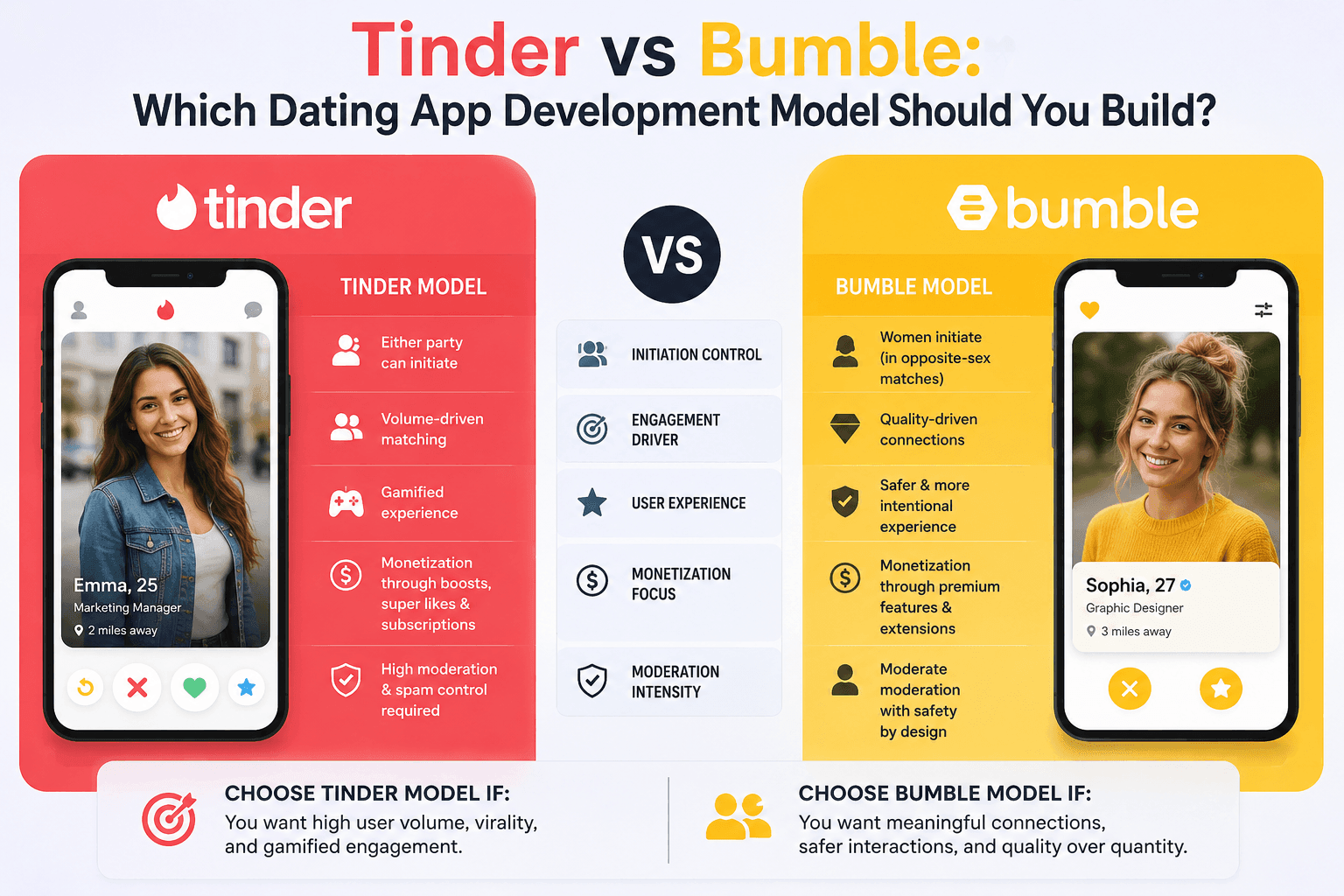
If you're comparing Tinder and Bumble before briefing a development team, you're actually asking a different question: which acquisition model, monetization structure, and moderation system can your business realistically sustain past launch? Founders who skip this step tend to build a Tinder clone with a Bumble color palette — a product with no defensible positioning and a cost structure that doesn't match its revenue model. This breakdown gives you the technical and strategic differences that actually matter before you commit budget to dating app development.
Why the Tinder vs Bumble Question Is Really a Business Model Decision
Tinder and Bumble run on similar core mechanics — geolocation, swipe-based discovery, mutual matching — but they diverge hard on two things that determine your entire build: who controls the first move, and how the app makes money from that control. Everything downstream — your matching algorithm, your moderation load, your monetization tiers, even your customer acquisition cost — inherits from that one decision. Treating this as a UI choice instead of an architecture choice is the most common mistake in early-stage dating app development.
Tinder's Swipe-First Model — What It Takes to Build
Core Feature Set
Tinder's model is volume-driven: maximize swipes, maximize matches, maximize daily active use. That requires a low-friction onboarding flow, a real-time geolocation matching engine, and a recommendation algorithm (Tinder's own "Elo-style" desirability scoring evolved into a more nuanced multi-signal model) that keeps the card stack relevant enough to sustain engagement. Push notification logic and re-engagement triggers aren't optional add-ons here — they're core to the retention model.
Monetization Architecture
Tinder monetizes friction removal: Super Likes, Boosts, unlimited swipes, and "see who liked you" all sell against scarcity the free tier creates deliberately. Building this well means your in-app purchase and subscription tiering has to be designed before your first wireframe, not bolted on after launch — because the entire free experience is engineered around what it withholds.
Technical Complexity & Cost Drivers
The expensive parts aren't the swipe UI — that's a solved pattern. The cost sits in matching algorithm tuning, fraud and bot detection at scale, image moderation (AI + human-in-the-loop), and infrastructure that handles high-frequency read/write on location data. Underbuilding fraud detection is the single most common reason volume-based dating apps fail post-launch — the model's own openness is what attracts bad actors.
Bumble's Women-First Model — What It Takes to Build
Core Feature Set & Differentiators
Bumble's differentiator is a time-gated messaging permission system: in male-female matches, women initiate contact within a 24-hour window, or the match expires. That's not a cosmetic feature — it requires a dedicated match-state engine tracking expiry timers, notification cadence, and reactivation flows (like Bumble's "extend" mechanic), which adds real backend complexity that a standard swipe app doesn't need.
Monetization Architecture
Bumble monetizes control extensions, not just visibility — extending matches, rematching with expired connections, and spotlighting your profile all sell against the platform's own gating rules. Bumble also diversified into BFF and Bizz verticals, meaning the underlying platform had to be built with modular relationship-type logic rather than a single-purpose dating flow. If you're evaluating this model, budget for that extensibility from day one — retrofitting multi-vertical logic onto a single-purpose codebase is significantly more expensive than designing for it upfront.
Technical Complexity & Cost Drivers
Beyond the timer-based match engine, Bumble's safety-first positioning (photo verification, in-app video/voice calling, AI-based lewd image detection) raises the moderation bar considerably. If your brand positioning leans on safety and trust, expect your content moderation infrastructure to be a bigger line item than your matching algorithm — this is a direct EEAT signal for your users too, not just a technical requirement.
Tinder vs Bumble: Side-by-Side Comparison for Founders
| Factor | Tinder Model | Bumble Model |
|---|---|---|
| Initiation Control | Either user can start after a mutual match | Women initiate conversations in opposite-sex matches |
| Core Engagement Driver | High-volume, gamified swiping experience | Curated matches with reduced spam and higher-quality interactions |
| Monetization Focus | Boosts, Super Likes, and other features that reduce friction | Match extensions, Spotlight, and features that increase user control |
| Backend Complexity | Scalable matching algorithms and fraud detection | Time-gated messaging engine with multi-vertical business logic |
| Moderation Intensity | High — open messaging increases spam and abuse risk | Very High — safety-first approach requires stricter moderation |
| Best-Fit Audience | Mass-market users seeking high-volume interactions | Safety-conscious users who prefer more controlled conversations |
Which Model Fits Your Target Market and Business Goals
When a Tinder-Style Model Makes Sense
Choose this if your target market prioritizes volume and speed over curation — younger demographics, casual dating markets, or geographies where daily active usage matters more than message quality. Your CAC strategy should assume high churn and design monetization around habitual use, not long-term subscriptions.
When a Bumble-Style Model Makes Sense
Choose this if your positioning is built on trust, safety, or a specific gender-dynamics differentiator. This model rewards brands that can sustain a stronger content moderation budget and a slower, more deliberate user growth curve — you're optimizing for retention quality over raw match volume.
Hybrid and Niche Alternatives Worth Considering
Most successful new entrants in 2026 aren't cloning either model outright — they're building niche-vertical dating apps (interest-based, faith-based, professional-networking-adjacent) with matching logic borrowed from Tinder but trust mechanics borrowed from Bumble. If your market research shows an underserved niche, this hybrid approach usually outperforms a direct clone on both defensibility and CAC.
What Professional Dating App Development Services Actually Deliver
A competent dating app development services provider isn't just writing swipe-card UI — that part is genuinely commoditized. What you're actually paying for is:
- Matching algorithm architecture tuned to your monetization model, not a generic recommendation engine
- Scalable geolocation infrastructure that holds up under concurrent user load
- Moderation and trust & safety systems — AI image screening, verification flows, reporting pipelines — built to your specific liability exposure
- Compliance engineering for GDPR, CCPA, and app store policy requirements specific to dating platforms (both Apple and Google apply stricter review standards to this category)
- Monetization infrastructure — subscription tiering, in-app purchase logic, and paywall experimentation tooling
If a proposal from a dating app development company vendor doesn't explicitly address moderation architecture and compliance scope, that's a gap worth pushing back on before signing — it's usually where post-launch costs blow past the original estimate.
Cost, Timeline, and Tech Stack Realities
A defensible MVP — not a demo, an actual launchable product — for either model typically runs a multi-month build cycle once you account for matching logic, moderation tooling, and payment integration. Bumble-style time-gated logic and multi-vertical extensibility generally push both timeline and cost higher than a straightforward Tinder-style swipe flow, primarily because of the additional state management and safety infrastructure. Any dating app development in usa quote that doesn't scale with your chosen model's actual complexity is either underscoped or padded — ask for a feature-by-feature cost breakdown, not a flat package price.
Final Recommendation
If you're still deciding between models, the decision isn't really Tinder vs Bumble — it's volume-and-friction-removal vs curation-and-trust. Get that positioning right before your first sprint, because it determines your entire technical scope, not just your UI. If you want a feature-by-feature cost breakdown mapped to your specific target market, that's the actual next step — not another feature comparison list.