

Lead ML Engineer
8+ yrs deploying production ML systems; owns model selection and evaluation design.


AI development is the process of designing, training, and deploying systems that use machine learning models or large language models (LLMs) to perform tasks that traditionally required human judgment — answering questions, recognizing patterns, predicting outcomes, or automating decisions. Unlike rule-based software, an AI system's behavior is learned from data rather than explicitly programmed line by line. In practice, this covers a spectrum from integrating an existing model (like GPT-5 or Claude) into a product, to training a custom model from scratch on proprietary data.
Every engagement starts with a use-case audit — we don't bolt a chatbot onto your product and call it AI. Below is the full scope of what our AI development team delivers.
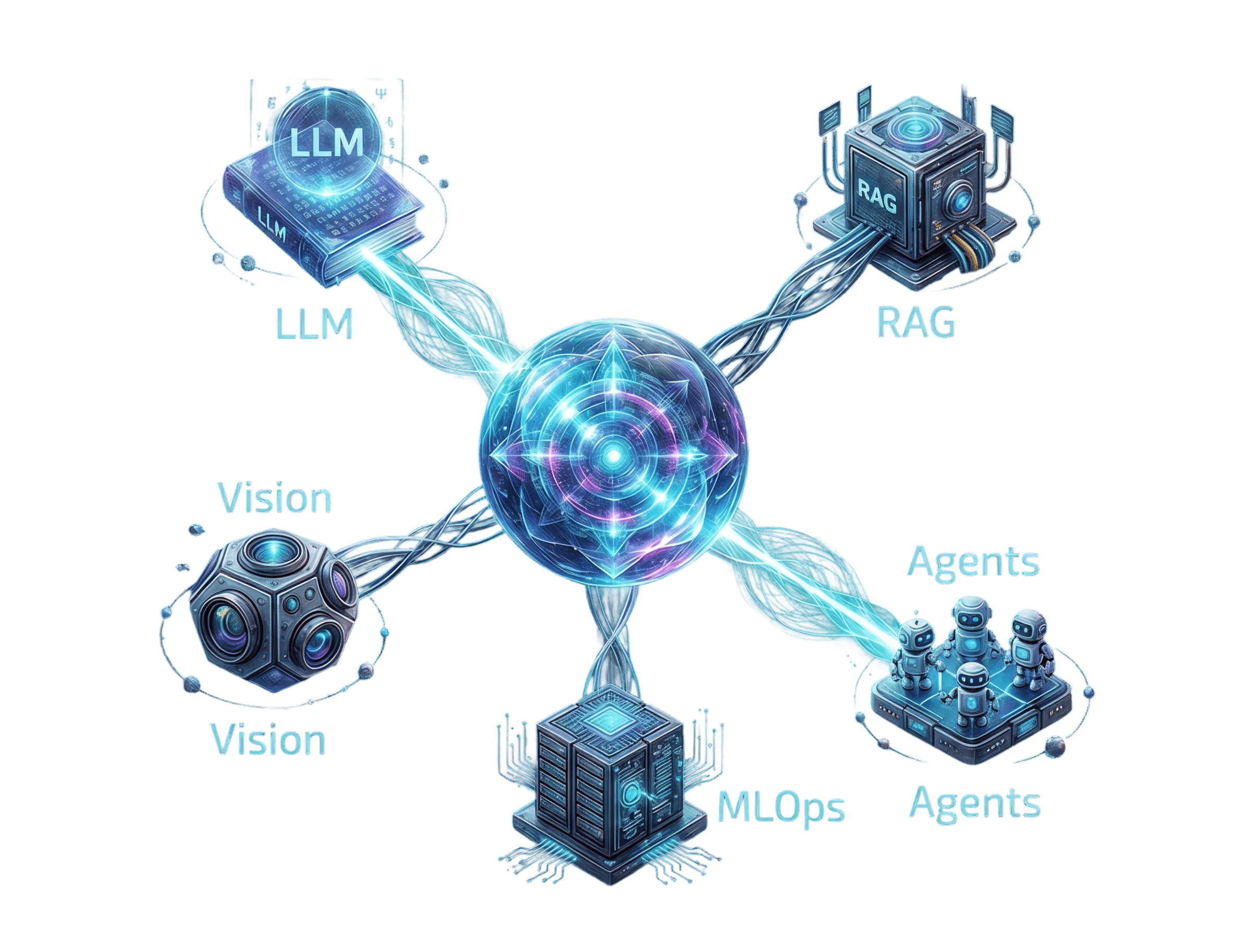
GPT-5, Claude, Gemini, and open-weight models integrated into your product, with fine-tuning on your domain data where prompting alone won't hold accuracy.
Retrieval-augmented pipelines connecting your LLM to internal docs, databases, and knowledge bases — accurate answers grounded in your data, not the model's training set.
Multi-step autonomous agents that call tools, query APIs, and complete workflows — customer support resolution, internal ops automation, research agents.
Object detection, OCR, defect inspection, and visual search built with custom-trained CV models for manufacturing, retail, and healthcare.
Sentiment analysis, entity extraction, document classification, and semantic search across unstructured text at scale.
Churn prediction, demand forecasting, and fraud detection models trained on your historical data, deployed with monitoring for drift.
Text, image, and voice generation pipelines for content ops, product personalization, and creative automation.
Production support and sales assistants with escalation logic, memory, and CRM integration — not a scripted decision tree.
CI/CD for models, versioning, A/B testing, and monitoring so performance doesn't silently degrade after launch.
The most common decision point in enterprise AI development. Compare on the factors that actually determine cost and accuracy.
Best for
RAG
Fast-changing knowledge bases
Fine-Tuning
Fixed domain style/behavior
Setup time
RAG
2–4 weeks
Fine-Tuning
4–8 weeks
Data required
RAG
Existing documents/DB
Fine-Tuning
Labeled training examples
Update cost
RAG
Low — update the index
Fine-Tuning
High — retrain on new data
Accuracy on niche facts
RAG
High, with citations
Fine-Tuning
Depends on training coverage
| Factor | RAG | Fine-Tuning |
|---|---|---|
| Best for | Fast-changing knowledge bases | Fixed domain style/behavior |
| Setup time | 2–4 weeks | 4–8 weeks |
| Data required | Existing documents/DB | Labeled training examples |
| Update cost | Low — update the index | High — retrain on new data |
| Accuracy on niche facts | High, with citations | Depends on training coverage |
Choose RAG if your knowledge base changes weekly and you need traceable, source-cited answers — support docs, internal wikis, compliance content.
Choose Fine-Tuning if you need a consistent tone, format, or specialized reasoning pattern that prompting can't reliably enforce.
Rough scope-based estimate. Final quote depends on data readiness and integration complexity.
$20K
Estimated project range (excludes ongoing model hosting/inference costs)
We audit your data and workflows before writing a line of code — flagging where AI adds real ROI versus where it's the wrong tool.
Data quality audit, vector store or fine-tuning readiness check, and system architecture design.
Choosing between proprietary APIs, open-weight models, RAG, or fine-tuning based on cost, latency, and data sensitivity.
Wired into your existing product with automated evaluation sets to measure accuracy before launch, not after.
Production deployment with drift monitoring, cost tracking, and retraining triggers.
Named practitioners, not an anonymous 'team of experts.' Content and estimates on this page are reviewed by the following leads.
8+ yrs deploying production ML systems; owns model selection and evaluation design.
Specializes in RAG pipelines and LLM integration architecture for regulated industries.
Owns deployment pipelines, monitoring, and drift-detection tooling post-launch.
Reviews every AI engagement for HIPAA/GDPR/SOC 2 alignment before deployment.
Defined scope and deliverables upfront. Best when requirements are clear and you want budget certainty before a single sprint begins.
Pay per sprint with flexible scope. Best for evolving AI use cases where requirements shift as you validate with real users.
A named AI engineering team on monthly retainer — embedded in your tools, roadmap, and release cadence without hiring overhead.
A scoped proof-of-concept to validate feasibility, accuracy, and ROI before committing to full production build.
HIPAA-compliant diagnostic support, intake automation, and patient triage assistants.
Real-time fraud scoring, AML/KYC automation, and compliance-ready document intelligence.
Personalized recommendations, demand forecasting, and conversational search across product catalogs.
Internal knowledge assistants, ticket routing, and workflow automation for distributed teams.
RAG-based intake system for a multi-clinic provider. Cut intake call volume 34%, HIPAA-compliant, deployed on private VPC.
Custom-trained risk model replacing rules engine. Reduced false-positive fraud flags by 41% in first quarter.
Computer vision search for a 12K-SKU catalog. Increased add-to-cart rate 18% on search results pages.
AI systems handling sensitive data are built to the same compliance bar as the rest of your infrastructure.
VPC-hosted or on-prem models for data that can't leave your environment.
Healthcare AI built with full audit trails and Business Associate Agreements.
Access controls, encryption at rest and in transit, and logging on every pipeline.
Input sanitization and guardrails on every user-facing LLM endpoint.
Region-locked model hosting for GDPR and regional compliance requirements.
Logged, reviewable outputs for regulated industries requiring explainability.
LLM Providers
Orchestration & RAG
Vector Databases
ML Frameworks
Cloud AI Platforms
Detailed breakdowns for each service area — for building out topical authority, link each card below to its own pillar page.
Architecture patterns and cost breakdown for integrating LLMs into existing products.
Full technical comparison beyond the summary table above.
How multi-step agents plan, call tools, and recover from failure.
What production model monitoring should include before you ship.