


Mistake 01
Fine-tuning to fix a prompting problem
If better prompt engineering would solve it, fine-tuning is expensive overkill. Exhaust prompting first.

The most common decision point in enterprise AI development. A 4-question framework, real cost ranges, and where most teams get it wrong.
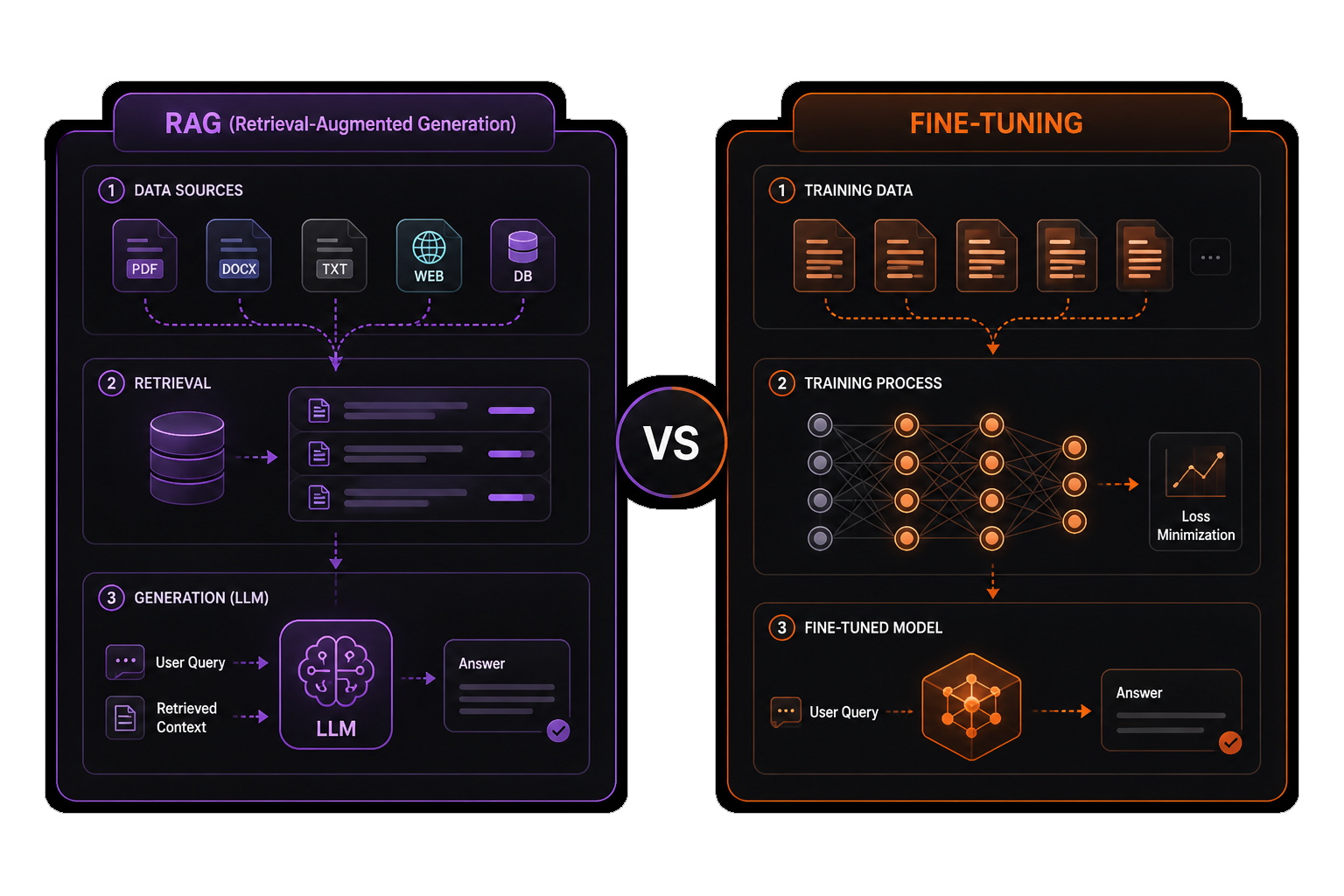


RAG (Retrieval-Augmented Generation) connects a model to an external knowledge source — your documents, database, or knowledge base — at query time. The model retrieves relevant chunks and uses them as context. Nothing about the base model changes.
Fine-tuning retrains a model's weights on labeled data so the behavior itself changes — tone, format, or reasoning pattern gets baked in rather than supplied as context.
RAG solves a knowledge access problem. Fine-tuning solves a behavior problem. Most teams pick wrong because they misdiagnose which problem they actually have.
Work through these in order. The first one that gives you a clear answer usually settles it.
Weekly or monthly updates to source docs, policies, or catalogs — RAG wins by default. Reindexing takes minutes; retraining takes weeks and costs real money every cycle.
RAG retrieves specific chunks and can point back to the source. Fine-tuned models generate from learned weights with no clean traceback — a problem in HIPAA, SOC 2, or GDPR-adjacent use cases.
"Doesn't know our product specs" is a knowledge gap → RAG. "Won't reliably match our brand voice or output schema" is a behavior gap → fine-tuning.
RAG needs existing, reasonably organized documents. Fine-tuning needs labeled input/output examples — hundreds to low thousands. No labeled data, no near-term fine-tuning, regardless of the other answers.
Assumes reasonably clean source data. Add 30–50% if your data needs significant cleanup first.
Setup time
RAG
2–4 weeks
Fine-Tuning
4–8 weeks
Typical cost
RAG
$8K–15K
Fine-Tuning
$25K–40K
Data required
RAG
Existing documents / DB
Fine-Tuning
Labeled training examples
Update cost
RAG
Low — reindex
Fine-Tuning
High — retrain on new data
Accuracy on niche facts
RAG
High, with citations
Fine-Tuning
Depends on training coverage
Auditability
RAG
Strong — source-traceable
Fine-Tuning
Weak — no clean traceback
| Factor | RAG | Fine-Tuning |
|---|---|---|
| Setup time | 2–4 weeks | 4–8 weeks |
| Typical cost | $8K–15K | $25K–40K |
| Data required | Existing documents / DB | Labeled training examples |
| Update cost | Low — reindex | High — retrain on new data |
| Accuracy on niche facts | High, with citations | Depends on training coverage |
| Auditability | Strong — source-traceable | Weak — no clean traceback |
Combined RAG + fine-tuning is common in production — budget for both lines, but the fine-tuning scope is usually narrower when RAG handles the knowledge layer.
Mistake 01
If better prompt engineering would solve it, fine-tuning is expensive overkill. Exhaust prompting first.
Mistake 02
Stuffing the same formatting rules into every prompt because output keeps drifting is a fine-tuning signal, not a "more context" signal.
Mistake 03
Ship with an accuracy benchmark before launch — not something you back into after users report wrong answers.
Frequent changes + citations needed
RAG
Fixed tone/format + labeled data ready
Fine-Tuning
Need current facts AND specific behavior
Combined approach
Not sure, tight budget
Start with RAG — cheaper, faster to iterate, layer fine-tuning in once the remaining gap is confirmed
Architecture patterns and cost breakdown for integrating LLMs into existing products.
When to use vision APIs vs custom models — cost ranges and a 4-question framework.
How multi-step agents plan, call tools, and recover from failure.
What production model monitoring should include before you ship.