




GUIDE
PRODUCTION READINESS

MLOps Checklist:What Production Model Monitoring Should Include Before You Ship

MLOps is the set of practices — versioning, CI/CD, monitoring, and drift detection — that keeps a machine learning model reliable after launch, not just accurate on the day it shipped. Here's the checklist we run before any model goes to production.

See AI Development Services
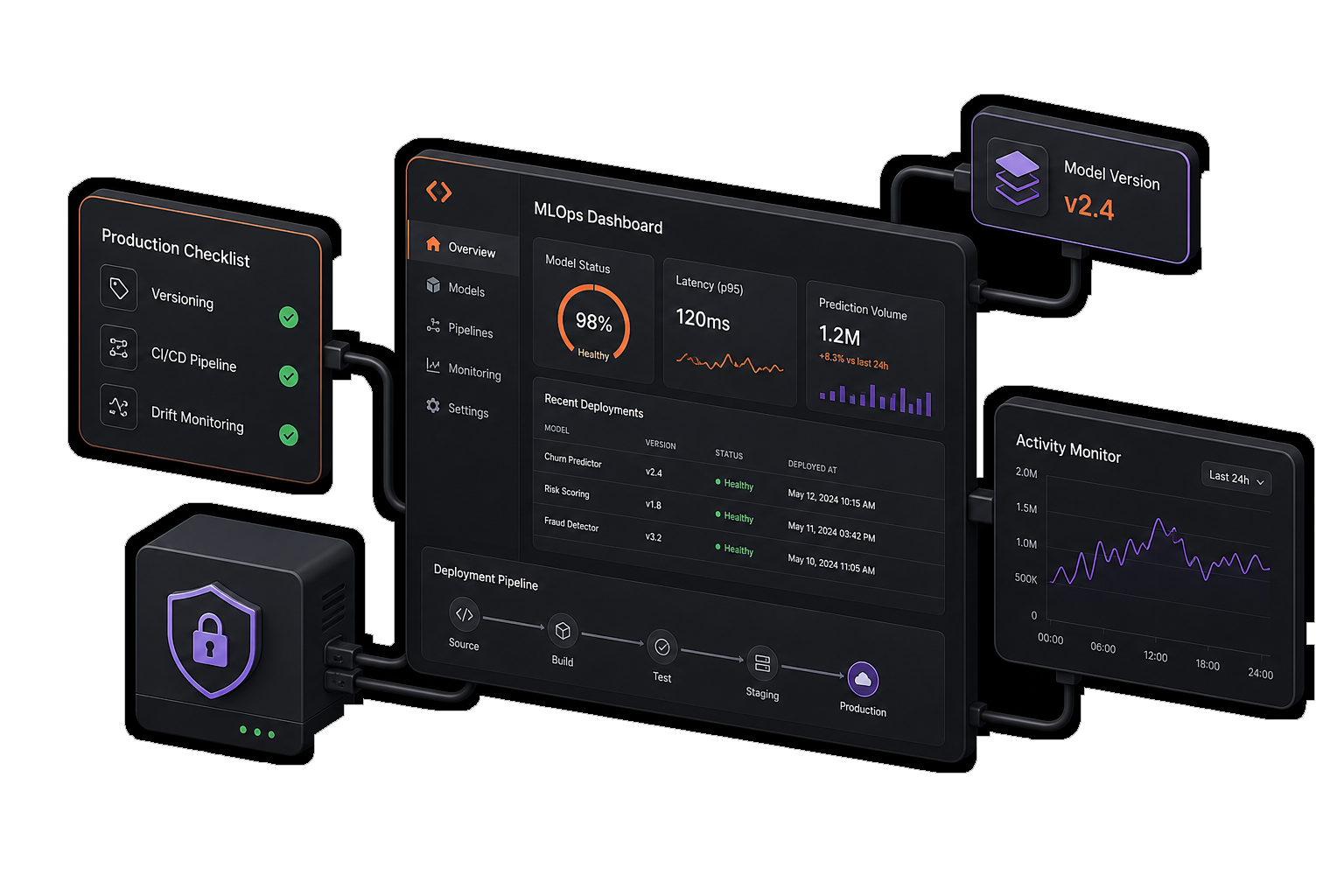
Production MLOps checklist dashboard with monitoring, versioning, and CI/CD gates
KEY
STATS
Tech Reforms logo accent for Checklist impact statDecorative hover highlight for Checklist
5
Checklist
Categories
Tech Reforms logo accent for Readiness impact statDecorative hover highlight for Readiness
18
Readiness
Individual checks
Tech Reforms logo accent for AI systems impact statDecorative hover highlight for AI systems
40+
AI systems
In production, monitored
Tech Reforms logo accent for Models shipped impact statDecorative hover highlight for Models shipped
0
Models shipped
Without a benchmark
DEFINITION

What Is MLOps?

MLOps (Machine Learning Operations) is the discipline of deploying, monitoring, and maintaining machine learning models in production — the operational layer that sits after a model is trained and before it's forgotten about. It borrows from DevOps (CI/CD, versioning, automated testing) but adds practices specific to ML: accuracy monitoring, data drift detection, and retraining triggers.

Without MLOps, a model that scored well in testing silently degrades in production as real-world data shifts away from what it was trained on — a failure mode with no error message, no crash, and no alert unless one is explicitly built.

This applies across every system covered in our cluster — LLM integrations, RAG and fine-tuned models, and AI agents all need a monitoring layer once they're live, not just at launch.

CHECKLIST

The Production MLOps Checklist

Grouped by category. Every item here is something we verify before a model ships — not something we add after a client asks why accuracy dropped.

01

Versioning & Reproducibility

4 checks
  • Model version tracking

    Every deployed model tied to a specific version, training data snapshot, and hyperparameters.

  • Rollback capability

    Previous model version can be restored within minutes if a new deployment underperforms.

  • Reproducible training pipeline

    Training run can be re-executed from stored config to produce the same model.

  • Dataset versioning

    Training and evaluation datasets are snapshotted, not pulled live and untracked.

02

CI/CD for Models

3 checks
  • Automated evaluation gate

    New model versions must clear an accuracy benchmark before deployment is allowed.

  • Staged rollout

    New models go to a canary or shadow deployment before full traffic — not straight to 100%.

  • A/B testing framework

    Ability to compare model versions on live traffic with statistical significance, not gut feel.

03

Monitoring & Drift Detection

4 checks
  • Accuracy tracking in production

    Ongoing measurement against ground truth or human review, not just at launch.

  • Data drift detection

    Alerts when incoming data distribution shifts meaningfully from the training distribution.

  • Latency & error rate monitoring

    Standard infrastructure monitoring applied to the model-serving layer specifically.

  • Retraining triggers

    Defined thresholds that automatically flag or initiate a retraining cycle when performance drops.

04

Cost & Resource Tracking

3 checks
  • Per-request inference cost

    Token or compute cost tracked per call, not discovered at month-end on the cloud bill.

  • Usage-based alerting

    Thresholds set so an unexpected spike in calls or cost triggers a notification before it triggers a budget crisis.

  • Resource autoscaling policy

    Serving infrastructure scales with load without manual intervention.

05

Security & Compliance

4 checks
  • Output logging & auditability

    Model inputs and outputs logged for review — required in most regulated deployments.

  • Access controls on the model endpoint

    Not every internal service or user should have unrestricted access to the model API.

  • Data residency compliance

    Inference and any stored logs respect the same regional requirements as the rest of the stack.

  • Prompt/input sanitization checks

    Guardrails against injection or malformed input are part of deployment, not an afterthought.

COST

What MLOps Infrastructure Costs

MLOps is usually priced as part of a build, or as an ongoing monitoring retainer for systems already in production.

  • 01

    Scope

    Basic monitoring

    Setup cost

    $3K–6K

    Ongoing cost driver

    Logging & alerting infra, minimal

  • 02

    Scope

    Full MLOps pipeline

    Setup cost

    $12K–25K

    Ongoing cost driver

    CI/CD, drift detection, automated retraining triggers

  • 03

    Scope

    Enterprise multi-model platform

    Setup cost

    $40K+

    Ongoing cost driver

    Cross-model dashboards, compliance logging at scale

DECISION
FRAMEWORK

How Much MLOps Do You Actually Need?

Full pipeline if

The model touches revenue or compliance

Fraud scoring, clinical support, financial decisioning — drift here has direct cost or regulatory consequences. Full monitoring and retraining triggers are non-negotiable.

Basic monitoring if

It's an internal or low-stakes tool

An internal knowledge assistant or content-generation helper can run on basic accuracy and error-rate monitoring without a full CI/CD-for-models setup.

Full pipeline if

Your data changes fast

High data drift risk — fast-moving markets, seasonal behavior shifts — needs automated drift detection, not a quarterly manual check.

Basic monitoring if

The system is a RAG assistant, not a trained model

Pure RAG systems don't drift the way trained models do — the priority shifts to index freshness and retrieval quality monitoring instead of accuracy drift.

Already have a model in production without monitoring?

Call +1 (582) 233-5015 — we'll audit your current setup against this checklist
Soft gradient background behind testimonials
Decorative background for testimonial content
OUR
TESTIMONIALS
Our Work
Speaks For Us

Samir Patel

VP Engineering, HealthTech

They refused to call our LLM assistant "done" until evals and rollback were live. First partner who treated model ops like real engineering.

Laura Kim

Head of Data, Retail SaaS

Drift alerts caught a seasonal shift three weeks before our NPS dip. The checklist paid for itself in one quarter.

Decorative graphic in 3D text rotation section
Dark textured background behind contact form
Contact
Us
Partner with Us for
Custom AI Development
and AI That Actually Ships
Phone handset icon for contact call-to-action
Call us at:
(582) 233-5015
YourBenefits
LLM & RAG Integration
Custom ML Models
AI Agents & Automation
HIPAA & SOC 2-Aligned Builds
Full IP Ownership
Post-Launch Model Monitoring

Book a free AI strategy call — we'll tell you honestly if AI is the right fit before we quote anything.

Schedule a free consultation

No sales pitch on the first call — just a feasibility read on your use case.

What happens
next?
Process step one illustration
We Schedule a call at your convenience
Process step two illustration
We do a discovery and consulting meeting
Process step three illustration
We prepare a proposal
FAQ

Frequently Asked
Questions

MLOps is the set of practices for deploying, monitoring, and maintaining machine learning models in production — including versioning, CI/CD for models, drift detection, and retraining triggers — so accuracy doesn't silently degrade after launch.
Model drift is when a deployed model's accuracy declines because real-world data has shifted away from the distribution it was trained on. It happens gradually and produces no error message, which is why dedicated drift detection is necessary.
A lighter version of it. RAG systems don't experience model drift the same way trained models do, but they still need monitoring — specifically around retrieval quality and how current the underlying index is.
There's no fixed schedule — retraining should be triggered by defined accuracy or drift thresholds, not a calendar date. A model in a fast-changing domain may need retraining monthly; a stable domain may go much longer.
At minimum: version tracking, an automated evaluation gate before deployment, basic accuracy and error-rate monitoring, and output logging. This covers the highest-risk gaps without the cost of a full enterprise pipeline.