
AI Chatbots vs Traditional Mobile Apps: Which Delivers Better Business Value in 2026?
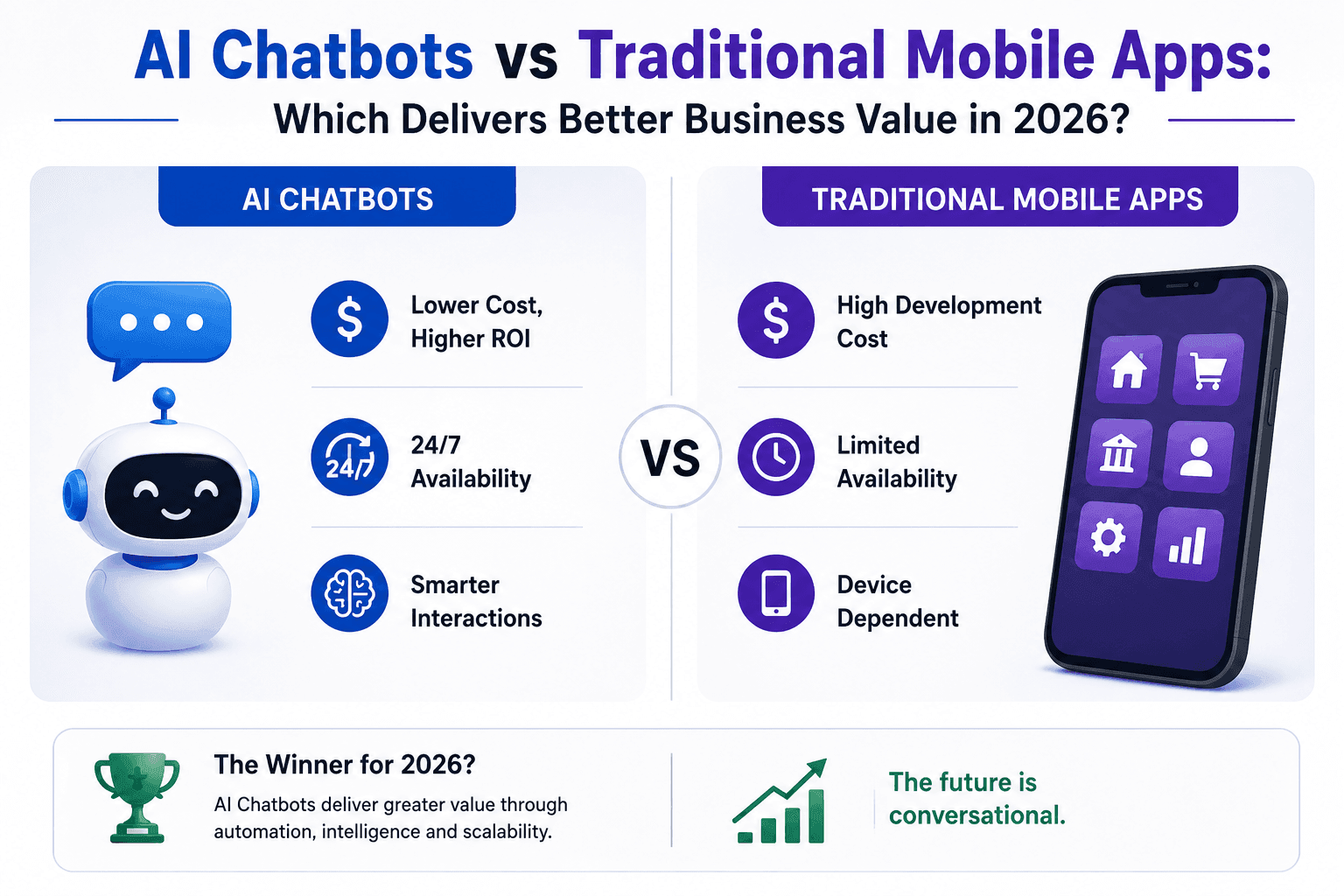
Every product roadmap meeting in 2026 eventually hits the same fork in the road: build a native app, or build a conversational AI layer instead. The question isn't rhetorical anymore. With hire LLM-powered agents now capable of booking flights, processing refunds, and querying live databases in natural language, the traditional app UI — tab bars, forms, nested menus — is being challenged as the default interface for digital products.
But "chatbots are replacing apps" is a lazy headline, not a strategy. The real answer depends on your use case, your users' intent patterns, your data complexity, and what you're optimizing for: retention, transaction speed, brand presence, or support cost reduction.
This guide breaks down the architectural, UX, and business-model differences between AI chatbots and traditional mobile app experiences, where each wins outright, and why the companies getting the best ROI in 2026 aren't choosing one over the other — they're combining both through custom app development services built around a hybrid interaction model.
1. What Counts as an "AI Chatbot Experience" in 2026
An AI chatbot experience today is not the rule-based, decision-tree bot from 2019. Modern AI chatbots are built on large language models (LLMs) with retrieval-augmented generation (RAG), function calling, and API orchestration layers. That means a chatbot can now:
Understand open-ended natural language, not just matched keywords
Call live APIs (inventory systems, payment gateways, CRMs) mid-conversation
Maintain context across a multi-turn session
Personalize responses using account or behavioral data
Operate across channels — in-app, web widget, WhatsApp, voice
The interface is conversational. The user states an intent ("reschedule my delivery to Friday"), and the system resolves it without navigating a menu tree.
2. What Counts as a "Traditional Mobile App Experience"
A traditional mobile app experience is structured, visual, and navigation-driven. Users interact through defined UI components — buttons, forms, lists, cards, dashboards — built natively (Swift/Kotlin) or cross-platform (Flutter, React Native).
The strength here is predictability. Every screen has a fixed purpose. Every action has a visible, tappable trigger. There's no ambiguity about what the system can or cannot do, because the interface itself communicates the boundaries.
3. The Core Architectural Difference (and Why It Matters for Cost)
This is the part most comparison articles skip, and it's the part that actually determines your budget and timeline.
Traditional apps are deterministic. You design every screen, every state, every edge case. QA is testing against a known finite set of user paths. Cost scales with the number of features and screens.
AI chatbot systems are probabilistic. The model generates responses dynamically, which means QA shifts from "does this screen work" to "does this system behave correctly across a near-infinite range of phrasing, intent, and edge-case inputs." You're not testing screens — you're testing guardrails, prompt architecture, hallucination rates, and fallback logic.
This is why chatbot projects often look cheaper at the MVP stage and more expensive at the reliability stage. A traditional app's cost curve is front-loaded in design and development. A chatbot's cost curve is front-loaded lower, but has ongoing costs in model tuning, monitoring, token usage, and guardrail maintenance that traditional apps simply don't have.
Any credible mobile app development company will walk you through this cost curve difference before scoping a project — because "just add a chatbot" is rarely the fixed-cost decision founders assume it is.
4. AI Chatbots vs Traditional Apps: Full Comparison Table
| Dimension | AI Chatbot Experience | Traditional Mobile App |
|---|---|---|
| Interface Model | Conversational, natural language | Visual, structured navigation |
| Learning Curve | Near-zero — users interact through chat | Requires onboarding and UI familiarity |
| Development Cost (MVP) | Lower initial development cost | Higher initial development cost |
| Ongoing Cost | Model usage, monitoring, and prompt tuning | Hosting, maintenance, and feature updates |
| Predictability | Probabilistic — requires guardrails | Deterministic and fully testable |
| Best For | Customer support, discovery, and quick transactions | Complex workflows, rich media, and offline functionality |
| Personalization | Deep, context-aware, real-time responses | Rule-based and audience-segment driven |
| Offline Capability | Very limited | Strong with local caching |
| Data-Heavy Tasks | Limited for visual dashboards and analytics | Excellent for charts, dashboards, and data visualization |
| Brand & Visual Identity | Harder to express through text alone | Fully customizable UI and branding |
| Regulatory & Compliance Complexity | Higher due to AI outputs and data handling | Lower and easier to audit |
| App Store Presence & Discovery | None unless embedded in an app | Full App Store and Google Play visibility with ASO |
5. Where AI Chatbots Win
Support-heavy products. If more than 30% of your user friction is "I don't know how to do X" or "what's the status of Y," a chatbot resolves that faster than any UI can, because the user doesn't need to learn where anything is.
High-frequency, low-complexity transactions. Rebooking, rescheduling, order status, FAQs, simple purchases — tasks with a clear, narrow intent are ideal for conversational resolution.
Reducing time-to-value for new users. There's no onboarding tutorial for a chatbot. The user types what they want. This matters enormously for products competing on activation speed.
24/7 scale without linear headcount cost. A well-built AI chatbot with retrieval-augmented generation can resolve a large share of Tier-1 support volume without proportional increases in support staff.
6. Where Traditional Mobile Apps Still Win
Anything visual or spatial. Dashboards, maps, media galleries, drag-and-drop builders, video, AR — chatbots cannot replace visual-first interaction. A fintech app showing a portfolio breakdown, a healthcare app displaying vitals trends, an eCommerce app with a product carousel — none of this works as plain text.
Complex, multi-step workflows. Loan applications, insurance underwriting, enterprise approval chains — processes with conditional logic, document uploads, and compliance checkpoints need structured, auditable UI, not open-ended conversation.
Offline-first and low-connectivity environments. Chatbots depend on live model access. Native apps can cache data locally and function with intermittent connectivity — critical for field service, logistics, and doctor apps in low-bandwidth regions.
Brand and habit formation. App icons on a home screen, push notifications, widgets — these build daily brand presence in a way a chat window embedded elsewhere cannot replicate.
Regulated industries. In doctor and fintech app development, every screen, disclosure, and consent flow needs to be auditable and version-controlled. Deterministic UI is far easier to certify than a generative system's output space.
7. The Hybrid Model: Why Most 2026 Builds Use Both
The framing of "chatbot vs app" is largely a false choice in production systems today. The pattern that's actually winning in 2026 is AI-augmented native apps — a traditional app shell with an embedded conversational layer for specific high-friction moments.
Examples already live in the market:
An eCommerce app where product browsing stays visual, but customer support and product discovery ("find me a waterproof jacket under $100") run through an embedded AI assistant.
A banking app where balance checks and transfers use the standard UI, but "why was I charged this fee" routes to an AI agent with RAG access to transaction history.
A doctor app where appointment booking is a form, but symptom triage before booking is conversational.
This hybrid approach requires a development partner who understands both native/cross-platform architecture (Flutter, React Native, native iOS/Android) and LLM integration (RAG pipelines, function calling, vector databases, API orchestration) — which is a materially different skill set than either discipline alone. This is exactly the kind of build where working with an experienced custom app developer, rather than assembling freelancers across two disciplines, prevents costly integration gaps between the AI layer and the app's core architecture.
8. Industry Breakdown
eCommerce apps: Chatbot for product discovery, sizing questions, and post-purchase support. Native UI for checkout, cart, and payment — conversion-critical flows should stay deterministic and fast.
FinTech apps: Chatbot for transaction queries and financial guidance. Native UI mandatory for transfers, KYC, and anything touching regulated financial actions — auditability isn't optional here.
Doctor apps: Chatbot for triage, appointment scheduling assistance, and medication reminders. Native UI required for EHR integration, prescription management, and anything under HIPAA-scope data handling.
Enterprise apps: Chatbot for internal knowledge search and IT helpdesk deflection. Native/web UI for dashboards, approvals, and reporting where data visualization is non-negotiable.
9. Cost and ROI Comparison
A realistic MVP-stage cost comparison for mid-market builds:
Rule-based or lightly-AI chatbot widget: Fastest and cheapest to launch, but ROI plateaus quickly if intent complexity grows.
LLM-powered chatbot with RAG and API integration: Higher build cost than a scripted bot, but scales support deflection meaningfully — ROI shows up in reduced support headcount and faster resolution times.
Traditional native/cross-platform app: Highest upfront investment, but ROI compounds through app store discovery, push notification retention, and brand equity — assets a chatbot alone doesn't build.
Hybrid app + embedded AI layer: Highest total cost, but typically the highest long-term ROI for products with both discovery/support friction and complex core workflows.
The mistake most businesses make is comparing MVP cost only. The right comparison is 18–24 month total cost of ownership against the specific business metric you're trying to move — support cost, conversion rate, or retention.
10. Common Mistakes Businesses Make When Choosing
Choosing a chatbot purely because it's cheaper upfront, without budgeting for ongoing model costs, monitoring, and guardrail engineering.
Bolting a chatbot onto an app without RAG or API access, resulting in a bot that can't actually resolve anything — just a worse FAQ page.
Building a full native app for a use case that's 90% support queries, when a chatbot would have solved it faster and cheaper.
Ignoring compliance review for chatbot outputs in regulated industries, creating liability from hallucinated or non-compliant responses.
Treating the chatbot and the app as separate roadmaps instead of one integrated product experience with shared data and context.
11. Expert Decision Framework
Ask these four questions before scoping either build:
Is the core user job visual or conversational? Dashboards, media, and spatial data → app. Questions, status checks, and quick actions → chatbot.
How regulated is the workflow? High compliance burden → deterministic UI first, conversational layer only for non-binding interactions.
What's the connectivity environment? Field, logistics, or low-bandwidth users → native app with offline support is non-negotiable.
What retention mechanism do you need? If home-screen presence, push notifications, and daily habit formation matter to your business model, you need a native or cross-platform app regardless of how good your chatbot is.
If the answers point in different directions across your product — which they usually do — you're looking at a hybrid build, not a binary choice.
12. 2025–2026 Trends to Watch
Agentic app experiences: Apps where an embedded AI agent can complete multi-step tasks (not just answer questions) using function calling across the app's own API surface.
Voice-first mobile interaction growing alongside chat, particularly in automotive and wearable-connected apps.
On-device small language models reducing latency and cost for chatbot features embedded in native apps, especially for privacy-sensitive healthcare and fintech use cases.
AI-native UX patterns — dynamic UI generation, where the app renders different components based on inferred user intent rather than a fixed screen tree.
Conclusion
The chatbot-versus-app debate isn't really about which technology is better — it's about matching interaction models to user intent. Conversational interfaces win on speed, accessibility, and support deflection. Native and cross-platform apps win on visual complexity, offline reliability, workflow depth, and brand presence.
The businesses winning in 2026 aren't picking a side. They're building hybrid products — a solid native or cross-platform app core with an embedded, well-architected AI layer for the moments where conversation genuinely beats navigation. Getting that split right requires more than picking a tech stack; it requires a development partner who can architect both sides as one coherent system rather than two bolted-together products.
If you're weighing a chatbot, a full app build, or a hybrid architecture for your product, our team provides custom app development services covering native iOS/Android, Flutter, React Native, and LLM-integrated AI experiences — scoped around your actual user journeys, not a generic build template. Talk to our team for a free architecture consultation and a realistic cost breakdown before you commit to either path.