
AI Dating App Development: Benefits, Features & Tech Stack
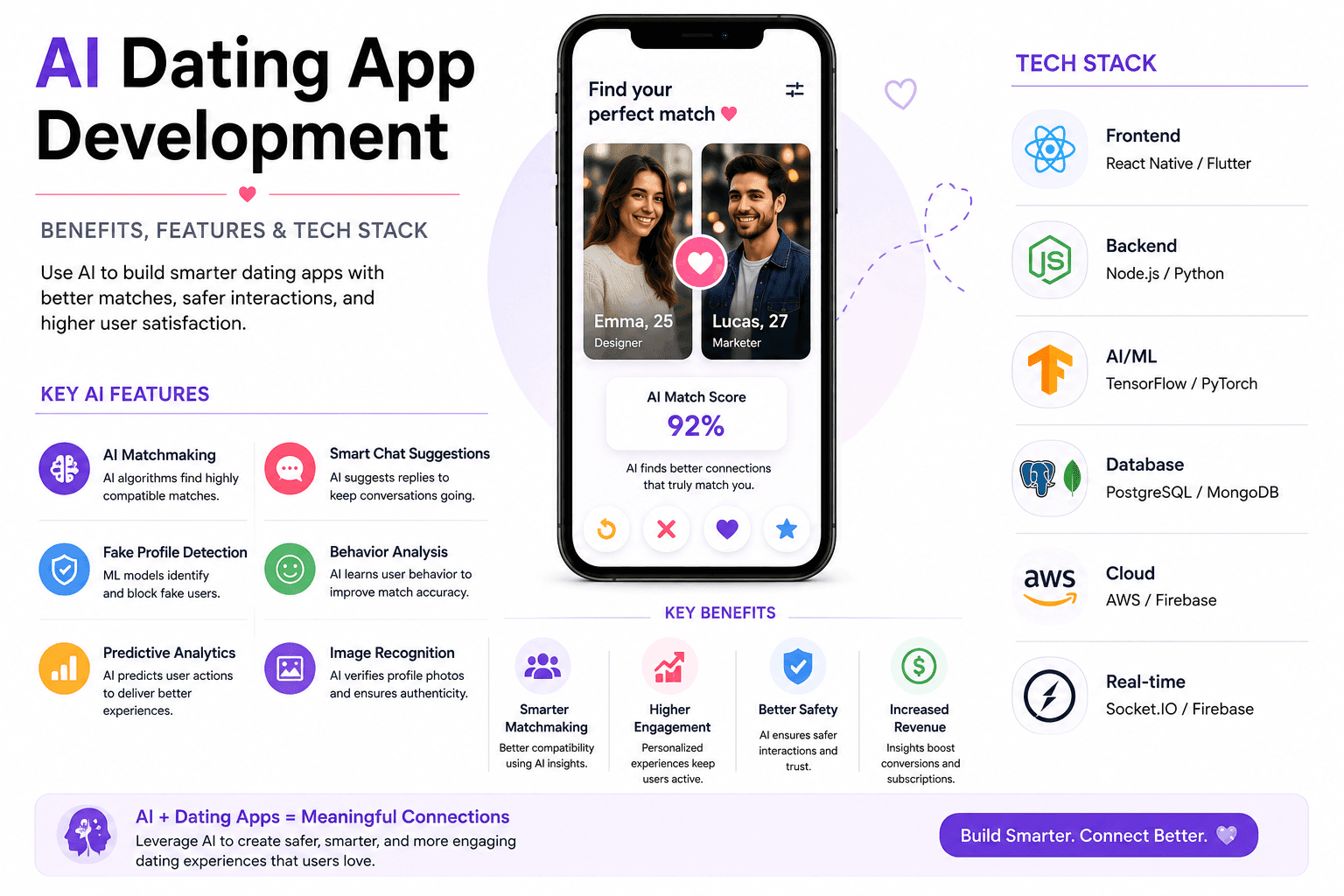
The dating app category isn't short on competition — over 8,000 apps are fighting for a market that Next Move Strategy Consulting values at roughly $12.52 billion in 2026, on its way to nearly $24.85 billion by 2035. Yet user trust is at an all-time low: Pew Research data shows 48% of dating app users report unwanted behavior on these platforms, and romance scams cost users over $1.3 billion in 2025 alone, according to FTC-sourced reporting.
That contradiction — a growing market with an eroding trust problem — is exactly why AI has moved from "nice-to-have" to the core differentiator in modern dating app development. Match Group's rollout of mandatory facial verification on Tinder cut exposure to bad actors by over 60% in early testing, and it's now expanding across the company's other apps in 2026. That single data point tells you where the industry is heading: apps that ship AI-driven trust, personalization, and matching will win the next cycle. Apps that don't will keep bleeding subscribers to the ones that do.
This guide breaks down what an AI dating app actually is, the business case for building one, the features that separate a serious product from a swipe clone, the tech stack decisions that determine your scalability and cost, and how to select the right dating app development services partner to execute it.
1. What Is an AI Dating App?
An AI dating app uses machine learning, natural language processing (NLP), computer vision, and behavioral analytics to handle tasks that used to rely on static filters and manual swiping. Instead of matching people purely on self-reported preferences (age, location, interests), the system learns from actual behavior — who a user messages back, how long conversations last, which profiles get repeat views, what causes someone to unmatch.
The practical difference shows up in three layers of the product:
- Matching layer — compatibility scoring models replace or augment rule-based filters.
- Trust and safety layer — computer vision for photo/identity verification, NLP for harassment and scam detection.
- Engagement layer — AI-generated icebreakers, conversation coaching, and smart notifications that reduce ghosting.
This isn't a bolt-on chatbot. It's infrastructure that touches onboarding, discovery, messaging, and retention simultaneously — which is why AI app development requires a different engineering approach than a traditional swipe-based MVP.
2. Why 2026 Is the Right Time to Build One
Three market signals justify the investment right now:
Trust has become the primary purchase driver. Tinder's Face Check rollout wasn't a UX experiment — it was a response to a declining user base and rising scam losses. Apps without verifiable safety infrastructure are losing ground to apps that have it.
AI-native competitors are already live. Happn's "Perfect Date AI" tool and a wave of AI-matchmaking startups launched in 2025–2026 show that incumbents and new entrants alike are treating AI as table stakes, not a premium add-on.
Niche and community-specific apps are outperforming generic ones. With over 8,000 apps competing on the same swipe mechanic, AI-driven personalization and vertical focus (faith-based, professional, LGBTQ+, regional) are the two levers that actually move retention and monetization numbers.
If you're advising a client or evaluating your own product roadmap, the strategic takeaway is simple: a "me-too" swipe app without AI differentiation is a weak business case in 2026. An AI-first, trust-first, niche-aware product is a defensible one.
3. Core Benefits of AI Dating App Development
Higher-Quality Matches, Not Just More Matches
Traditional filters optimize for match volume. AI models optimize for match quality — analyzing response patterns, conversation depth, and even linguistic compatibility to predict which pairs are statistically more likely to convert into real conversations or dates. This directly improves the metric investors and users both care about: percentage of matches that lead to meaningful engagement, not just a match count.
Fraud, Bot, and Catfishing Reduction
Computer vision-based liveness detection (a short video selfie compared against a face vector) and duplicate-account detection make it exponentially harder for scammers to operate at scale. Given that AI-generated deepfake profiles are now a documented tactic, this isn't optional risk mitigation — it's a core product requirement.
Lower Churn Through Personalization
AI-driven onboarding, smart prompts, and conversation coaching reduce the two biggest churn triggers: users who never get a quality match, and users who match but never get a reply. Behavioral nudges (e.g., surfacing a profile at the moment a user is most active) measurably increase session frequency.
Better Monetization Without Feeling Predatory
AI enables tiered, usage-based monetization — boosted visibility, AI-curated "top picks," or AI-assisted profile optimization as premium features — instead of arbitrarily gating basic functionality, which is a common complaint driving churn on legacy platforms.
Moderation at Scale
Manual moderation doesn't scale past a few hundred thousand users. NLP-based message screening and image moderation models catch harassment, explicit content, and scam language in real time, reducing both legal exposure and support overhead.
Data-Driven Product Iteration
Every AI layer generates structured behavioral data. Product and growth teams get a continuous feedback loop for A/B testing matching algorithms, onboarding flows, and monetization triggers — instead of relying on quarterly user surveys.
4. Must-Have Features of an AI-Powered Dating App
AI Matchmaking Engine
The core differentiator. Combines collaborative filtering, content-based filtering, and behavioral signals (swipe patterns, message response rate, time-to-reply) to generate a compatibility score, not just a filtered list.
Facial and Identity Verification
Liveness detection via video selfie, face-vector matching against profile photos, and duplicate-account detection. This is quickly becoming a baseline expectation post-Tinder's Face Check rollout, not a differentiator.
AI Conversation Assistant
Context-aware icebreaker suggestions and reply prompts based on shared interests or profile content — reduces the "match but never message" drop-off that kills engagement metrics.
Behavioral Compatibility Scoring
Goes beyond stated preferences to model actual interaction behavior, giving the algorithm a feedback loop that improves match quality over time.
Harassment and Scam Detection (NLP)
Real-time text analysis flags harassment, solicitation, and known scam scripts (financial requests, off-platform redirects) before they reach the user, with escalation paths to human moderators.
Video and Voice-First Discovery
Short video profiles and live video-call features (before an in-person meeting) are becoming standard, reducing catfishing risk and improving pre-date compatibility signals.
Geolocation-Based Real-Time Discovery
Precise, privacy-respecting location matching with configurable radius, combined with AI-based "best time to meet" suggestions for hyperlocal or event-based matching.
Smart Notifications and Re-Engagement
Predictive models identify the optimal time to notify a user based on historical app-open behavior, rather than blasting generic push notifications.
Subscription and Monetization Engine
Tiered plans (freemium, boosted visibility, super likes, AI-curated picks) with in-app purchase and payment gateway integration (Stripe, Apple/Google in-app billing, regional gateways for cross-border apps).
Admin and Trust & Safety Dashboard
A back-office panel for moderators to review flagged content, manage verification appeals, and monitor abuse patterns — this is often underbuilt in MVPs and becomes a scaling bottleneck later.
5. Tech Stack for AI Dating App Development
There's no single "correct" stack — the right choice depends on scale, budget, timeline, and whether AI is core IP or a wrapped third-party service. Here's a practical breakdown used across mid-to-enterprise dating app builds:
| Layer | Common Choices | Notes |
|---|---|---|
| Frontend (Mobile) | Flutter, React Native, Swift (iOS), Kotlin (Android) | Cross-platform is ideal for MVPs; native is better for performance-intensive features like video and AR |
| Backend | Node.js, Python (Django/FastAPI), Go | Python is preferred when AI/ML services are tightly integrated with the backend |
| AI / ML Layer | TensorFlow, PyTorch, scikit-learn, OpenAI APIs, Anthropic APIs | Custom models power matchmaking; LLMs assist with chat, recommendations, and moderation |
| Computer Vision | AWS Rekognition, Azure Face API, FaceTec (Liveness Detection) | Dedicated liveness detection solutions improve identity verification |
| Database | PostgreSQL, MongoDB, Redis | Hybrid architecture combines relational storage, flexible profiles, and real-time caching |
| Real-Time Messaging | WebSockets, Firebase, Stream, Sendbird | Supports chat, typing indicators, online presence, and message delivery |
| Geolocation | Google Maps API, Mapbox, PostGIS | PostGIS enables efficient location-based matching and geo-queries |
| Cloud Infrastructure | AWS, Google Cloud, Microsoft Azure | Kubernetes and Docker provide scalable, containerized deployments |
| Push Notifications | Firebase Cloud Messaging (FCM), OneSignal | Used for match alerts, messages, reminders, and engagement campaigns |
| Payments | Stripe, RevenueCat, Apple In-App Purchases, Google Play Billing | RevenueCat simplifies cross-platform subscription management |
| Security | OAuth 2.0, JWT, End-to-End Encryption, SOC 2 & GDPR Compliance | Strong security and compliance are essential for protecting sensitive user data |
Expert tip: don't build custom computer vision liveness detection from scratch for an MVP. Licensing a proven verification vendor is faster to market and reduces the regulatory and bias-testing burden that comes with in-house biometric models.
Native vs. Cross-Platform: Which Should You Choose?
| Factor | Flutter / React Native | Native (Swift + Kotlin) |
|---|---|---|
| Time to Market | Faster — single shared codebase | Slower — separate iOS and Android codebases |
| Cost | Lower initial development cost | Higher due to parallel platform development |
| Performance for AI Features | Excellent for most AI-powered applications | Better for AR, advanced video processing, and on-device machine learning |
| Best For | MVPs, startups, and product-market fit validation | Apps focused on video-first experiences, AR, or high-performance features |
| Long-Term Maintenance | Simpler and more cost-effective for small teams | Greater platform flexibility and optimization at enterprise scale |
For most dating app development services engagements, Flutter or React Native is the pragmatic starting point — you can always re-platform performance-critical modules (like live video or AR filters) to native later, once usage data justifies the investment.
6. Step-by-Step Development Process
1. Market and competitor gap analysis — identify your niche (general, regional, faith-based, professional, LGBTQ+) and the specific trust or matching gap you're closing.
2. Define the AI matching logic — decide what data inputs (behavioral, stated preference, biometric) feed the compatibility model before any UI work starts.
3. UX/UI design with safety built in — verification, reporting, and blocking flows should be designed alongside the swipe/discovery UI, not bolted on afterward.
4. MVP development — core matching, chat, verification, and monetization; avoid scope creep into secondary features like AR filters at MVP stage.
5. AI model training and validation — train initial matching/scoring models on synthetic or seed data, then refine with real user behavior post-launch.
6. QA, security, and compliance testing — GDPR, CCPA, and biometric data regulations (e.g., BIPA in Illinois) require explicit legal review before storing any face-vector data.
7. Phased rollout — soft launch in one geography or niche community, measure match quality and safety metrics, then scale.
8. Post-launch iteration — continuous A/B testing of matching weights, onboarding flow, and monetization triggers using real engagement data.
7. Cost to Build an AI Dating App
Cost depends heavily on feature scope, AI complexity, and whether you build the verification/matching layer in-house or integrate third-party AI services.
- MVP (core swipe, chat, basic AI matching, third-party verification): the leanest build, cross-platform, minimal custom AI.
- Mid-tier app (custom matching model, NLP moderation, video profiles): significantly higher due to ML engineering and infrastructure needs.
- Enterprise-grade platform (custom liveness detection, advanced behavioral AI, multi-region compliance): the highest investment, comparable to building a small fintech-grade trust and safety system.
Rather than quoting a fixed number that goes stale within a quarter, the honest answer is: get a scoped estimate based on your specific feature list, target regions, and compliance requirements — cost varies too much by scope, team location, and AI vendor choices to generalize responsibly.
8. Common Mistakes to Avoid
- Treating AI as a marketing feature, not a product foundation. Bolting an AI chatbot onto a static-filter matching engine doesn't move retention numbers — the matching logic itself needs to be AI-driven.
- Underinvesting in trust and safety infrastructure. Verification and moderation tooling is expensive to retrofit once your user base scales.
- Ignoring data privacy regulations around biometric data. Face-vector and liveness data are subject to strict regulations in several jurisdictions (GDPR in the EU, BIPA in Illinois); non-compliance risk is real and expensive.
- Launching without a clear niche. In a market with 8,000+ competing apps, a generic swipe clone with no differentiated audience or AI edge has a weak acquisition story.
- Over-engineering the MVP. Building custom deep learning matching models before you have behavioral data to train on wastes budget — start with a hybrid rules + lightweight ML model and let real usage data drive complexity later.
- Neglecting the admin/moderation dashboard. Teams often deprioritize this until abuse reports overwhelm a small trust and safety team — build it from day one.
9. Expert Best Practices
- Start with a hybrid matching model. Combine rule-based filters with a lightweight ML layer at launch, then evolve toward deeper behavioral models once you have sufficient interaction data.
- License biometric verification rather than building it in-house for MVP and mid-tier launches — it reduces both time-to-market and regulatory exposure.
- Design for explainability. Users trust "why you matched" more when the app can surface a simple reason (shared interests, similar activity patterns) rather than a black-box score.
- Build moderation tooling before you need it, not after a PR incident forces your hand.
- Instrument everything from day one. Match quality, message response rate, and time-to-first-date are the metrics that actually indicate product-market fit — not raw download numbers.
- Localize both language and cultural matching norms if you're targeting multiple regions; matching behavior varies meaningfully across markets.
10. Future Trends Shaping AI Dating Apps
- Mandatory identity verification becoming an industry norm, following Match Group's lead across its portfolio of apps in 2026.
- Video-first and live-call discovery replacing static photo grids as the primary trust signal.
- AI dating coaches and relationship-continuity tools extending the product beyond the match into post-match relationship support.
- Deepfake detection becoming a core safety feature, not an afterthought, as AI-generated fake profiles grow more sophisticated.
- Niche, AI-curated communities outperforming broad, general-purpose apps on retention and monetization.
11. Why Work With a Dedicated Dating App Development Company
Building an AI dating app isn't a generic mobile app project — it sits at the intersection of machine learning, biometric compliance, real-time infrastructure, and monetization design. A team that treats it like a standard CRUD app will underbuild the matching engine, underestimate the trust and safety workload, and miss the compliance requirements around biometric and behavioral data.
A specialized dating app development company partner brings pre-built expertise in:
- Designing and training compatibility-scoring models
- Integrating and configuring biometric verification vendors correctly
- Structuring real-time chat and presence infrastructure at scale
- Navigating GDPR, CCPA, and biometric data regulations across regions
- Building monetization flows that increase LTV without triggering churn
If you're evaluating a build partner, ask them directly how they'd architect the matching layer, what verification vendor they'd recommend and why, and how they handle biometric data compliance — the answers will tell you quickly whether you're talking to a generalist or a team that actually understands this category.
Conclusion
The dating app development market isn't shrinking, but user patience with generic, trust-poor experiences clearly is. The apps winning share in 2026 — Tinder with mandatory verification, Happn with AI date-planning, Hinge with intent-driven design — all share one trait: they've made AI a structural part of the product, not a marketing bullet point.
If you're building or upgrading a dating app in usa, the decisions that matter most are made early: how your matching model is architected, which verification approach you license, and how your tech stack scales with real user behavior data. Get those right, and everything else — retention, monetization, trust — follows.
Ready to build a dating app people actually trust? Our team specializes in AI-powered dating app development — from compatibility-scoring engines and biometric verification to scalable cloud infrastructure and monetization design. Talk to our team today and get a scoped project estimate for your dating app development services requirement.