
AI Features for Modern Taxi Apps: The Complete 2026 Playbook
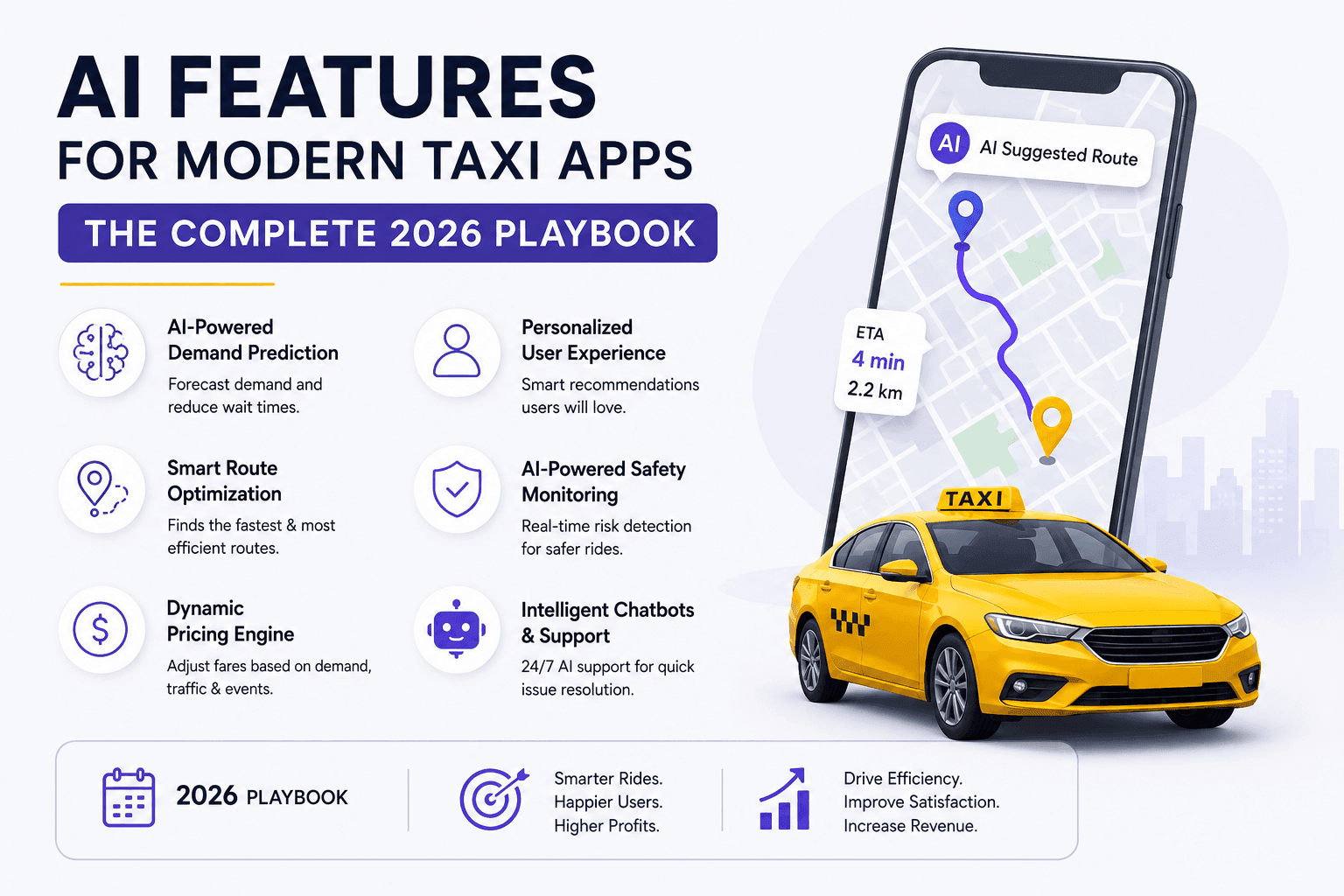
Taxi and ride-hailing apps stopped being “GPS plus a payment button” years ago. In 2026, the app is the product — and AI is what separates a platform riders trust from one they delete after a single bad ETA. If you're evaluating taxi app development services right now, the AI layer is no longer an optional add-on quoted separately; it's the core engineering decision that determines your CAC, driver retention, and unit economics.
This guide breaks down the AI features that actually move business metrics — not vanity features that look good in a pitch deck — along with implementation trade-offs, common mistakes, and what to ask any development partner before you sign a contract.
1. Why AI Is Now Table Stakes for Taxi Apps
The ride-hailing market isn't a niche vertical anymore — it's a full-scale global infrastructure category. The global ride-hailing market is projected to grow from roughly $315 billion in 2026 to over $716 billion by 2034, expanding at a compound annual growth rate near 11%. That growth isn't coming from more people discovering ride-hailing exists — app-based bookings already account for the overwhelming majority of ride-hailing transactions worldwide. Growth is coming from operators squeezing more efficiency, safety, and personalization out of the same rider base, and AI is the mechanism doing the squeezing.
Three forces are pushing AI from “nice to have” to “non-negotiable”:
- Margin pressure — Commission caps and driver-pay regulations in multiple markets mean operators can't just raise prices to protect margin. AI-driven dispatch and route optimization cut empty miles, which is where the real margin leak happens.
- Rider expectations reset by category leaders — Once a rider experiences sub-minute ETA accuracy or a chatbot that resolves a dispute in 90 seconds, that becomes the baseline expectation for every custom taxi app they open next — including yours.
- Safety and compliance scrutiny — Regulators and insurers increasingly expect identity verification, anomaly detection, and incident-response logging built into the platform, not bolted on after an incident.
If your development roadmap treats AI as a “phase 2” feature, you're building a phase-1 app that competitors will outflank within a year.
2. Core AI Features Every Modern Taxi App Needs
These are the features that should be in scope from day one of any serious build — they directly affect unit economics or safety, not just polish.
AI-Powered Dispatch and Route Optimization
This is the single highest-ROI AI feature in a taxi app. Instead of matching the nearest driver, machine learning models weigh live traffic, historical demand patterns, driver acceptance behavior, and destination likelihood to assign the ride that minimizes total system idle time — not just the individual trip's pickup time.
Business scenario: A mid-size fleet operator running 400 vehicles in a metro area typically loses 15–20% of driver active time to empty repositioning. A well-tuned dispatch model can cut that by a third, which directly increases driver take-home pay without the platform spending a rupee/dollar more — a retention lever that matters more than any bonus campaign.
Dynamic and Predictive Pricing
Surge pricing gets a bad reputation because most implementations are reactive — price spikes only after demand has already outstripped supply. Predictive pricing models forecast demand 15–45 minutes ahead using weather, events, historical seasonality, and public transit disruptions, allowing the platform to pre-position drivers before the surge hits rather than pricing riders out of a shortage after the fact.
AI Chatbots and Virtual Support Assistants
Support tickets in ride-hailing are high-volume and low-complexity: lost items, fare disputes, driver-not-found. An LLM-based support layer can resolve 60–80% of these without a human agent, and — critically — it should be trained on your actual policy documents and past resolutions, not a generic FAQ bot, or it will hallucinate refund policies and create chargebacks.
Fraud Detection and Anomaly Monitoring
GPS spoofing, fake trip generation, promo abuse, and payment fraud cost ride-hailing platforms real money at scale. AI fraud models flag anomalies in real time — a “completed trip” with a GPS trace that doesn't move, a device fingerprint tied to 40 different promo redemptions, a card that's been declined on 6 other accounts.
Real-Time ETA and Traffic Prediction
Static ETAs based on map-API distance are a trust killer. Machine learning models trained on your platform's own historical trip data (not just third-party map data) consistently outperform generic map ETAs because they account for real pickup friction — building access, curbside congestion, local driving behavior — that map APIs don't see.
Identity Verification and Driver Safety AI (Computer Vision)
Face-match verification at trip start, drowsiness/distraction detection via in-cab camera feeds, and license/document authenticity checks are now standard risk-mitigation features, especially for platforms operating in markets with driver-identity fraud history.
3. Advanced AI Features That Create a Competitive Moat
Once the fundamentals are solid, these features are what separate category leaders from commodity apps.
Predictive Demand Forecasting for Fleet Positioning
Beyond pricing, forecasting models can tell fleet managers where to pre-position idle vehicles hours in advance — near a stadium before an event lets out, near business districts before evening rush. This is a fleet-management AI feature, not just a rider-facing one.
Voice AI and Multilingual Conversational Booking
Voice-based booking matters more than most product teams assume, particularly for accessibility and for markets with lower literacy or older user segments. Grab's AI assistant, built to understand local accents, has extended usability to visually impaired and elderly riders — a feature that expands addressable market, not just convenience.
Personalization and Recommendation Engines
Frequent-route prediction, saved-destination suggestions, ride-type recommendations based on time of day and past behavior — these reduce booking friction and increase session-to-booking conversion, which is a metric most taxi apps under-optimize compared to e-commerce apps.
Sentiment Analysis on Support and Review Data
Running NLP sentiment analysis across support tickets, in-app ratings, and driver feedback surfaces systemic issues (a specific city's pickup-zone confusion, a payment gateway failure pattern) faster than manual review ever could.
Predictive Maintenance for Fleet-Owned Vehicles
For operators who own or lease their fleet, AI models trained on vehicle telemetry (mileage, braking patterns, engine diagnostics) predict maintenance needs before breakdowns happen — reducing vehicle downtime, which directly protects driver earnings and platform reliability.
Autonomous Vehicle Readiness and Hybrid Dispatch
This is the frontier, not the baseline. Waymo has surpassed 100,000 weekly rides, and Uber has committed to deploying 20,000 robotaxis in partnership with autonomous vehicle makers. Most operators don't need AV integration today, but building a dispatch architecture that can route between human drivers and AV fleets in the same request-matching layer is a forward-compatible architecture decision worth making now if you're building for a 5-year horizon.
4. AI Feature Comparison Table (Impact vs. Complexity)
| AI Feature | Business Impact | Complexity | MVP Priority |
|---|---|---|---|
| AI Dispatch & Route Optimization | Very High (improves margins and driver efficiency) | Medium | Must-Have |
| Predictive Dynamic Pricing | High | Medium–High | Must-Have |
| Fraud & Anomaly Detection | High (reduces fraud and financial risk) | Medium | Must-Have |
| AI Chatbot & Support Assistant | Medium–High (reduces support costs) | Low–Medium | Should-Have |
| Real-Time ETA Prediction (Proprietary) | High (improves customer trust and retention) | Medium | Should-Have |
| Identity Verification (Computer Vision) | High (enhances safety and compliance) | Medium | Must-Have (Regulated Markets) |
| Demand Forecasting & Fleet Positioning | Medium–High | High | Phase 2 |
| Voice AI & Multilingual Booking | Medium (supports market expansion) | Medium | Phase 2 |
| Personalization Engine | Medium (improves engagement and conversions) | Low–Medium | Phase 2 |
| Predictive Maintenance | Medium (valuable for company-owned fleets) | High | Phase 2 / 3 |
| AV-Ready Dispatch Architecture | Low today, High long-term | High | Phase 3 |
5. Native vs. Cross-Platform: How Your Tech Stack Affects AI Performance
AI features aren't purely a backend concern — the client-side stack determines how well they perform in the real world.
- Computer vision features (face match, drowsiness detection) need reliable camera and sensor API access with minimal latency. Native iOS, Android development typically gives more predictable performance here than cross-platform frameworks, though Flutter and React Native have closed much of that gap in 2026 with mature camera-plugin ecosystems.
- Real-time location and background tracking for dispatch accuracy depends heavily on how the framework handles background processes and battery optimization — a poorly configured cross-platform build can silently degrade GPS ping frequency and wreck your ETA model's accuracy.
- On-device AI (edge inference) for features like offline fraud pre-screening or low-connectivity ETA fallback favors native SDKs (Core ML on iOS, ML Kit/NNAPI on Android), which is a consideration if you're targeting markets with inconsistent connectivity.
For most startups and mid-size fleets, a well-architected cross-platform build (Flutter or React Native) with native modules for the camera/GPS-heavy AI features is the pragmatic middle ground — full native development is usually only justified at enterprise/multi-country scale where performance-per-market tuning matters.
6. Common Mistakes When Adding AI to a Taxi App
Mistake 1: Bolting AI onto a rigid legacy backend. If your matching engine wasn't designed to consume real-time model outputs, retrofitting AI dispatch becomes a multi-quarter re-architecture instead of a feature release.
Mistake 2: Training pricing models on too little local data. A predictive pricing model trained on aggregate global patterns will misfire badly in a new city with its own traffic and event rhythms. Local calibration matters more than model sophistication.
Mistake 3: Treating the support chatbot as a cost-cutting tool first. Bots trained purely to deflect tickets, without proper escalation logic, generate refund disputes and app-store review damage that costs more than the support headcount saved.
Mistake 4: Ignoring model drift. Demand patterns, fraud tactics, and traffic conditions change. Teams that ship an AI feature and never retrain it end up with degrading accuracy within 6–12 months and don't notice until metrics have already slipped.
Mistake 5: Skipping explainability for pricing and fraud decisions. Regulators and riders both increasingly expect a reason when a fare surges or an account gets flagged. “The algorithm decided” is not a defensible answer in most markets anymore.
Mistake 6: Underestimating data infrastructure cost. AI features are only as good as the data pipeline feeding them. Many teams budget for the model and forget the ETL, storage, and labeling costs that make the model usable.
7. Implementation Framework: How to Prioritize AI Features
A practical sequencing model for taxi app development company engagements:
- Foundation phase — Real-time GPS tracking, basic dispatch logic, payments, driver/rider verification — get the data pipeline live before any AI layer, since every AI feature depends on this data existing and being clean.
- Efficiency phase — AI dispatch optimization, dynamic pricing, proprietary ETA prediction — these have the clearest, fastest ROI and should be the first AI investment.
- Trust phase — Fraud detection, identity verification, safety AI — non-negotiable before scaling into new markets or regulated verticals.
- Engagement phase — Chatbot support, personalization, voice AI — layer these once retention and safety fundamentals are solid.
- Scale phase — Predictive maintenance, multi-city demand forecasting, AV-ready architecture — reserved for operators with fleet ownership or multi-country ambitions.
Skipping straight to phase 4 or 5 features because they demo well is the single most common (and expensive) mistake we see in taxi app development services RFPs.
8. Industry Trends Shaping Taxi Apps Through 2027
- Super-app consolidation — Ride-hailing platforms are increasingly bundling delivery, micromobility, and even travel booking into one AI-orchestrated app, which changes how dispatch and pricing models need to reason across service types simultaneously.
- EV-aware routing — As electric fleets grow, AI routing needs to factor in charging-station proximity and battery range, not just traffic — a routing problem that didn't exist for combustion fleets.
- Regulatory-driven explainable AI — Expect more jurisdictions to require fare-calculation transparency and algorithmic accountability reporting, particularly around surge pricing and driver deactivation decisions.
- Hybrid human-AV dispatch — As autonomous fleets scale in select cities, dispatch systems that can route seamlessly between human drivers and AVs based on trip type, regulation, and rider preference will become a genuine differentiator rather than a novelty.
- Voice-first and accessibility-driven AI — Multilingual, accent-aware voice booking is moving from “nice to have” to a genuine market-expansion tool in regions with lower app literacy.
Conclusion
AI in taxi apps in usa isn't a single feature you bolt on — it's an architectural decision that touches dispatch, pricing, safety, and support simultaneously. The operators winning market share in 2026 aren't the ones with the flashiest AI demo; they're the ones who sequenced their AI investment correctly: data foundation first, efficiency AI second, trust and safety AI third, engagement AI last. Get that order wrong and you'll spend a development budget on features that look impressive in a sales deck but don't move retention, margin, or safety metrics.
If you're scoping a build or evaluating taxi app development for your market, the right partner should be able to tell you which of these features matter for your specific stage and city — not sell you all of them at once.
Building or upgrading a taxi app and not sure which AI features are worth the investment for your market and budget?
Our team has shipped AI-powered dispatch, predictive pricing, and fraud-detection systems for ride-hailing platforms across multiple regions. Talk to our taxi app development services team for a free technical scoping session.
→ Book a Free Consultation