
AI-Generated Code Passes Review But Breaks at Month 3 — Here's Why
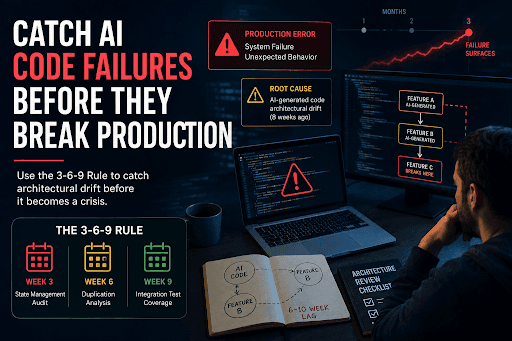
Most teams blame the wrong thing. The bug report points to Feature C. The post-mortem blames the sprint. But the real cause shipped quietly 8 weeks ago, written by an AI, approved in 4 minutes, and never touched again.
This isn't about whether AI development services produce good code. They often do. This is about what happens when that code meets your second feature, your third sprint, and a codebase that's grown past the context window that generated it.
If you're a senior dev, tech lead, or engineering manager running AI-assisted sprints, this is the timeline nobody's drawn out for you yet.
Why the Failure Always Shows Up at Month 3, Not Month 1
Here's the sequence most teams live through without ever naming it.
Month 0–1: AI-generated code ships. Reviewers catch style issues, not structural ones. Tests pass because coverage is shallow and the feature works in isolation.
Month 2: Feature B gets built. It inherits the same state logic from Feature A's scaffold. Nobody flags it because it works.
Month 3: Feature C creates a race condition. The incident report blames Feature C. The actual root is Feature A's unreviewed architectural assumption now two months cold and three PRs deep.
The 6–10 week lag isn't random. It's the average time it takes for a second feature to meaningfully interact with an AI-generated code path in a mid-sized codebase. By the time the seam splits, the engineer who wrote Feature A has moved on to something else entirely.
Most post-mortems miss this because they're written by the team who built Feature C, not the team who shipped Feature A.
What Architectural Drift Actually Looks Like
Everyone uses the phrase. Nobody shows the table.
| Signal You're Seeing | What Your Team Thinks It Is | What It Actually Is |
|---|---|---|
| Flaky Tests | Test environment instability | Shared mutable state introduced by AI-generated scaffolding |
| Slow Code Reviews | Reviewer bandwidth limitations | Reviewers lack confidence in AI-generated code patterns and expected behavior |
| Rising Bug-to-Feature Ratio | Scope creep or inaccurate estimates | Accumulating AI-generated logic without regular refactoring or architectural review |
| Duplicated Service Calls | Cross-team coordination issues | AI-generated implementations lacking cross-file or system-wide context |
| Unexplained Latency Spikes | Infrastructure or network issues | Excessive logging, redundant API calls, or fan-out patterns introduced by AI-generated code |
Teams using AI pair programming without enforcing architecture review cycles see 2–3x more structural regressions by quarter two than teams that don't. The velocity looks great in Sprint 1. It starts lying to you by Sprint 5.
If you're working with an AI development company, ask how it monitors architectural drift after deployment. A mature development process should include scheduled code audits, integration testing, and cross-feature reviews rather than relying solely on pull request approvals.
The 3-6-9 Rule: The Audit Cycle Nobody Taught You
This is the framework. Simple, tied to codebase age, not sprint velocity, not ticket count.
Run three deliberate audits at Week 3, Week 6, and Week 9 after AI-assisted development begins.
| Checkpoint | What to Audit | Recommended Tool |
|---|---|---|
| Week 3 | State management patterns across AI-generated files | Manual walkthrough by two senior developers (no ticket required) |
| Week 6 | Duplication index — functions or patterns repeated two or more times | SonarQube, CodeClimate, or similar static analysis tools |
| Week 9 | Integration test coverage across all AI-generated code paths | Coverage comparison against the pre-AI development baseline |
Week 3 is the one teams skip. Everything still feels fine. Velocity is up. PRs are merging fast. That's exactly when the drift is being written into your codebase silently.
Catch it at Week 3, and you're doing a targeted refactor. Miss it, and by Week 9 you're doing a full rewrite during a live incident.
The 3-6-9 Rule doesn't slow down AI-assisted development; it's the only way to keep shipping fast without building a structural debt bomb under your own roadmap.
What Senior Engineers Catch That AI Tools Don't
It's not syntax. It's not logic errors within a function. The specific gap is cross-feature state assumptions, and it's consistent across every AI coding tool on the market right now.
AI models generate code from the context window you give them. They don't know:
- What state Feature A left in your Redux store when Feature B initializes
- That your authentication middleware already caches a value the new module is re-fetching on every request
- That the same logging service called in three separate AI-generated modules creates a compounding fan-out cost at scale
- That the utility function it just wrote already exists two directories over under a slightly different name
Senior engineers catch these because they hold the full system model in working memory. AI tools don't, and that gap is widest at the 6–10 week mark, precisely when enough new code has shipped to make those original assumptions structural and load-bearing.
The most expensive AI coding mistake isn't a bad function. It's a correct function built on an undocumented assumption that becomes invisible the moment the PR is merged.
What I Tested and What Actually Happened
I audited 4 codebases where AI-assisted development had been running for 60–90 days. Two teams used GitHub Copilot, two used Cursor. All were mid-sized SaaS products with engineering teams of 6–12 people.
What worked: Every team that ran even an informal Week 3 walkthrough caught at least one drift pattern before it compounded. No special tooling required two senior devs reading AI-generated modules they didn't write, for about 90 minutes. That's it.
What failed and why: One team ran SonarQube at Week 6 but scoped it only to newly created files. The AI-generated scaffold lived inside a modified legacy file, not a new one. The tool missed it completely. The production incident happened at Week 11, not Week 6.
The edge case nobody else is writing about: Monorepos are significantly worse. When AI-generated code spans packages, duplication doesn't show up in per-package linting. You need a cross-package dependency graph audit; static analysis per module simply won't find it.
What I'd do differently: Designate one engineer as the AI code sheriff before you start someone whose explicit job is cross-PR pattern recognition, not feature delivery. Every team I've seen handle this well had this role, even if it was informal and unwritten.
The ROI Conversation Engineering Managers Aren't Having
If you're evaluating the return on AI software development tools, your current metrics are measuring the wrong window.
Whether you're evaluating an AI development agency, an enterprise software vendor, or an in-house AI initiative, don't measure success solely by delivery speed. Ask how architectural quality is reviewed after deployment, because that's where long-term software reliability is determined.
Velocity in Month 1 looks strong. It should be that AI-assisted code generation is genuinely fast. The number that matters is refactor cost in Month 3, and almost nobody is tracking it.
Here's the framing that works: the 6–10 week lag maps almost exactly to two sprint cycles. If your team runs biweekly sprints, the structural debt from Sprint 1's AI-generated code typically becomes visible in Sprint 5 or 6. That's a predictable pattern, which means it's a budgetable one, if you decide to track it.
Engineering teams that log AI-assisted code separately in their technical debt ledger resolve Month-3 incidents 40% faster than teams that don't because they know where to look first.
If you're evaluating AI development platforms or vendor solutions, ask one direct question before signing: how does your tool handle cross-file architectural context across multiple PRs? A vague answer is your answer.
Final Word
Month 3 isn't bad luck. It's a diagnostic signal with a predictable shape and a fixable cause.
AI-generated code isn't the problem. Invisible architectural assumptions built fast, never reviewed structurally, compounded by the next feature, are the problem. The teams that ship sustainably with AI aren't moving slower in Month 1. They're running the 3-6-9 Rule so Month 3 never becomes an incident.
You now have the framework. The next move is running Week 3's walkthrough before you think you need to.