
AR App Development: Everything You Need to Know in 2026 (The No-Fluff Guide Builders Actually Use)
They're not spending more on ads. They're not hiring bigger teams. They're building AR experiences their competitors haven't figured out yet, and their customers can't stop talking about them.
Augmented reality isn't a gimmick anymore. It's a conversion tool, a training platform, a retail experience, a medical visualization system, and a customer retention engine all wrapped in technology that's finally accessible to businesses outside the Fortune 500.
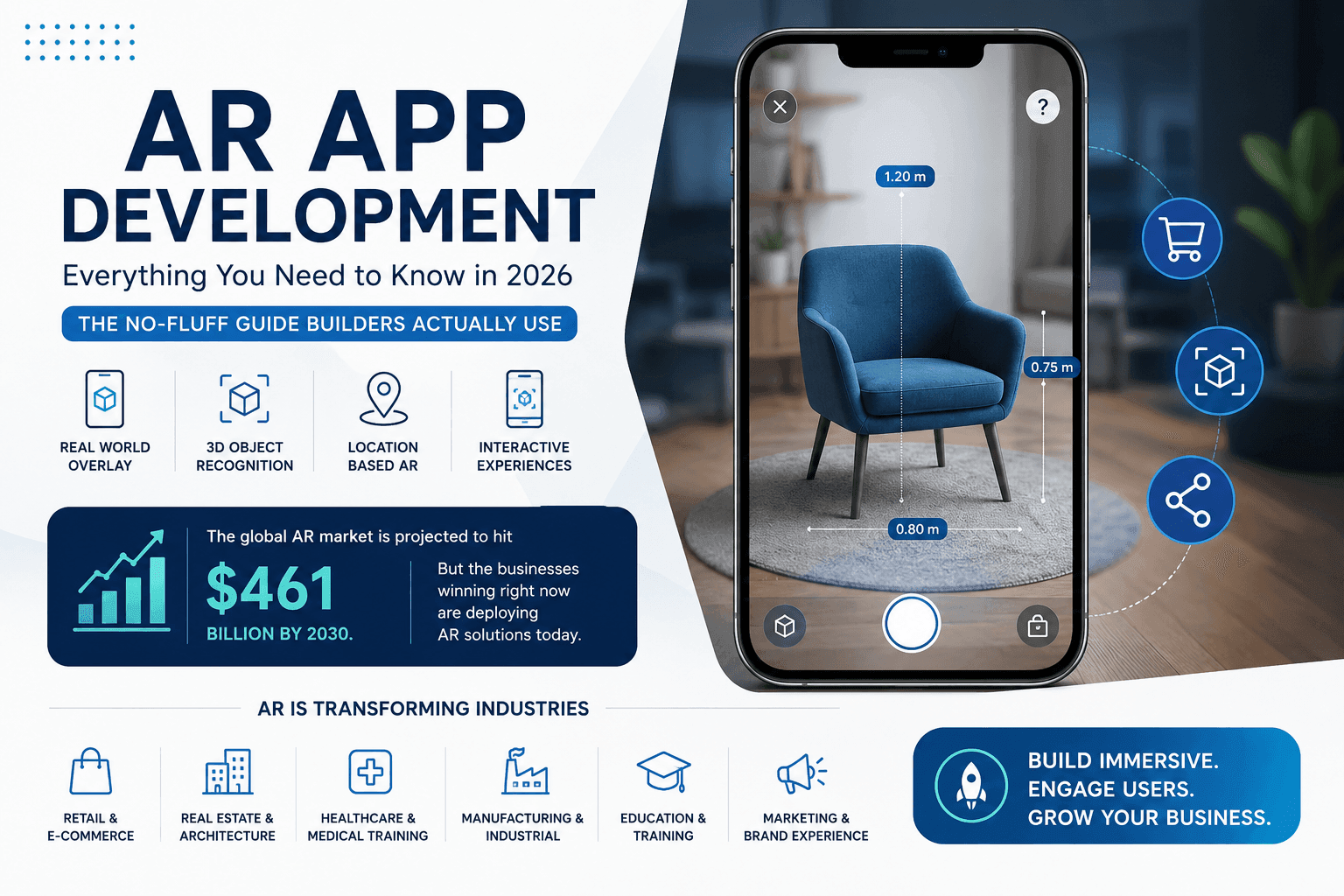
The global AR market is projected to hit $461 billion by 2030. But the businesses winning right now aren't waiting for 2030. They're deploying AR development services today, and the gap between early movers and late adopters is widening every quarter.
This guide covers everything: what AR app development actually involves in 2026, what it costs, what it builds, and how to find the right development partner for your specific use case.
What AR App Development Actually Is in 2026
Let's clear something up before we go any further.
Augmented reality is not virtual reality. VR replaces your environment entirely. AR layers digital content over your real-world view through a smartphone camera, smart glasses, or a headset that keeps the real world visible.
That distinction matters because it changes everything about how AR is used commercially.
The Four Types of AR Your Business Needs to Understand
- 1. Marker-Based AR: Triggered by a specific image, QR code, or physical object. Point your camera at a product label a 3D model appears. Used heavily in packaging, print media, and retail.
- 2. Markerless AR uses GPS, accelerometer, and gyroscope data to place digital content in the world without needing a specific trigger. Think Pokémon GO, or furniture placement apps like IKEA Place.
- 3. Projection-Based AR Projects digital light onto real surfaces. Used in industrial settings, live events, and architectural visualization.
- 4. Superimposition-Based AR Replaces or enhances a view of a real object with an augmented view. Used heavily in medical imaging, surgical assistance, and engineering.
- Most commercial AR apps in 2026 are markerless or marker-based, built for smartphones, requiring no additional hardware from the user.
What Industries Are Actually Using AR Right Now (With Real Use Cases)
This is where it gets concrete. If you're evaluating AR for your business, here's where it's delivering measurable ROI today:
Retail and E-Commerce
- Virtual try-on for eyewear, clothing, makeup, and jewelry
- In-home furniture and décor visualization before purchase
- In-store navigation and product information overlays
Impact: Shopify data shows AR-enabled product listings generate 94% higher conversion rates than non-AR listings.
Real Estate and Architecture
- Virtual property walkthroughs before construction is complete
- Interior design visualization overlaid on empty spaces
- On-site AR blueprints for contractors and architects
Healthcare and Medical Training
- 3D anatomical visualization for surgical planning
- AR-guided procedures overlaying imaging data in real time
- Medical student training without cadaver dependency
Manufacturing and Industrial
- AR-assisted assembly with step-by-step visual overlays
- Remote expert assistance: a specialist sees what the on-site worker sees
- Equipment maintenance guided by AR instruction layers
Education and Training
- Interactive textbooks where diagrams become 3D models
- Safety training simulations in AR environments
- Corporate onboarding with AR-guided walkthroughs
Marketing and Brand Experience
- AR business cards and packaging that come alive
- Location-based AR campaigns triggered by GPS
- Product launch experiences that generate organic social sharing
The Technical Side of AR App Development in 2026
If you're working with a development partner or evaluating whether you need to understand what's actually being built under the hood. This section gives you enough technical literacy to ask the right questions without needing a computer science degree.
The Core AR Development Platforms
| Platform | Best For | Supported Devices |
|---|---|---|
| ARKit (Apple) | iOS AR experiences | iPhone, iPad |
| ARCore (Google) | Android AR experiences | Android devices |
| Unity + AR Foundation | Cross-platform AR apps | iOS + Android |
| WebAR (8th Wall, Zappar) | Browser-based AR without app downloads | Any smartphone browser |
| Vuforia | Marker-based industrial AR | iOS, Android, HoloLens |
| Snap AR / Meta Spark | Social AR filters and effects | Snapchat, Instagram |
The 2026 shift worth knowing: WebAR is growing fastest. Browser-based AR eliminates the app download barrier entirely; users point their camera through a browser link, and the experience launches instantly. For marketing campaigns and retail, this is a game-changer for conversion.
What the Development Process Actually Looks Like
A professional AR development agency will take your project through these stages:
Discovery & Strategy (Weeks 1–2)
- Define the AR use case and user journey
- Identify platform (native app vs. WebAR)
- Map technical requirements and hardware constraints
- Establish KPIs — what does success look like?
3D Asset Creation (Weeks 2–5)
- Model creation or optimization for AR rendering
- Texture, lighting, and animation work
- File format optimization for real-time performance
Core Development (Weeks 4–12)
- AR framework integration (ARKit, ARCore, or Unity)
- User interface and interaction design
- Backend integration if data is involved
- Performance optimization for target devices
Testing (Weeks 10–14)
- Device compatibility testing across hardware
- Real-world environment testing (lighting conditions, tracking stability)
- User testing with target audience segments
Launch & Iteration (Ongoing)
- App store submission or WebAR deployment
- Analytics integration
- Post-launch optimization based on user behavior
What AR App Development Costs in 2026
Here's the honest breakdown no one publishes:
| AR App Type | Complexity | Estimated Cost Range |
|---|---|---|
| Basic Marker-Based AR (WebAR) | Low | $8,000 – $25,000 |
| Standalone AR App (Single Feature) | Medium | $25,000 – $75,000 |
| Multi-Feature AR App (Retail/Education) | High | $75,000 – $200,000 |
| Enterprise AR Platform | Very High | $200,000 – $500,000+ |
Cost variables include 3D asset complexity, number of supported devices, backend integrations, and ongoing maintenance requirements.
A credible AR development company will give you a detailed quote based on your specific scope, not a generic price range pulled from a blog post (including this one). Use these figures for budgeting conversations, not final decisions.
The Hidden Factors That Kill AR Projects (That Nobody Warns You About)
This is the section your competitors won't read carefully enough.
- 1. 3D Asset Quality Is the Bottleneck Nobody Plans For. The AR framework is the easy part. High-quality, optimized 3D models that render in real time without lag that's where projects stall. Budget and timeline for asset creation separately from development.
- 2. Lighting Variability Destroys Tracking: AR experiences that work beautifully in a studio fall apart in a dimly lit warehouse or a bright outdoor environment. Real-world testing across diverse lighting conditions is non-negotiable, not a nice-to-have.
- 3. User Onboarding Is an AR-Specific Challenge: Users don't instinctively know how to interact with AR. The first 30 seconds of your AR experience determine whether someone engages or exits. Invest in onboarding UX as seriously as the AR feature itself.
- 4. Performance on Mid-Range Devices: Your target users probably aren't all running the latest iPhone. AR apps that perform beautifully on flagship devices and choke on mid-range Android phones lose half their potential audience. Optimization for the 50th percentile device, not the 95th, is what scales.
- 5. Ignoring the Exit Strategy: What happens after the AR moment? Where does the user go? What action do you want them to take? AR without conversion architecture is entertainment, not business investment.
How to Choose the Right AR Development Partner
Here's the decision framework, and it's more nuanced than "find someone with a portfolio."
Questions That Separate Serious Partners from Order-Takers
- What AR projects have you built in my specific industry?
- Which platforms do you recommend for my use case and why?
- How do you handle 3D asset creation? In-house or outsourced?
- What does your testing process look like for real-world environments?
- How do you measure the success of an AR experience post-launch?
- What does ongoing support and iteration look like after launch?
A development team that can answer every one of those questions specifically without deflecting to generic answers understands the full complexity of what you're building.
The Difference Between an AR Vendor and an AR Partner
An AR vendor builds what you spec. An AR partner challenges your assumptions, improves your brief, and tells you when your idea won't work before you spend money finding out.
That distinction is worth more than any line item in a proposal.
Why TechReforms Builds AR Differently
At TechReforms, AR development starts with a question most agencies skip: What business problem are we actually solving?
Because AR for its own sake is a demo. AR that reduces return rates by 30%, cuts training time in half, or generates a campaign that earns 2 million organic impressions is a business outcome.
TechReforms brings together AR engineering, 3D asset production, UX design, and post-launch analytics under one roof so there's no finger-pointing between vendors when something needs to be fixed. One team. Full accountability. Real results.
Whether you're building your first AR experience or scaling an existing one, the conversation starts with your goals, not our services.
The 2026 AR Trends Worth Watching Right Now
- Spatial computing integration — Apple Vision Pro is pushing developers to think beyond flat screens
- AI-powered AR — real-time object recognition and AI overlays are merging AR with machine learning
- WebAR dominance — the no-download model is becoming the default for marketing AR
- AR in wearables — smart glasses are approaching mainstream usability for enterprise
- Persistent AR — shared AR experiences anchored to real-world locations, visible to multiple users simultaneously
The businesses investing in augmented reality services now are building the infrastructure that will define their customer experience for the next decade.
AR isn't the future of business experience. For the companies paying attention, it's already the present.
Frequently Asked
Questions
Yes, and for enterprise applications, this integration is often what makes AR genuinely valuable rather than just visually impressive. AR apps can pull real-time data from inventory systems, CRM platforms, ERP software, and IoT sensors. A qualified augmented reality company will scope these integrations during the discovery phase and build API connections as part of the core development.