
Common Mistakes Businesses Make When Hiring AR Developers
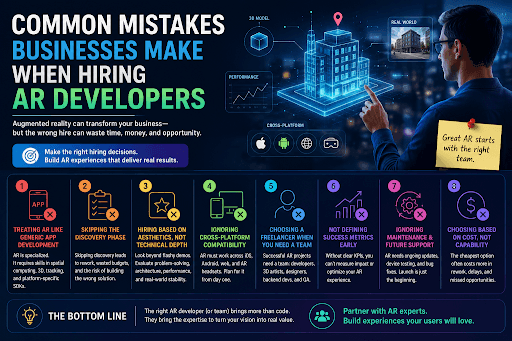
Augmented reality is no longer a tech novelty; it's a competitive advantage. From retail try-ons to industrial training simulations, businesses across every sector are investing in AR. But here's what nobody tells you: hiring the wrong AR developer can cost you more than not building at all.
If you're evaluating AR development services for your next project, this guide is written specifically for decision-makers who don't want to learn these lessons the expensive way. At TechReforms, we've seen firsthand what happens when businesses rush this process, and we're laying it all out so you don't repeat those same errors.
The mistakes below aren't theoretical. They happen every day, in companies of every size.
The AR Hiring Mistakes That Are Costing Businesses More Than They Realize
Mistake #1: Treating AR Like Generic App Development
This is the single most common and most damaging mistake.
AR development is a specialized discipline. It requires expertise in:
- Spatial computing — understanding how digital objects anchor to real-world environments
- 3D modeling and rendering — assets need to look convincing at any angle, in any lighting
- Motion tracking and depth sensing — especially critical for markerless AR experiences
- Platform-specific SDKs — ARKit (Apple), ARCore (Google), Vuforia, 8th Wall, and others behave very differently
When businesses post a generic "mobile developer" job listing and hope someone with "some AR experience" applies, they end up with flat, glitchy experiences that damage brand credibility rather than build it.
What to do instead: Look for developers with a demonstrable portfolio of shipped AR projects, not just prototypes. Ask specifically which SDKs they've worked with and in what context.
Mistake #2: Skipping the Discovery Phase to Save Money
Businesses often want to jump straight into development. Discovery feels like paying for conversations instead of code. But in AR, skipping discovery is where budgets go to die.
A proper discovery phase for AR projects should cover:
- Use case validation — Is AR actually the right solution, or is a simpler interface better?
- Device and platform targeting — Web-based AR vs. native app vs. wearable has massive implications
- Environment mapping requirements — Indoor vs. outdoor, lighting conditions, surface types
- Performance benchmarking — Frame rate, latency, and battery drain targets
Any credible augmented reality services provider will insist on a discovery phase before writing a single line of production code. If a developer skips this step to get started faster, that's a red flag, not a sign of efficiency.
Mistake #3: Hiring Based on Portfolio Aesthetics, Not Technical Depth
A beautiful AR demo reel doesn't tell you whether a developer can handle your actual requirements.
Here's what to look for beyond the visuals:
| What Looks Impressive | What Actually Matters |
|---|---|
| Polished AR Demo Videos | Code architecture, maintainability, and scalability |
| Flashy Effects | Tracking stability and reliability in real-world environments |
| Clean UI | Smooth performance across mid-range and lower-end devices |
| Lots of Projects | Depth of involvement, technical contribution, and measurable results in each project |
Ask candidates: "Walk me through a technical problem you hit on this project and how you solved it." Their answer will tell you more than any portfolio ever will.
At TechReforms, every client engagement includes a technical review process because we know pretty demos and production-ready software are two very different things.
Mistake #4: Ignoring Cross-Platform Compatibility
Your users aren't all on the same device. Some are on iOS, some on Android, some on desktop browsers, and increasingly, some on AR headsets like Meta Quest or HoloLens.
Businesses that hire developers without clarifying cross-platform requirements often end up with:
- An AR experience that works flawlessly on iPhone 14 but breaks on Android mid-range devices
- A WebAR solution that doesn't render correctly on Chrome mobile
- An app that crashes on older OS versions still used by a significant portion of their audience
Cross-platform AR development requires intentional architecture decisions from day one not patches applied at the end.
This is especially critical for businesses in retail AR, real estate visualization, AR-powered e-commerce, and field service AR industries where device fragmentation is highest among end users.
Mistake #5: Choosing a Freelancer When You Need a Team
Solo AR developers are skilled, but AR projects of any real complexity need more than one brain.
A serious AR build typically requires:
- An AR/XR engineer for core functionality
- A 3D artist or technical artist for asset creation and optimization
- A UX designer with spatial design experience
- A backend developer if the AR experience integrates with live data, APIs, or cloud anchors
- A QA specialist for device and environment testing
Hiring a single freelancer to cover all of these roles produces exactly the kind of rushed, unstable AR experience that gets one-star reviews.
Working with a full-service AR development company means these roles are already staffed, coordinated, and experienced in working together. That's not a luxury; it's a prerequisite for shipping something worth shipping.
Mistake #6: Not Defining Success Metrics Before Development Starts
What does a successful AR feature actually look like for your business?
Most companies can't answer that question before they start building. And without defined metrics, there's no way to evaluate whether the development work delivered value.
AR success metrics vary by use case:
- Retail AR → conversion rate lift, return rate reduction, session time
- Industrial AR → training completion time, error rate reduction, onboarding cost
- Marketing AR → engagement rate, dwell time, social shares
- Real estate AR → lead quality, virtual tour completion rate
A developer or an augmented reality company that never asks about your success metrics isn't thinking about your business outcomes. They're thinking about shipping features. That's a misalignment you'll feel when the invoice arrives, and the ROI doesn't.
Mistake #7: Underestimating Ongoing Maintenance Needs
AR apps don't exist in a vacuum. OS updates break tracking behavior. SDK providers deprecate features. New device models introduce new edge cases.
Businesses that treat AR development as a one-time project instead of an ongoing product commitment typically face:
- Broken experiences after iOS or Android updates
- Tracking failures on newly released devices
- Security vulnerabilities from unpatched dependencies
- Outdated 3D assets that look inconsistent with updated brand guidelines
Before signing any contract, ask explicitly: "What does post-launch support look like, and what's your response time for critical issues?"
The right AR development agency will have a clear answer because they've been asked this before and they've built the infrastructure to support it.
Mistake #8: Prioritizing Cost Over Capability
We get it, budgets are real. But AR is a domain where the cost-quality tradeoff is steeper than almost anywhere else in software development.
Here's the math most businesses don't run:
- Cheap AR build: $15,000–$25,000, poor tracking, unstable performance, high rework cost
- Mid-tier AR build: $40,000–$80,000, solid performance, scalable architecture, post-launch support
- Enterprise AR build: $100,000+, custom pipelines, multi-device support, full QA coverage
Choosing the cheapest option often means paying twice: once for the original build, and again to fix or rebuild it.
An established augmented reality agency will give you transparent pricing with a clear rationale for every line item. If a quote seems unusually low, ask what's not included.
How TechReforms Helps Businesses Get AR Hiring Right
At TechReforms, we've built AR solutions for clients across retail, healthcare, real estate, and manufacturing. We don't just write code; we help businesses define what they're actually trying to build, who needs to build it, and how to measure whether it worked.
Whether you're looking to build an in-house AR team or outsource to specialists, our consulting and development services are designed around one goal: AR that performs in the real world, not just in a demo.
Frequently Asked
Questions
Look for hands-on experience with at least one major AR SDK (ARKit, ARCore, Vuforia, or 8th Wall), a portfolio of shipped AR products (not just prototypes), and familiarity with 3D asset pipelines. Bonus points for experience with spatial UX design and cross-platform development.