
Dating App Development Cost in 2026: Complete Breakdown — MVP to Enterprise
Introduction
You have an idea for a dating app. Maybe it is niche — for professionals, pet lovers, or a specific cultural community. Maybe it is ambitious — AI-powered matching, video dates, real-time translation.
Either way, the first question every serious founder asks is the same: how much is this actually going to cost?
And the honest answer is — it depends. But 'it depends' without a framework is useless.
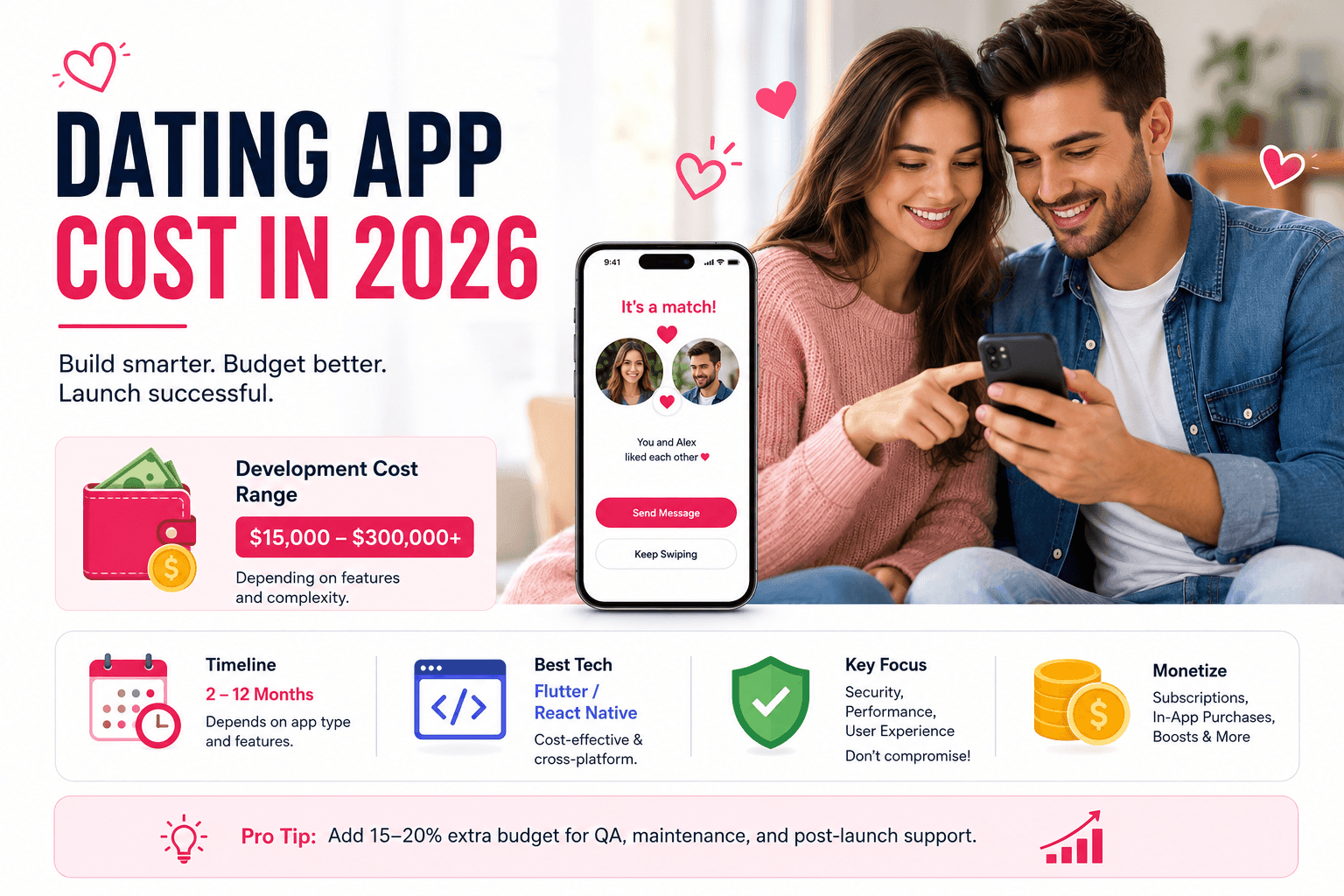
In 2026, dating app development typically ranges from $15,000–$60,000 for an MVP focused on core features, up to $70,000–$350,000+ for a full-scale product with advanced features, AI matchmaking, video calls, and multi-region compliance.
That is a wide range. The gap between those numbers is decisions — about features, platforms, team location, and how fast you want to move.
This guide gives you the full picture. No inflated agency estimates. No bare-bones numbers that ignore what actually makes a dating app competitive in 2026. Just a clear, expert-level breakdown so you can budget with confidence and build something that has a real chance of succeeding.
For more on building mobile apps, see our guide: Mobile App Development services — TechReforms
Why Dating App Development Costs More in 2026
Dating apps are not simple products anymore. The era of 'swipe left, swipe right' as a complete feature set is over.
In 2024–2026, dating apps are evolving into broader social discovery platforms that incorporate live streams, virtual events, and community forums. This shift from simple swipes to complex ecosystems demands intricate backend architectures for real-time moderation and content delivery networks.
On top of that, user expectations have fundamentally shifted:
Seamless social login is now expected at onboarding
AI-powered recommendations are a baseline, not a differentiator
Video profiles and video-first dating are standard
Apple's App Tracking Transparency and Google's Privacy Sandbox require consent management systems, adding 5–10% to budgets
Bottom line: Budgeting only for 'screens and features' is outdated. A successful dating app in 2026 requires investment in safety, infrastructure, and governance from day one.
The online dating and matchmaking market has grown to $10.77 billion in 2026 at a CAGR of 9.3% — making this a high-stakes, high-reward market. Source: Statista Online Dating Market 2026
Dating App Development Cost: Quick Breakdown by Tier
Here is the high-level view before we go deep:
| Tier | Type | Cost Range | Timeline |
|---|---|---|---|
| Basic MVP | Core features only | $15,000 – $60,000 | 2–4 months |
| Mid-Range Product | Standard features + geolocation + messaging | $75,000 – $150,000 | 4–7 months |
| Full-Scale Platform | AI matching, video, advanced security | $150,000 – $300,000 | 7–12 months |
| Enterprise Grade | Multi-region, custom AI, compliance-heavy | $300,000 – $400,000+ | 12+ months |
Key insight: The cost to develop a dating app that actually competes in today's market — one with good design, solid features, and real performance — usually falls between $60,000 and $150,000. Use the tier table as your starting point.
Key Factors That Drive Your Final Cost
Dating app cost is not a single number. It is the sum of decisions about scope, platforms, technology stack, geography, and safety level.
Feature Set and Complexity
This is the biggest variable. Basic profiles and matching are expected. AI-driven matching, video calls, and gamification push costs up significantly. Every feature you add carries three hidden costs: development time, QA testing, and ongoing maintenance.
Platform Choice
Are you building for iOS, Android, or both? Building natively for iOS and Android separately costs 15 to 30% more than using a cross-platform framework like Flutter or React Native.
UI/UX Design Quality
Custom UI/UX design costs more than templates, but it is what separates apps that retain users from apps that lose them in the first week. In dating apps specifically, first impressions drive sign-up conversion rates.
Team Location
Developer hourly rates vary dramatically — $100 to $150 per hour in the USA and Western Europe, $40 to $70 in Eastern Europe, and $20 to $50 in India. That difference compounds across a 6–9 month project.
Backend Infrastructure
Dating apps handle enormous amounts of real-time data — location, messages, matches, and user activity. Your backend needs to handle all of this without breaking down under load. A solid backend architecture is not optional.
Feature-by-Feature Cost Breakdown
Here is what individual features typically cost to build:
| Feature | Estimated Cost |
|---|---|
| User Registration & Authentication | $3,000 – $7,000 |
| Profile Setup & Photo Upload | $4,000 – $8,000 |
| Swipe / Match Mechanism | $5,000 – $10,000 |
| Real-Time Messaging (Chat) | $8,000 – $15,000 |
| Geolocation & Proximity Matching | $5,000 – $10,000 |
| Push Notifications | $2,000 – $4,000 |
| Social Login (Google, Apple, Facebook) | $2,000 – $4,000 |
| Video Calling | $10,000 – $20,000 |
| AI-Powered Matchmaking | $15,000 – $40,000 |
| In-App Purchases & Subscription Engine | $8,000 – $15,000 |
| User Verification & Trust Badges | $5,000 – $10,000 |
| Admin Panel & Moderation Dashboard | $10,000 – $20,000 |
| AI-Based Content Moderation | $8,000 – $20,000 |
| Advanced Search & Filters | $5,000 – $12,000 |
| Analytics & Reporting | $4,000 – $8,000 |
QA Budget Rule: A buggy dating app will get deleted faster than a bad first date. Budget for proper QA — it typically adds 15–20% to your total development cost, but it saves you from disasters post-launch.
Native vs. Cross-Platform: Which Costs Less?
Native Development (Swift for iOS, Kotlin for Android)
Maximum performance and platform-specific capabilities
Best for video-heavy or real-time interaction features
Costs 15–30% more than cross-platform
Two separate codebases = two separate maintenance costs
Cross-Platform (Flutter or React Native)
Cross-platform frameworks like Flutter or React Native can reduce costs by 20 to 40% compared to native development
Single codebase, faster development, lower initial investment
Strong for most standard dating app features
Expert Recommendation for 2026
Cross-platform development using React Native or Flutter is standard for dating apps in 2026. The exception is video feature-heavy apps — native iOS and Android give better WebRTC performance for video dating use cases. Most founders launch iOS-first to control quality, then add Android once the product is validated. This approach reduces initial cost by 30–40%.
See also: Native vs Cross-Platform Dating Apps Comparison — TechReforms
Team Location and Hourly Rate Comparison
Where you hire your development team is the single most powerful budget lever you have.
| Region | Hourly Rate | Full Project Estimate (Mid-Range App) |
|---|---|---|
| USA / Canada | $100 – $250/hr | $120,000 – $250,000 |
| Western Europe | $80 – $150/hr | $100,000 – $200,000 |
| Eastern Europe | $40 – $90/hr | $60,000 – $120,000 |
| India / South Asia | $20 – $50/hr | $30,000 – $80,000 |
| Southeast Asia | $20 – $45/hr | $25,000 – $70,000 |
Hiring a team offshore does not mean compromising on quality — it means being smart with your budget. The critical factor is not location — it is vetting. Evaluate portfolios, technical assessments, and communication quality before committing.
Hidden Costs Most Founders Miss
These do not show up in most agency quotes. They will show up in your bank account.
Third-Party API and Integration Costs
Payment gateways, video calling APIs, location services, social login, push notification services — every integration adds cost. Each one requires development time, testing, and ongoing maintenance.
App Store Fees
Apple charges $99/year for the IOS Developer Program. Google Play charges a one-time $25 registration fee. Both platforms take a 15–30% cut on in-app purchases and subscriptions — a recurring business cost that affects your revenue model from day one.
AI Verification API Costs
AI-powered identity verification integrations — tools like Persona, Onfido, and Jumio — add $5,000–$10,000 to build costs and $0.50–$2.00 per verification in ongoing API costs. At scale, that per-verification cost adds up fast.
Compliance and Legal
GDPR, CCPA, COPPA — depending on your target markets, compliance infrastructure can add 5–10% to your development budget. Ignoring this is not a budget strategy; it is a liability.
Cloud Hosting and Infrastructure
Early-stage apps might run on $200–$500/month in cloud costs. As your user base grows, this scales rapidly. Budget for infrastructure from the start rather than rebuilding architecture under pressure.
Reference: GDPR Compliance for App Developers — GDPR.eu
AI Features Cost in Dating Apps (2026)
AI is no longer optional. Dating apps without AI matching, AI moderation, or AI safety features are not competitive in 2026. The platforms that survived the post-pandemic consolidation — Hinge, Bumble Premium, and a wave of AI-native niche apps — all use AI as the core product mechanism.
AI-Powered Matchmaking Algorithm
A machine learning matching system considers explicit preferences (age, distance, interests), implicit signals (who you message first, conversation length, reply rate), and collaborative filtering (users similar to you matched with whom).
Cost estimate: $15,000 – $40,000 depending on model complexity.
AI Content Moderation
Computer vision models that detect nudity, weapons, and hate speech, combined with NLP models that flag abusive messaging patterns, are the baseline for any serious dating app launch in 2026. Moderation infrastructure costs $8,000–$20,000 to build.
Real-Time AI Video Date Assistance
Real-time AI assistance during video dates — conversation topic suggestions, ice-breaker prompts based on shared profile interests, post-date compatibility scoring — has the highest engineering complexity but also the highest user differentiation.
AI Profile Verification
Photo verification using face liveness detection, behavioural pattern analysis to identify bot accounts, and phone number verification are now expected trust signals. Users explicitly check for verification badges before engaging.
Total AI budget recommendation: Budget $30,000–$80,000 specifically for AI features if you want a platform that is genuinely competitive in 2026.
How to Clone Popular Dating Apps: Cost Estimates
Many founders start by modeling an existing platform. Here are realistic build cost estimates:
| App to Clone | Key Features | Estimated Cost |
|---|---|---|
| Tinder | Swipe, matching, chat, geolocation | $50,000 – $120,000 |
| Bumble | Swipe, matching, women-first messaging | $60,000 – $130,000 |
| Hinge | Profile prompts, AI matching, video profiles | $70,000 – $150,000 |
| Grindr | Location-based matching, real-time chat, community features | $40,000 – $90,000 |
| Happn | Real-time location tracking, activity timeline | $45,000 – $90,000 |
| Plenty of Fish | Advanced search, messaging, ad-supported monetization | $35,000 – $75,000 |
Smart approach: Model the core mechanic, add your niche differentiation, and skip the features your audience does not need. Cloning is a starting point — not a strategy.
Related reading: MVP App Development Services — TechReforms
Post-Launch Costs: The Budget Nobody Plans For
This is where most dating app projects run into trouble.
The initial build is not the biggest expense in building a dating app. Post-launch costs — maintenance, hosting, moderation, and compliance — often equal or exceed the original build over two to three years.
Bug Fixes and Maintenance
Bug removal post-release typically costs around 20% of the initial development investment. For a $100,000 app, budget $15,000–$20,000 per year for ongoing maintenance.
Feature Updates and OS Compatibility
Apple and Google release major OS updates annually. Each update can break existing functionality. Factor in quarterly update cycles into your annual budget.
Content Moderation at Scale
Manual moderation does not scale — and a single viral incident involving harmful content destroys platform trust overnight. Invest in automated moderation infrastructure before scale forces your hand.
Annual Post-Launch Budget Estimate
| Scale | Estimated Annual Cost |
|---|---|
| Small App (Under 50K Users) | $20,000 – $50,000/year |
| Mid-Scale App (50K–500K Users) | $50,000 – $150,000/year |
| Large Platform (500K+ Users) | $150,000+/year |
How to Reduce Dating App Development Cost Without Cutting Corners
There is a difference between smart cost optimization and false economy. Here is how experienced founders reduce spend without undermining their product:
1. Start With an MVP
Do not build the full-featured app on day one. Validate your concept, your niche, and your audience with the minimum set of features that can deliver real value. Expand from there. An MVP for a dating app typically includes: user registration, profile setup, basic matching, messaging, and push notifications.
2. Use Cross-Platform Frameworks
Startups can reduce the custom dating app development cost by 20% to 50% through launching an MVP first, prioritizing core features, using cross-platform frameworks, and adopting phased feature releases.
3. Prioritize iOS First
iOS users monetize at higher rates than Android users globally. Validate your product on iOS, generate revenue, then fund the Android expansion.
4. Use Proven Third-Party Services
Do not build a video calling system from scratch. Integrate Agora, Twilio, or Daily.co. Do not build your own payment engine — use Stripe. Third-party services save development time and carry their own maintenance.
5. Choose the Right Development Partner
Offshore development is not a compromise — it is a strategy. Review portfolios, conduct technical interviews, run a paid test task, and check references before committing.
Monetization Models and How They Affect Your Build Cost
Your revenue model is not a separate decision from your development cost. Revenue models decide the architecture, data flows, and compliance obligations of a dating app. The choice of monetization models directly influences the app development complexity and long-term operating costs.
Recommendation: For most early-stage dating apps: Freemium with subscription tiers is the lowest-complexity, highest-proven-revenue model. Start there. See also: App Monetization Strategies — TechReforms
Common Mistakes That Blow Up the Budget
Mistake #1: Trying to Build Tinder on Day One
Do not try to out-Tinder Tinder on day one. Launch something focused, learn from real users, and grow from there.
Mistake #2: Skipping QA to Save Money
QA is insurance. A broken swipe mechanic, failed payment, or messaging bug at launch costs you users permanently. Budget 15–20% of development cost for quality assurance.
Mistake #3: Underestimating Backend Complexity
Dating apps are among the most demanding backend use cases — real-time messaging, geolocation queries across millions of users, and ML inference at request time. Do not hire a team optimized for simple apps to build a real-time social platform.
Mistake #4: No Post-Launch Budget
Most founders budget for build cost only. The first 12 months post-launch — bug fixes, server scaling, feature iterations, marketing — requires its own budget line.
Mistake #5: Choosing a Partner Based on Price Alone
The cheapest quote is rarely the cheapest outcome. Low hourly rates paired with poor communication, weak QA, or thin experience create costly rebuild situations 6 months later.
Mistake #6: Ignoring Compliance Early
GDPR violations can result in fines up to 4% of annual global turnover. Building compliance into your architecture from day one is dramatically cheaper than retrofitting it later. Featured Snippet: How much does it cost to develop a dating app in 2026?
Dating app development cost in 2026 ranges from $15,000 for a basic MVP to $300,000+ for an enterprise-grade platform with AI matchmaking, video dating, and advanced security. Most competitive dating apps targeting real market traction fall in the $60,000–$150,000 range. Key cost drivers include feature complexity, platform choice (native vs. cross-platform), team location, AI integration, and post-launch maintenance.