
Dating App Trends in 2026: What's Actually Working Now
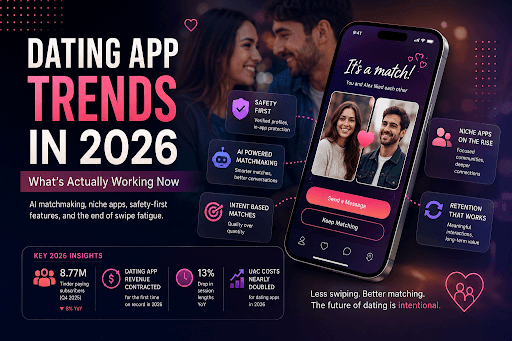
Most dating app content in 2026 still reads like a 2022 press release. "Add video." "Use AI." "Focus on Gen Z." Nobody tells you that Tinder's paying subscribers dropped 8% year-over-year to 8.77 million in Q4 2025, eight consecutive quarters of decline, or that dating app revenue contracted for the first time on record in 2026, with session lengths down roughly 13% year-over-year and user acquisition costs nearly doubling.
This isn't a growth story anymore. It's a redistribution story, and knowing where users are moving is exactly what separates a winning product from another delete-after-three-weeks app.
If you're exploring dating app development services for a new platform, or trying to diagnose why your existing app is bleeding retention, here's what's actually happening in 2026.
The STIR Framework: What Every Competitive App Is Built Around
Before the trends, a lens. At TechReforms, we call it STIR: the four pillars that every dating app worth building in 2026 has in common.
- Safety-first infrastructure
- Trust signals embedded in UX
- Intent-based matching over swipe volume
- Retention loops that don't depend on addiction
Every trend below maps to one of these. An app missing even one of them is fighting an uphill battle.
What Are the Biggest Dating App Trends in 2026?
The market has split cleanly into two camps: bloated legacy apps trying to do everything, and focused niche platforms doing one thing deeply. The niche apps are winning.
Dating applications for niche communities are attracting highly engaged users by targeting specific interests and lifestyles. Apps like Boo (personality-matching), Feeld (alternative relationship structures), and new entrants serving specific cultural or demographic communities are outgrowing the big platforms in retention metrics not in raw downloads, but in the number that actually matters: people who stay.
Why? Because users in 2026 are exhausted by volume. They don't want more matches. They want better ones.
Quotable stat: Total dating app users are flat globally, but revenue per user is rising. Apps are optimizing for monetization over match quality, and users are noticing.
The product lesson: broad audiences are a trap. Specificity is the moat.
How Is AI Matchmaking Actually Changing the Experience?
AI in dating apps has moved past "better algorithms" — that was 2022. Now it's categorically different: AI is shifting from filter to co-pilot, actively coaching conversations and guiding matches instead of just ranking them. This shift is pushing every dating app development company to rethink core product architecture — from matching engines to in-app AI assistants.
Hinge introduced an AI recommendation engine in late 2025 that the company says resulted in a 15% increase in matches and contact exchanges. Match Group, Bumble, and Grindr have all followed with their own AI feature rollouts: photo verification, prompt suggestions, and behavioral matchmaking enhancements.
But here's the tension nobody talks about: nearly 70% of users want AI help improving their profiles, yet 64% say they distrust matches who use AI-generated images. Users want AI behind the scenes, not wearing the mask.
The apps getting this right are using AI to coach conversations, flag early ghosting risk, and scan for romance scam patterns. The ones getting it wrong are letting AI-generated content flood profiles and killing the authenticity that makes connections land.
Quotable stat: 85% of dating interactions are projected to involve AI-powered apps by 2030 but only 39% of users are willing to pay up to $40/month for AI matching, revealing a clear pricing ceiling.
Is Dating App Burnout Getting Worse and Are Apps Fixing It?
Burnout is the defining behavioral trend of the last two years, and most apps still aren't solving it correctly.
The cycle is predictable: user downloads app → swipes aggressively → matches pile up but don't convert → user feels overwhelmed and disengages → deletes app → returns 90 days later. This loop repeats roughly four times per year for the average user.
Engagement is high, but retention is a real challenge, with users averaging 51 minutes per day while uninstall rates reach over 60% for non-organic users.
The apps trying to break this cycle are experimenting with intentional friction: daily swipe limits, longer profile completion requirements, and "slowplay" modes that reveal matches gradually. While swipes are declining, match rates and message rates are actually increasing, suggesting users are becoming more selective and purposeful. Less swiping, better matching. The data supports it.
Quotable stat: Apps that introduced daily like limits saw a 22% increase in match-to-conversation conversion within 90 days of the feature launch.
What most guides skip: burnout hits differently by gender. Women experience message-volume overwhelm. Men experience match-rate anxiety. A one-size-fits-all fix doesn't work, and apps segmenting the burnout experience by user profile are pulling ahead.
What Do Dating App Statistics Say About Who's Actually Using These Apps in 2026?
The demographic picture has shifted in ways that surprise most product teams.
| Demographic | Key 2026 Shift |
|---|---|
| Gen Z (18–26) | Moving away from Tinder; increasingly choosing Hinge, Boo, and niche dating apps |
| Millennials (27–42) | Highest-paying subscriber segment; prioritize intent-based matching and meaningful relationships |
| Men (35+) | Largest underserved segment; experience the highest burnout and lowest retention rates |
| Women (All Ages) | Safety, identity verification, and privacy features are now the #1 factors in app selection |
Dating in 2026 as a woman looks meaningfully different than 2022. Safety is no longer something users hope for; it's the first thing they check before downloading. 70% of users feel safer with dating apps that focus on providing strong safety features, and apps without robust verification, blocking, and reporting tools are being filtered out regardless of how good their matching is.
For Gen Z, the move is toward raw authenticity. Heavily filtered photos are a red flag. Voice notes, unedited video prompts, and casual-format content outperform studio-quality profile photos in engagement metrics consistently.
Tinder vs Bumble vs Hinge in 2026: Who's Actually Winning?
The big three are no longer moving in the same direction.
| Platform | 2026 Status | What's Working | What's Struggling |
|---|---|---|---|
| Tinder | Declining in Western markets | Strong adoption in India and Southeast Asia | Gen Z migration and feature bloat |
| Bumble | Stable with strategic repositioning | Women-first experience and strong safety brand | Slowing subscriber growth |
| Hinge | Growing steadily | Intent-driven matching, strong brand positioning, and relationship-focused UX | Premium pricing ceiling and subscription saturation |
Match Group's strategy of increasing revenue per payer while losing total payers defines the current moment, which tells you everything about where legacy platforms are headed. They're squeezing existing users harder because they've stopped being able to attract new ones at scale.
The real competition isn't Tinder vs Hinge. It's all of them vs the niche challenger apps eating their most engaged users.
Conclusion
The dating app market in 2026 isn't dying; it's bifurcating. Generic platforms are shrinking. Specific, safety-forward, intent-led apps are gaining real ground. The STIR Framework (Safety, Trust, Intent, Retention) is the filter every product decision should pass through.
Don't try to out-feature Tinder. Out-focus it.