
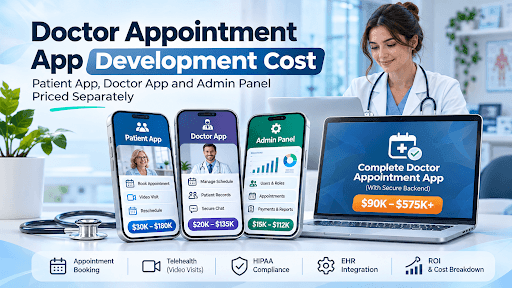
Doctor Appointment App Development Cost: Patient App, Doctor App and Admin Panel Priced Separately
Every empty slot on your schedule costs money. Missed appointments drain roughly $150 billion from U.S. healthcare each year, and most practices still book by phone.
A doctor appointment app fixes that. The problem is that quotes from app development services rarely explain what you’re paying for. One agency says $30,000. Another says $300,000. Neither one breaks it down.
So we will. Below, TechReforms prices the patient app, doctor app and admin panel separately. We also show the backend and compliance costs other quotes leave out, and the ROI math you need before you sign anything.
Table of Contents
- Doctor Appointment App Development Cost at a Glance
- How Much Does Each Part of a Doctor Appointment App Cost?
- What Hidden Costs Do Most Doctor App Quotes Leave Out?
- Why Do Doctor App Quotes Range From $15K to $500K?
- Is a Doctor Appointment App Worth the Investment?
- Native vs. Cross-Platform: Which Costs Less?
- How to Lower Your Cost Without Cutting Corners
- Why Choose TechReforms as Your Doctor App Development Company?
- Doctor App Trends to Watch in 2026
- FAQs
- Conclusion
Doctor Appointment App Development Cost at a Glance
Quick answer: In 2026, a complete doctor appointment app built by a U.S.-standard team costs about 90,000–195,000 for a basic version, 170,000–350,000 for a mid-tier version, and 285,000–575,000+ for an advanced platform. That covers four parts: the patient app, the doctor app, the admin panel and a shared HIPAA-ready backend.
All estimates in this guide assume a blended rate of 100–150 per hour. That’s a realistic middle of the U.S. market, where app developer hourly rates in 2026 generally run from $75 to $250 per hour, with most experienced, US-based mobile and web developers landing between $100 and $200 per hour.
| Component | Basic | Mid-Tier | Advanced |
|---|---|---|---|
| Patient App (iOS + Android) | 30K–60K | 55K–112K | 90K–180K |
| Doctor App | 20K–45K | 40K–82K | 65K–135K |
| Admin Panel (Web) | 15K–37K | 30K–67K | 55K–112K |
| Backend, APIs & Security | 25K–52K | 45K–90K | 75K–150K |
| Total | 90K–195K | 170K–350K | 285K–575K+ |
These are TechReforms planning estimates based on typical scoping hours, not fixed prices. Your final quote depends on your features, integrations and timeline.
How Much Does Each Part of a Doctor Appointment App Cost?
Each part of a doctor appointment app has a different user, a different feature set and a different price. Pricing them separately shows you exactly where your money goes, and lets you launch in phases if your budget needs it.
- 1. Patient App Cost: 30,000–180,000
The patient app is what your patients download. It has to be simple enough for a 70-year-old and fast enough for a busy parent.
| Tier | Estimated Hours | Cost Range | What’s Included |
|---|---|---|---|
| Basic | 300–400 hrs | 30K–60K | Sign-up, doctor search, booking, reminders, cancel/reschedule |
| Mid-Tier | 550–750 hrs | 55K–112K | Insurance details, intake forms, payments, secure chat, ratings |
| Advanced | 900–1,200 hrs | 90K–180K | Video visits, EHR records access, AI slot suggestions, multi-language |
Online rescheduling deserves a spot in even the cheapest build. One survey found that 69% of patients wanted to reschedule online without calling.
- 2. Doctor App Cost: 20,000–135,000
The doctor app is the provider’s side of the platform. Physicians use it to manage their day without a call to the front desk.
| Tier | Estimated Hours | Cost Range | What’s Included |
|---|---|---|---|
| Basic | 200–300 hrs | 20K–45K | Calendar, accept/decline bookings, patient list, notifications |
| Mid-Tier | 400–550 hrs | 40K–82K | Availability rules, visit notes, e-prescription links, chat |
| Advanced | 650–900 hrs | 65K–135K | Telehealth console, EHR read/write, analytics, multi-location schedules |
Expert tip: If your doctors already live inside an EHR all day, a lightweight doctor app plus EHR sync often beats a feature-heavy standalone app. You save money, and your doctors don’t have to learn another tool.
- 3. Admin Panel Cost: 15,000–112,000
The admin panel is a web dashboard for your practice managers. It’s the control room for doctors, schedules, payments and reports.
| Tier | Estimated Hours | Cost Range | What’s Included |
|---|---|---|---|
| Basic | 150–250 hrs | 15K–37K | Manage doctors and patients, view bookings, basic reports |
| Mid-Tier | 300–450 hrs | 30K–67K | Role-based access, billing, no-show tracking, content management |
| Advanced | 550–750 hrs | 55K–112K | Multi-clinic control, audit logs, revenue analytics, custom reporting |
Most competitor guides lump the admin panel into the doctor app or skip it. That’s a mistake. Role-based access and audit logs are central to HIPAA compliance, so they need their own budget.
- 4. Backend, APIs and Security: The Hidden Fourth Piece (25,000–150,000)
Here’s what most cost guides leave out. All three apps run on one shared backend: the servers, database, APIs, encryption and booking logic.
| Tier | Estimated Hours | Cost Range | What’s Included |
|---|---|---|---|
| Basic | 250–350 hrs | 25K–52K | Booking engine, user auth, encrypted database, SMS/email reminders |
| Mid-Tier | 450–600 hrs | 45K–90K | Payment gateway, insurance verification, audit trails, HIPAA hosting setup |
| Advanced | 750–1,000 hrs | 75K–150K | FHIR/EHR integration, video infrastructure, AI scheduling, load scaling |
A quote that shows only “app screens” and no backend line is a red flag. That cost will show up later as a change order.
What Hidden Costs Do Most Doctor App Quotes Leave Out?
Most doctor app quotes leave out HIPAA compliance work, EHR integration, third-party service fees, app store fees and ongoing maintenance. Together these can add 20–40% to your first-year budget.
HIPAA Compliance and Security Testing
Any app that stores patient data must meet HIPAA. That means encryption, access controls, audit logs, a signed Business Associate Agreement (BAA) with your cloud host, and security testing before launch.
Budget roughly 5,000–25,000 for a security risk assessment and penetration testing.
Cutting this corner is expensive. Under 2026 inflation-adjusted rules, Tier 1 fines run from $145 to $73,011 per violation, with an annual cap of $2,190,294 per identical provision.
EHR Integration
Connecting to Epic, Oracle Health (Cerner), athenahealth or eClinicalWorks is usually the biggest single add-on. Plan for 15,000–60,000 per EHR, plus any vendor program fees.
The good news is that federal rules made this easier. Under the 21st Century Cures Act, certified electronic medical record systems are now required to provide open FHIR API endpoints to their customers and patients.
Third-Party Services
These are monthly usage fees, not build costs. They’re small per transaction, but they add up.
- SMS reminders: Twilio charges $0.0083 per SMS segment sent or received in the US, plus carrier fees. 10,000 reminders a month costs roughly $120.
- HIPAA-eligible cloud hosting (AWS, Google Cloud or Azure with a BAA): about 500–3,000 per month, depending on traffic.
- Video visits: usage-based video SDKs typically bill per participant minute.
- Payments: card processors such as Stripe charge per transaction.
App Store Fees
Apple’s Developer Program costs $99 per year. Google Play charges a one-time $25 registration fee.
Maintenance and Updates
Plan to spend 15–20% of the original build cost every year on maintenance. That covers OS updates, security patches, bug fixes and small feature improvements.
| Hidden Cost | Typical Range | Type |
|---|---|---|
| HIPAA risk assessment and pen testing | 5K–25K | One-time (repeat yearly) |
| EHR integration | 15K–60K per EHR | One-time |
| Cloud hosting (HIPAA-eligible) | 500–3,000/month | Ongoing |
| SMS reminders | ~$120 per 10,000 texts | Ongoing |
| App store accounts | $99/yr (Apple), $25 once (Google) | Ongoing |
| Maintenance | 15–20% of build/year | Ongoing |
Why Do Doctor App Quotes Range From $15K to $500K?
Doctor app quotes vary mostly because of hourly rates, scope and what’s left out of the quote. A $15,000 quote and a $300,000 quote are usually describing different products.
Some widely ranked guides put the total at $15,000 to $60,000 or more. Those numbers usually reflect offshore hourly rates, a single platform and no compliance or integration work.
Location is the biggest lever. In one 2026 benchmark, agency rates for mid-level mobile app developers ranged from $205 to $340 per hour in the U.S., while offshore shops charge a fraction of that.
These are the main factors that move your price:
- Team location and seniority
- Platforms (iOS, Android, web, or all three)
- Number of user roles (patient, doctor, admin, front desk, billing)
- Integrations (EHR, insurance, payments, labs)
- Compliance depth (HIPAA, SOC 2, state privacy laws)
- Design complexity (custom UI vs. design system)
Our advice: Ask every app development agency for an hour-by-hour estimate per component. If they can’t give you one, they haven’t scoped your project yet.
Is a Doctor Appointment App Worth the Investment?
Yes, for most practices. A doctor appointment app usually pays for itself through fewer no-shows, less front-desk phone time and more patients booked online.
No-shows are the biggest drain. Each missed appointment carries an average cost of $200 or more.
Patients want a better way to book. While 77 percent of patients say the ability to book, change or cancel appointments online is important to them, only 2.4 percent of appointments are self-scheduled.
Self-scheduling reduces no-shows directly. Research indicates that patient no-show rates drop by 29% when a self-scheduling tool is utilized.
The ROI Math for a 4-Doctor Clinic
Here’s an example calculation for a typical primary care group:
| Metric | Value |
|---|---|
| Appointments per day | 100 (4 doctors × 25) |
| No-show rate (primary care average) | 19% = 19 missed visits/day |
| Daily revenue lost | 19 × $200 = $3,800 |
| No-shows prevented with self-scheduling (29% reduction) | ~5.5 per day |
| Revenue recovered per month (20 workdays) | ~$22,000 |
| Revenue recovered per year | ~$264,000 |
The 19% figure comes from published specialty averages, which list Primary Care at 19%.
At that pace, a mid-tier app costing 170,000–350,000 pays for itself in roughly 8 to 16 months. That’s before counting reduced call volume and new patients finding you through the app.
Native vs. Cross-Platform: Which Costs Less?
For most doctor appointment apps, cross-platform development with Flutter or React Native costs 30–40% less than building separate native iOS and Android apps.
| Factor | Cross-Platform (Flutter / React Native) | Native (Swift + Kotlin) |
|---|---|---|
| Codebases | One shared codebase | Two separate codebases |
| Build cost | Lower | Higher |
| Time to launch | Faster | Slower |
| Performance | Excellent for booking apps | Best for heavy video/AR |
| Maintenance | One team, one update | Two updates per change |
| Best for | Most clinics, startups, MVPs | Hospital-grade telehealth platforms |
All the patient and doctor app estimates above assume cross-platform development. If you need native, add roughly 35–60% to those two lines.
How to Lower Your Cost Without Cutting Corners
The smartest way to control cost is to launch in phases. Start with what removes the most friction, then expand once patients are using it.
Build It in Three Phases
- Phase 1 (MVP): Basic patient app, basic doctor app, basic admin panel and a HIPAA-ready backend. Focus on booking, reminders and rescheduling.
- Phase 2 (Growth): Add payments, intake forms, insurance details and one EHR integration.
- Phase 3 (Scale): Add video visits, AI scheduling, multi-location support and advanced analytics.
Common Mistakes That Inflate Your Budget
- Skipping discovery. Without a scoping phase, features get added mid-build and your budget grows each time.
- Building every feature at once. Version one should prove adoption, not win awards.
- Treating HIPAA as a final step. Adding compliance after launch means rebuilding parts of the backend.
- Choosing the cheapest quote. A low quote with no backend or security line will come back as change orders.
- Ignoring the front desk. If your staff can’t use the admin panel easily, they’ll go back to phone booking.
Best Practices
- Use a proven design system so you’re not paying for custom UI on every screen.
- Choose a HIPAA-eligible cloud provider that signs a BAA from day one.
- Use FHIR standards so your EHR integration doesn’t lock you in.
- Track no-show rates before and after launch so you can prove ROI.
Why Choose TechReforms as Your Doctor App Development Company?
TechReforms is a doctor app development company that builds secure, HIPAA-ready appointment platforms for U.S. clinics, healthcare startups and multi-location practices. You get transparent, component-level pricing before any code is written.
As a doctor app development agency, we do more than build screens. We scope your workflows, plan for compliance and design every role around how your practice actually runs.
What sets our doctor app development services apart:
- Line-item quotes for the patient app, doctor app, admin panel and backend
- HIPAA-first architecture with encryption, audit logs and BAA-ready hosting
- EHR integration with FHIR-based connections
- Cross-platform builds in Flutter or React Native for faster launches
- Phased roadmaps that match your budget and growth plans
- Post-launch support for maintenance, updates and scaling
If you’re comparing an app development company or an app developer USA practices can trust, this is the standard to hold everyone to.
How Our Process Works
- Free discovery call: We learn your specialty, patient volume and goals.
- Scoping and estimate: You get an hour-by-hour estimate for each component.
- UX design: We design flows for patients, doctors and staff.
- Agile development: You see working builds every two weeks.
- Security testing: We test for HIPAA risks before launch.
- Launch and support: We publish to the App Store and Google Play, then keep the app healthy.
Doctor App Trends to Watch in 2026
AI-powered scheduling predicts no-show risk and fills cancellations automatically. It’s becoming a standard advanced-tier feature.
FHIR-first integration is now the norm. Federal rules have made EHR data access faster and more standardized for third-party apps.
No-shows are rising again. MGMA reports that no-shows topped its December 2025 poll of practice challenges at 27%, narrowly ahead of online scheduling at 24%. Practices that solve both with one app get ahead.
Conclusion: Know Every Line Before You Sign
A doctor appointment app isn’t one price. It’s four parts: a patient app, a doctor app, an admin panel and a backend. Each has its own cost.
Once you see the breakdown, you can decide what to build now, what to phase in and what return to expect. You avoid surprise costs, and the hidden costs are on the table from day one.
Stop losing $200 every time a slot goes empty. Book a free discovery call with TechReforms and get a line-by-line estimate for your patient app, doctor app and admin panel within days.
Frequently Asked
Questions
A doctor appointment app costs about 90,000–195,000 for a basic version, 170,000–350,000 for a mid-tier version, and $285,000 or more for an advanced platform, using U.S.-standard rates. That covers the patient app, doctor app, admin panel and backend.
A patient app for iOS and Android costs about 30,000–60,000 at the basic level, 55,000–112,000 at mid-tier, and 90,000–180,000 for advanced features such as video visits and EHR records access. It still needs a backend to work.
A basic doctor appointment app usually takes 3–5 months. A mid-tier version takes 5–8 months, and an advanced platform with EHR integration and telehealth can take 9–12 months or more.
Yes. If your app stores or transmits protected health information, it must follow HIPAA. That includes encryption, access controls, audit logs and a Business Associate Agreement with your hosting provider.
Yes. Most practices start with a basic patient app, doctor app and admin panel focused on booking and reminders. Payments, EHR integration and video visits can be added in later phases.