
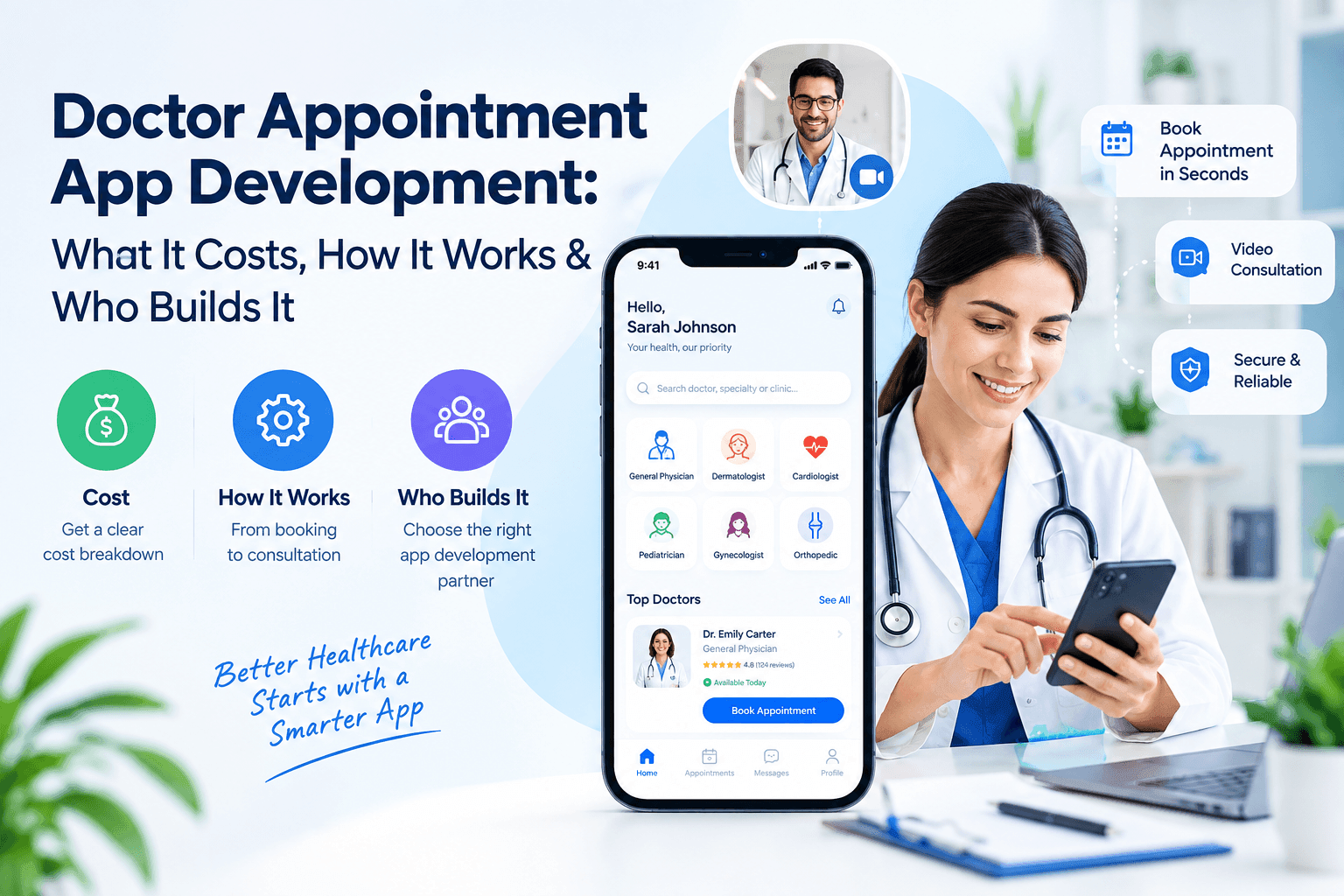
Doctor Appointment App Development: What It Costs, How It Works & Who Builds It
You called the clinic at 9 AM. Got put on hold. Called again. Left a voicemail. By noon, you gave up and Googled "urgent care near me."
That's not a patient problem. That's a product gap, and it's costing U.S. clinics an estimated $200 per missed or abandoned appointment slot.
If you're a healthcare founder, clinic operator, or startup building in the medical space, doctor app development isn't optional in 2026. It's the baseline. Most apps fail not because the idea was wrong, but because the build was uninformed: wrong budget, wrong features, wrong team. This guide fixes that.
Why U.S. Clinics Can No Longer Delay
Skip the market-size paragraph. Here's what actually matters:
- 40%+ of appointments are booked after business hours; if your practice lacks 24/7 digital booking, you're handing those patients to competitors.
- No-show rates average 18–20% nationally; automated reminders cut that below 6%.
- OCR tightened HIPAA enforcement in 2025; non-compliant digital tools now trigger documented financial penalties, not just warnings.
- Medicare and Medicaid reimbursement is increasingly tied to patient engagement metrics, the kind only apps can reliably capture.
This isn't about convenience anymore. It's competitive survival.
What a Doctor Appointment App Actually Does (Beyond the Obvious)
Most guides stop at "patients can book slots." That's like saying a car "gets you places." Here's what a properly built medical scheduling platform handles across three layers:
For Patients: Real-time slot booking synced to EHR calendars, insurance pre-verification before confirmation, digital intake forms that cut check-in time from 12 minutes to under 2, and follow-up scheduling triggered at the end of each visit.
For Providers: A slot management dashboard with appointment-type color coding, patient chart preview 15 minutes before each visit, no-show tracking with automated re-engagement, and billing flags tied to each encounter.
For Admins: Multi-provider scheduling across a network, waitlist auto-fill when cancellations happen, and reporting dashboards tracking utilization and retention KPIs.
The difference between a booking app and a clinical scheduling platform is that the second one lives inside the workflow, not outside it.
The Real Cost Breakdown
Every client wants a number. Here's one that's actually useful:
| Build Tier | What's Included | Timeline | Cost (U.S. Market) |
|---|---|---|---|
| MVP / Pilot | Booking, profiles, reminders, payments | 10–14 weeks | $25,000 – $45,000 |
| Growth App | Telemedicine, EHR integration, multi-provider support | 5–8 months | $60,000 – $120,000 |
| Enterprise Platform | AI scheduling, HL7/FHIR, analytics, and compliance layers | 9–15 months | $150,000 – $400,000+ |
The Hidden Costs That Blow First-Time Budgets
HIPAA Compliance Architecture isn't a document; it's AES-256 encryption, role-based access controls, MFA, session timeouts, and audit logging baked into the codebase from day one. Compliance adds 15–30% to any project budget. Teams that treat it as a checklist discover the gap six months and $40K into the build.
Discovery Phase: A 1–2 week sprint covering compliance mapping and feature prioritization costs $3,000–$8,000 and routinely saves $20,000–$50,000. Skipping it is the leading cause of healthcare app budget overruns.
EHR Integration: Connecting to Epic, Cerner, or Athenahealth adds 6–10 weeks. API sandbox approvals alone take 2–4 weeks before a single integration call can be tested.
Post-Launch Maintenance: Ongoing upkeep runs 15–25% of the initial build annually. A $60K app costs $9K–$15K per year to stay compliant and current; plan for it from the start.
Features That Drive Retention vs. Features That Drive Pitches
Everyone wants AI in their healthcare app. Almost nobody maps it to actual patient behavior first.
Build these first; they move the needle:
- Automated no-show follow-up — reschedule link sent within 4 hours of a missed slot; 30–40% recapture rate
- Insurance verification widget — surfaces eligibility gaps before the visit, reducing claim rejections at the source
- Waitlist auto-fill — fills cancellations via automated text without any staff involvement, recovering ~$200 per slot
- Recall campaigns — automated prompts for annual checkups and follow-ups; drives repeat visits without a marketing budget
Skip these at launch; low early ROI:
- AI symptom checkers — high build cost, regulatory grey area, minimal pre-diagnosis utility
- Blockchain records — no U.S. EHR system interoperates with blockchain at scale
- Wearable integration — only valuable when your patient population actively uses devices and your clinical workflows can act on the data
- Build for the workflow your team is already in. Layer intelligence on top once you have adoption data.
How the Build Actually Works
A well-run healthcare app project moves through six phases: Discovery & compliance mapping (PHI boundary mapping, regulatory classification every architecture decision flows from here), UX design with clinical usability testing (over 80% of users abandon apps with friction-heavy interfaces), backend and compliance infrastructure (encryption, audit logging, access controls built in parallel with design), iterative feature development (core booking first, EHR integrations layered in after stability), third-party security audit and pen testing (non-negotiable before any patient data goes live), and finally staged App Store rollout with crash monitoring and a documented incident response plan active from day one.
Who Should Build It and What to Ask Before You Sign
Three types of teams dominate this space. Offshore generalist shops ($15–$30/hr) carry variable quality and often treat HIPAA as a theoretical checkbox; compliance gaps appear months into the build. U.S. enterprise agencies ($150–$250/hr) offer compliance fluency but are often overkill for MVPs. Specialized healthcare app development teams are the right fit for most U.S. founders; they speak HIPAA natively, understand EHR ecosystems, and design for clinical workflows, not just user flows.
Before signing anyone, ask: Have you shipped a HIPAA-compliant app in the U.S.? Can I speak to that client? Do you sign a BAA? Who on your team has hands-on FHIR experience? What's your post-launch incident response protocol? A team that's done it answers without hesitation.
Why Most Healthcare Apps Stall After Launch
The failures aren't usually technical. They follow three patterns:
Feature overload at v1.0 — Shipping AI, telemedicine, and wearables simultaneously means nothing works reliably. The apps that win launch one workflow done exceptionally well.
Staff adoption ignored — If front-desk workers see the app as a threat rather than a tool that kills phone tag and manual reminders, adoption fails at the supply side regardless of patient demand.
No post-launch iteration — A static product in a dynamic regulatory environment (HIPAA updates, CMS rule changes, CPT revisions) becomes a liability within 18 months.
Teams that deliver real outcomes in healthcare app development the kind that actually reduces no-shows and satisfies auditors start every engagement with a compliance audit before writing a line of code. That's the standard TechReforms holds, and the standard you should hold any partner to.
This content was produced by the TechReforms editorial team. For consultations on healthcare app builds, visit TechReforms.com