
Fintech App Security Risks Nobody Warns You About
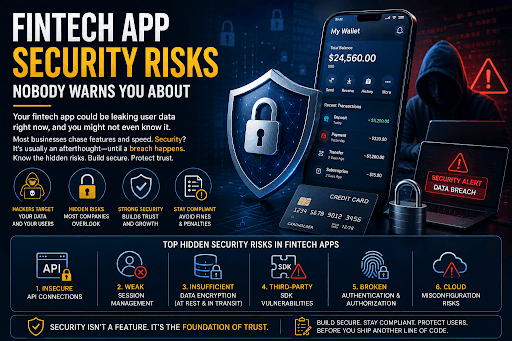
Your fintech app could be leaking user data right now, and you might not even know it.
Most businesses chasing fintech app development focus on features, speed, and UI. Security? It's usually an afterthought until a breach happens. Fintech apps are the #1 target for cybercriminals in the U.S., and the vulnerabilities aren't always the obvious ones. This guide exposes the hidden security risks that most developers, vendors, and even your fintech app development company won't bring up until it's too late. If you're building or scaling a financial app, read this before you ship another line of code.
Why Fintech Apps Are a Hacker's Favorite Target
Fintech apps sit at the intersection of two things hackers love most: money and personal data. Unlike traditional banking systems with decades of hardened infrastructure, fintech apps are often built fast, scaled faster, and secured last.
In 2023 alone, financial services companies experienced an average of 703 cyberattacks per week, more than any other industry. And here's the uncomfortable truth: most of those breaches didn't happen because of sophisticated hacking. They happened because of overlooked, preventable vulnerabilities baked into the app from day one.
The Hidden Security Risks Most People Miss
1. Insecure API Connections
APIs are the backbone of every fintech app; they connect your app to banks, payment processors, credit bureaus, and third-party services. But they're also one of the most exploited attack surfaces in financial technology.
What goes wrong:
- APIs without proper authentication tokens
- Exposed API endpoints that return more data than needed
- No rate limiting, allowing brute force attacks
- Missing input validation that opens the door to injection attacks
Most teams building a fintech product through a fintech app development agency don't audit third-party API security; they just assume the vendor handles it. That assumption has cost companies millions.
2. Weak Session Management
Ever noticed how some apps keep you logged in forever? That's a massive security hole in fintech.
Session tokens that don't expire, aren't rotated after login, or aren't invalidated after logout are a playground for session hijacking attacks. Once an attacker steals a valid session token, they don't need your password; they already have access.
The risks include:
- Persistent session tokens stored in insecure locations
- No automatic logout after inactivity
- Session fixation attacks during authentication flows
- Tokens transmitted over unencrypted channels
3. Insufficient Data Encryption At Rest AND In Transit
Most developers know to use HTTPS. Few actually implement end-to-end encryption correctly across all data states.
| Data State | Common Mistake | What Should Happen |
|---|---|---|
| In Transit | Using HTTP for internal microservices | Use TLS 1.3 across all services with no exceptions |
| At Rest | Storing data in plaintext databases | Use AES-256 encryption as a minimum standard |
| In Use | Processing data in unencrypted memory | Use secure enclaves or memory encryption where appropriate |
| Backups | Storing backup files without encryption | Encrypt backups and enforce strict access controls |
If your fintech app development services provider isn't explicitly discussing all four encryption states, you have a gap.
4. Third-Party SDK Vulnerabilities
Your app is only as secure as every SDK and library it uses. Most fintech apps integrate dozens of third-party tools: analytics, push notifications, KYC verification, payment gateways. Each one is a potential entry point.
What nobody tells you:
- Outdated SDKs with known CVEs (Common Vulnerabilities and Exposures) still ship in production apps
- Third-party SDKs can access far more device permissions than they need
- Open-source libraries aren't always vetted for financial-grade security
- Supply chain attacks target popular libraries to inject malicious code upstream
The SolarWinds attack wasn't a fintech breach, but it proved how devastating third-party vulnerabilities can be at scale. The same principle applies to every fintech app in the App Store today.
5. Broken Authentication and Authorization
Authentication is who you are. Authorization is what you're allowed to do. Breaking either one is catastrophic in financial applications.
Common broken auth patterns:
- Weak password policies with no MFA enforcement
- JWT tokens with no expiration or weak signing algorithms
- Role-based access control (RBAC) that isn't enforced server-side
- Password reset flows vulnerable to account takeover
- No anomaly detection for login attempts across geographies
A user logging in from New York and then from Vietnam 10 minutes later should trigger an alert. Most apps don't have that logic built in.
6. Improper Mobile Device Security
Desktop security gets all the attention. Mobile gets ignored even though most fintech users access their accounts exclusively through smartphones.
Mobile-specific risks:
- Root/jailbreak detection not implemented
- Sensitive data cached in plain text on device storage
- Screenshots of financial data saved to camera roll
- Clipboard sniffing by malicious apps reading copied account numbers
- Reverse engineering of the app binary to extract hardcoded credentials
If your app doesn't detect a rooted device and restrict access accordingly, you're essentially handing attackers a master key.
7. Compliance Gaps That Create Legal Liability
Security in fintech isn't just about hackers; it's about regulatory compliance. In the U.S., fintech apps must navigate:
| Regulation | What It Covers | Risk If Ignored |
|---|---|---|
| PCI DSS | Payment card data handling and security requirements | Heavy fines, penalties, and potential loss of payment processing |
| GLBA | Consumer financial data privacy and safeguards | Federal penalties and regulatory enforcement |
| SOC 2 | Security, availability, processing integrity, confidentiality, and privacy controls | Loss of enterprise client trust and business opportunities |
| CCPA | California consumer privacy and data rights | Significant financial penalties for violations |
| FinCEN AML | Anti-money laundering controls and reporting requirements | Regulatory enforcement, financial penalties, and potential criminal liability |
Compliance isn't a checkbox; it's a continuous process. One audit failure can shut down your entire operation.
How TechReforms Approaches Fintech Security Differently
Most development shops build first and patch later. TechReforms doesn't work that way.
Our security-first development process means:
- Threat modeling before the first sprint: we identify attack surfaces before writing code
- Penetration testing at every major release, not just at launch
- OWASP Mobile Top 10 compliance built into our development checklist
- Third-party SDK audits on every integration, every time
- Regulatory compliance mapping from day one: PCI DSS, GLBA, SOC 2, CCPA
- Real-time anomaly detection architecture included in core app design
- Zero-trust architecture principles applied across all microservices
We've helped fintech startups and scaling enterprises in the U.S. build apps that don't just pass audits; they're genuinely resistant to the attacks happening right now.
When clients come to us after a breach, the first thing we find is almost always one of the seven risks listed above. When they come to us before a breach, we make sure none of them ever apply.
Security Red Flags to Watch for in Any Dev Partner
Before you sign a contract with any development team, ask these questions:
- Do you conduct threat modeling before development begins?
- Is penetration testing included or an add-on?
- How do you vet third-party SDKs and libraries?
- What's your process for tracking CVEs in dependencies?
- Do you have experience with PCI DSS and GLBA compliance?
- Can you show examples of security documentation from past fintech projects?
If you get vague answers or upselling instead of answers, walk away.
Don't Wait for a Breach to Take Security Seriously
TechReforms builds fintech apps that are secure from line one, not patched after launch. Contact us today and get a free security gap assessment for your existing or planned fintech product.
Conclusion
The fintech security risks that cause the most damage aren't the ones making headlines they're the quiet, unglamorous vulnerabilities sitting in your session management, your APIs, your third-party SDKs. By the time most teams notice, the damage is done.
Security isn't a feature you add at the end. It's a foundation you build from the start. TechReforms exists to make sure every fintech app we touch is built on that foundation because in financial technology, trust isn't just a value. It's your entire product.