
Freelancer vs App Development Agency vs In-House Team: Which Fits Your Stage?
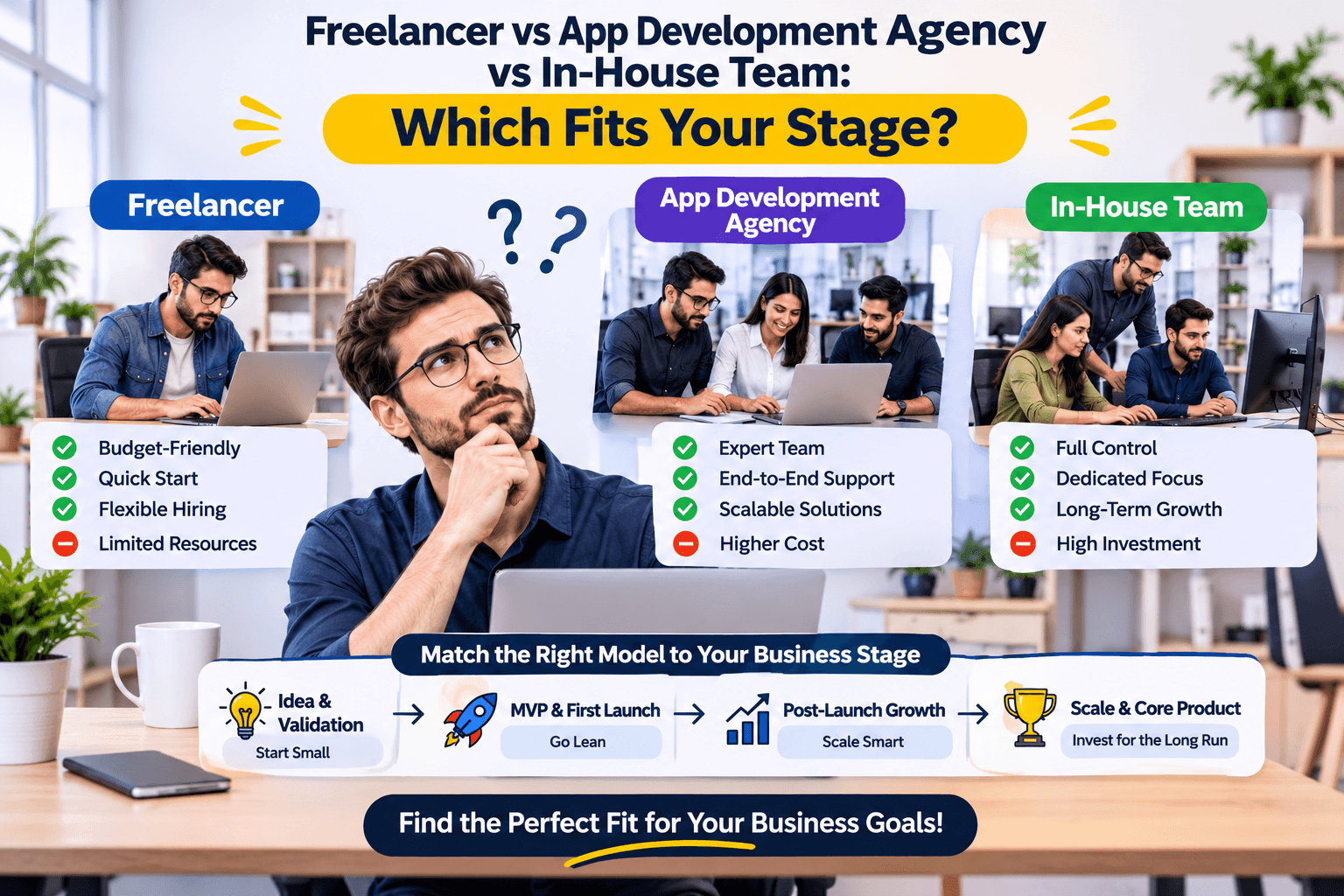
You have an app idea, a budget that feels either too big or too small, and three very different ways to get it built. Pick the wrong one and you lose more than money. You lose months.
That is the real problem with buying mobile app development services today. Every option sounds reasonable on paper. A freelancer is cheaper, an agency is faster, and an in-house team gives you control. Each claim is true, and each one hides a cost that only shows up later.
So the better question isn't which model is best. It's which model fits where your product is right now. A founder testing an idea needs something very different from a funded company with 200,000 users and a roadmap that never ends.
This guide walks through all three options stage by stage. You'll see what each one really costs, where each tends to break, and how to tell which one your app needs today.
What Each Model Actually Means
Before comparing them, it helps to be precise. People use these terms loosely, and that's where a lot of bad hiring decisions start.
Freelance App Developer
A freelancer is an independent developer you contract for a specific job. You usually find them through platforms like Upwork or Toptal, or through a referral from someone you trust.
Most freelancers specialize. One might be strong in Swift for iOS, another in Kotlin for Android, and a third in Flutter or React Native. Very few can handle design, backend, testing and store submission equally well.
That means you become the project manager. You write the requirements, review the work, chase deadlines and decide what done looks like.
App Development Agency
An app development agency is a company that designs, builds and launches apps for clients using a ready-made, multi-skilled team. You get a product manager, UI/UX designers, mobile engineers, backend developers and QA testers under one contract.
The agency owns the delivery process. It runs discovery, plans sprints, tests on real devices and handles the App Store and Google Play launch.
You still make the product decisions. You just don't have to coordinate five separate people to get them built.
In-House Development Team
An in-house team is a group of developers, designers and testers you hire as full-time employees. They work only on your product and live inside your company culture.
This model gives you the deepest product knowledge over time. It also brings the heaviest commitment, because salaries, benefits, equipment, recruiting and retention all become your responsibility.
In-house works best when the app is the business itself, not a side channel for it.
How to Match the Model to Your Stage
Your product stage matters more than your budget. The same $40,000 can be a smart investment or a wasted one depending on what you're trying to prove.
Here is how the decision usually plays out across the four stages most apps go through.
Stage 1: Idea and Validation
At this point you're not building a product. You're testing whether anyone wants one.
A clickable prototype in Figma, a landing page or a simple no-code demo is often enough. A skilled freelance designer can deliver this in a few weeks for a modest fee.
Hiring full-time engineers here is almost always premature. You'd be paying salaries to build something the market hasn't asked for yet.
Stage 2: MVP and First Launch
This is where most founders feel the pressure, and where the choice carries the most risk. An MVP has to work on real phones, pass store reviews and handle real users, payments and data.
It touches design, frontend, backend, APIs, QA and release management at once. One freelancer rarely covers all of that well.
That's why many startups choose to outsource mobile app development at this stage. A focused agency can ship a lean first version in roughly 6 to 12 weeks, and TechReforms' MVP development process is built around exactly that window.
Example: A dental group in Houston wants an app for bookings, reminders and payments. The owner has no technical staff. A freelancer could build the screens, but who handles HIPAA-aware data storage, testing and App Store approval? An agency takes all of that off the owner's desk.
Stage 3: Post-Launch Growth
Once real users arrive, the work changes. You're fixing bugs, reading analytics, shipping new features and keeping up with yearly iOS and Android updates.
Many companies stay with their agency here because the team already knows the codebase. Others start hiring their first internal product lead to own the roadmap while the agency keeps building.
Stage 4: Scale and Core Product
When the app becomes the center of the business, the math flips. You now have years of continuous work, sensitive product knowledge and a culture to protect.
This is the stage where it makes sense to hire mobile app developers as full-time staff. Most growing companies get there gradually, adding internal engineers while an outside partner fills skill gaps.
Key Factors to Compare Side by Side
The table below gives the short version. The notes after it explain why each row matters.
| **Factor** | **Freelancer** | **App Development Agency** | **In-House Team** |
|---|---|---|---|
| Upfront cost | Lowest | Moderate, usually fixed or milestone-based | Highest, with ongoing payroll |
| Time to start | Days | 1 to 3 weeks | 2 to 4 months to recruit |
| Skills covered | One or two | Design, mobile, backend, QA, PM | Whatever you hire |
| Who manages the work | You | The agency's project manager | Your own leadership |
| Continuity risk | High | Low | Medium (staff turnover) |
| Quality control | Depends on the person | Structured QA process | Depends on your processes |
| Scaling up or down | Hard | Easy | Slow and costly |
| Best stage | Validation, small tasks | MVP, launch, growth | Scale, core product |
Cost and Hidden Overhead
The sticker price is only part of the bill. A freelancer's low hourly rate can climb fast once you count your own management time and the rework a missed requirement creates.
Speed to Market
Agencies usually win here because the team already exists. In-house is slowest, since recruiting a single senior mobile engineer can take months.
Quality Control and Testing
Testing is the step a solo developer is most likely to rush. Agencies typically test on a range of real iPhones and Android devices before every release.
That matters because store rejection is common for rushed builds. Apple's App Store Review Guidelines cover privacy, payments, performance and design, and missing any of them delays launch.
Continuity and Bus Factor
If your only developer gets sick, takes a full-time job or simply stops replying, your project stops too. An agency spreads knowledge across a team, so one absence doesn't freeze your roadmap.
Code and IP Ownership
Ownership needs to be written down, whatever model you choose. In the US, work by an independent contractor isn't automatically yours unless the contract says so, and the U.S. Copyright Office's guide on works made for hire explains why that wording matters.
A reputable agency signs an NDA up front and transfers full source code and IP rights on completion. TechReforms does this on every project as standard.
Benefits of Each Option
None of these models is wrong. Each one wins in a specific situation, and knowing those situations saves you from paying for strengths you don't need.
Why a Freelancer Can Be the Right Call
- Lower cost for narrow work: Fixing a crash, adding a payment screen or building a prototype rarely needs a full team.
- Fast start: Many freelancers can begin within days of a signed agreement.
- Direct contact: You talk to the person writing the code, with no layers in between.
- Niche skills on demand: You can bring in a Core ML or ARKit specialist for one feature, then let them go.
Why an Agency Often Fits Startups and SMBs
- A complete team from day one: Strategy, UI/UX, development, QA and launch support come together.
- Predictable delivery: Fixed-price or milestone contracts make budgets easier to plan and defend.
- Lower risk: Process, documentation and backup engineers protect you if someone leaves.
- Broad experience: A team that has shipped fintech, healthcare and eCommerce apps has already solved problems you haven't met yet.
- Support after launch: OS updates, security patches and new features keep coming without a new hiring cycle.
Why an In-House Team Pays Off Later
- Deep product knowledge: Your engineers live with the product every day and learn your users over years.
- Full control: You set priorities hour by hour without a contract in between.
- Culture and speed of decisions: Internal teams can pivot fast when the whole company shares the same goals.
- Long-term savings at scale: With years of steady work, salaried staff can cost less than outside billing.
Common Mistakes Founders Make
Most failed app projects don't fail because of bad code. They fail because of a mismatch between the team and the job.
1. Building In-House Too Early
Hiring three engineers before product-market fit locks you into payroll while you're still guessing. If the idea changes, those costs don't.
2. Stretching One Freelancer Across a Whole Product
A great iOS developer isn't automatically a backend architect, a designer and a QA tester. Asking one person to cover everything usually means something critical gets skipped.
3. Picking on Hourly Rate Alone
A $40 per hour developer who needs three rounds of rework is more expensive than a $90 per hour team that ships it right once. Compare total project cost, not the hourly number.
4. Treating Contractors Like Employees
If you set a freelancer's hours, tools and daily tasks, you may be creating an employment relationship without realizing it. The IRS guidance on independent contractors and employees explains the tests, and getting it wrong can mean back taxes and penalties.
5. Skipping a Real Vetting Process
The best mobile app development company for you isn't always the one with the slickest website. Check live apps in the App Store and Google Play, read verified Clutch reviews and speak to a past client directly.
A top app development agency will also be honest about what it doesn't do well. Be cautious with any partner that agrees to every feature, deadline and budget without a single question.
6. Ignoring Time Zones and Communication
Many US businesses prefer working with a mobile app development company in USA so live calls happen in the same business hours and decisions move faster. Whoever you pick, agree on weekly demos, a shared Slack channel and one named point of contact before work begins.
7. Forgetting Life After Launch
An app is never finished. Plan budget and ownership for bug fixes, OS updates, security patches and new features from the start.
Mobile App Development Cost by Model
The honest answer to what will it cost? depends on scope, platforms and integrations. Still, each model has a typical price shape, and seeing them together makes the trade-offs clear.
| **Model** | **How you pay** | **Typical range for a first app** | **What's included** |
|---|---|---|---|
| Freelancer | Hourly or per task | About $10,000 to $60,000+ | Code from one or two people; you handle design, QA and management |
| App development agency | Fixed price, milestones or monthly team | About $15,000 to $150,000+ | Discovery, UI/UX, build, QA, launch and support |
| In-house team | Salaries, benefits, tools | $500,000+ per year for a lean team | Whatever roles you hire and keep |
Ranges are typical US market estimates for planning, not quotes. Your real number depends on features, platforms and compliance needs.
Why In-House Costs More Than the Salary
According to the U.S. Bureau of Labor Statistics, software developers earned a median annual wage of around $136,000 in May 2025. That's just one engineer's base pay.
Add benefits and payroll taxes, which commonly run around 30% on top of wages, and a single developer can pass $175,000 a year. A lean team of two mobile engineers, a designer and a QA tester easily crosses half a million dollars before recruiting fees, laptops and software licenses.
Why Freelancer Quotes Rise Over Time
Freelance app development pricing looks attractive at the start. Then scope grows, a second specialist joins for the backend, and you spend evenings reviewing pull requests instead of running your business.
Platform fees also exist. Marketplaces like Upwork take a service cut from freelancers, which often gets built into the rates you see.
Why Agency Pricing Is Easier to Plan
A good agency gives you a clear breakdown before work starts. TechReforms, for example, offers fixed-price builds starting from $15,000 for a lean MVP, with no hidden charges added later.
If you want affordable mobile app development services without cutting corners, a fixed scope is your best friend. It forces both sides to agree on exactly what gets built and what doesn't.
For real numbers by app type and complexity, TechReforms' app cost and timeline benchmark breaks down what similar projects have taken.
Ready to Talk About Your App?
TechReforms has helped startups and growing US businesses ship more than 350 live apps across iOS, Android and cross-platform. Our mobile app development company cover discovery, UI/UX, development, QA, launch and long-term support, all with full IP ownership and transparent fixed pricing.
Tell us where your product stands, and we'll tell you honestly which model fits, even if it isn't us. Book a free consultation or get a quote for app development today, and you'll have a clear scope, cost and timeline before you commit a single dollar.
Frequently Asked
Questions
A freelancer is cheaper per hour, but not always per project. Once you add your own management time, separate design and QA help, and the cost of rework, an agency's fixed price is often close or lower for a full app.
Usually after product-market fit, when the app is the core of the business and there's at least 18 to 24 months of continuous work planned.
Yes, and many companies do. Make sure your contract gives you full source code and IP ownership, and ask the agency for documentation and a handover plan so your new engineers can take over smoothly.