
Game Development Team Structure: Roles You Need at Every Stage
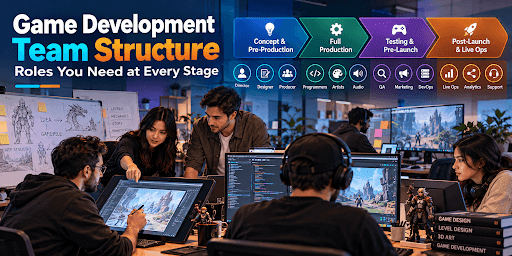
Here's a hard truth most studios learn too late: games rarely fail because of a bad idea. They fail because the wrong people were in the room at the wrong time. A brilliant concept with no technical lead stalls. A polished build with no QA ships broken. Whether you're an indie founder or a funded startup evaluating game development services, your team structure decides your budget, your timeline, and ultimately your player reviews. In this guide, we break down exactly which roles you need at every stage, from concept to live ops, so you can hire smart, spend wisely, and ship a game players love.
Why Does Game Development Team Structure Matter So Much?
Game development isn't one job. It's dozens of specialized disciplines working in sequence. Hiring everyone on day one burns cash. Hiring too late creates bottlenecks that push back your launch date.
A well-planned team structure helps you:
- Control burn rate by adding roles only when the production pipeline needs them
- Reduce rework, since design, art, and engineering stay aligned from the start
- Hit milestones like vertical slice, alpha, beta, and launch on schedule
- Protect quality with testing and polish built in rather than bolted on
- In our experience, the studios that scale their teams stage by stage consistently ship faster than those that staff up all at once.
What Roles Do You Need During Concept and Pre-Production?
Pre-production is where you prove the idea works before spending serious money. Keep this team small and senior.
Game Director or Creative Lead
This person owns the vision. They define the core gameplay loop, target audience, genre, and the "feel" of the game. Every later decision traces back to their direction.
Game Designer
The designer turns vision into rules. They write the Game Design Document (GDD), map out mechanics, progression systems, and economy balancing, and build paper or digital prototypes.
Technical Lead or Lead Programmer
Before a single asset is made, someone must answer: Can we actually build this? The tech lead chooses the engine (Unity, Unreal Engine, or custom), sets the architecture, and flags technical risks early.
Concept Artist
Concept art sets the visual direction, including characters, environments, and mood boards. It's also your most powerful tool for pitching investors or publishers.
Producer
The producer builds the roadmap, estimates budgets, and keeps scope realistic. Skip this role, and scope creep will quietly eat your runway.
Goal of this stage: A playable prototype that proves the core loop is fun.
Who Should Be on Your Team During Full Production?
This is where your team grows the most. Production turns the prototype into a complete game, and each discipline expands.
Programming Team
- Gameplay programmers build mechanics, controls, and player interactions
- Engine or tools programmers create internal tools that speed up content creation
- Backend and network engineers handle multiplayer, servers, leaderboards, and cloud saves
- UI programmers implement menus, HUDs, and in-game interfaces
Art Team
- 3D modelers and 2D artists create characters, props, and environments
- Animators bring characters and objects to life
- Technical artists bridge art and code with shaders, VFX, and performance optimization
- Art director keeps the visual style consistent across hundreds of assets
Design Team
- Level designers build maps, missions, and player flow
- Narrative designers or writers craft story, dialogue, and lore
- UI/UX designers make sure the game is intuitive and accessible
Audio Team
Sound designers and composers create music, sound effects, and voice direction. Audio is often underestimated, yet it's one of the biggest drivers of immersion.
Goal of this stage: A content-complete build, often reached through vertical slice and alpha milestones.
What Roles Are Critical During Testing and Pre-Launch?
A great game can still flop if it launches buggy. This stage is about polish, stability, and readiness.
QA Testers and QA Lead
Quality assurance teams run functional testing, regression testing, compatibility testing across devices, and performance checks. Start QA early, ideally during alpha, not the week before release.
Playtest Coordinator
They organize internal and external playtesting, collect feedback, and turn player behavior into actionable design changes.
Release Manager or DevOps Engineer
Handles build pipelines, platform certification (Steam, App Store, Google Play, PlayStation, Xbox), and submission requirements.
Marketing and Community Manager
Wishlists, trailers, social media, Discord, and press outreach should begin months before launch day. Visibility doesn't happen by accident.
Goal of this stage: A stable, certified beta ready for soft launch or full release.
Who Do You Need After Your Game Launches?
- Launch isn't the finish line. For mobile and multiplayer games especially, it's the starting line.
- A live ops team runs events, seasonal content, and updates
- Data analysts track retention, session length, and player drop-off points
- Monetization specialists optimize in-app purchases, ads, and battle passes ethically
- Community and customer support keep players engaged and respond to issues
- Maintenance developers patch bugs and keep the game compatible with OS and platform updates
Strong post-launch support is what separates a game that fades in three months from one that earns revenue for years.
How Big Should Your Game Development Team Be?
It depends on scope. Here's a practical breakdown:
| Project Type | Typical Team Size | Timeline |
|---|---|---|
| Hyper-Casual Mobile Game | 3–8 People | 2–4 Months |
| Indie PC or Mobile Title | 5–20 People | 6–18 Months |
| Mid-Size Multiplayer Game | 20–80 People | 1–3 Years |
| AAA Console/PC Game | 100+ People | 3–5+ Years |
Many successful studios don't hire all of these roles full-time. Instead, they build a lean core team and bring in specialists exactly when needed.
Should You Build an In-House Team or Hire a Game Development Partner?
This is the question most founders and product owners wrestle with. Here's an honest comparison.
Building in-house works if:
- You have long-term funding and multiple titles planned
- You want full control of company culture and IP knowledge
- You can afford 3–6 months of recruiting
Partnering with a game development agency works if:
- You need to start production quickly
- You want senior talent without full-time salaries and benefits
- Your project needs specialists (multiplayer, AR/VR, blockchain, console porting) for limited periods
- You want predictable costs and defined milestones
A hybrid model, where your core creative team plus an external co-development partner handles engineering, art, or QA, is now one of the most common setups in the industry.
Why Do Studios Choose TechReforms to Build Their Games?
At TechReforms, we don't just supply developers. We supply the right team for your stage. As a full-cycle game development company, we scale with you from the first prototype through post-launch live ops.
Here's what you get when you work with us:
Stage-based team scaling: Start with a lean pre-production pod and expand only when your game is ready
- Senior-led teams: Every project includes experienced producers, tech leads, and art directors
- Full-stack expertise: Unity, Unreal Engine, mobile, PC, console, multiplayer, and AR/VR
- Transparent milestones: Clear sprint reports, playable builds, and no surprise invoices
- US-aligned collaboration: Time-zone-friendly communication for clients across the United States
- End-to-end support: Concept, design, development, QA, launch, and live ops under one roof
If you've been searching for a reliable game developer that USA businesses trust to deliver on time and on budget, TechReforms is built for exactly that.
Ready to Build Your Dream Team?
Book a free consultation with TechReforms today. We'll review your game idea, recommend the right team structure for your stage, and give you a clear roadmap with timeline and cost estimates. No commitment required.