
Game Development Trends in 2026: What Studios Can’t Afford to Ignore
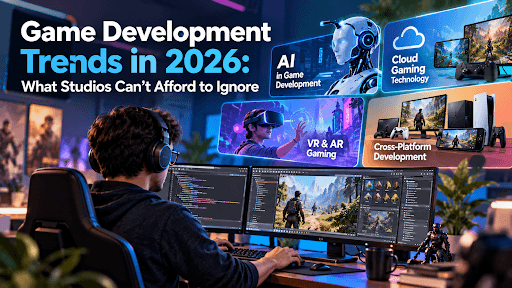
Every year, someone declares a new technology the future of gaming, and every year half of those predictions quietly fade out. So which game development trends in 2026 deserve a real budget, and which ones are just conference noise?
The answer matters more than it used to. The player base is still growing, but more slowly, and studios now compete for the same attention. Picking the wrong technology bet can sink a project. Picking the right one can give a small team a real edge.
This guide covers what’s actually moving the industry, what the latest data says, and how to decide where your own project fits. If you’re comparing a game development company or planning an in-house build, it should help you ask better questions.
Where the Game Industry Stands in 2026
Start with the market itself, because it explains why these trends exist.
Newzoo forecasts the global games market at $213.9 billion in 2026, up 6.1% year over year, with growth across every major region and all three platforms. Mobile is the biggest slice at roughly $121.1 billion, while console is expected to reach $46.9 billion and PC $45.9 billion.
Two details stand out for anyone building games:
- China and the US together account for 52% of all consumer spending on games.
- The Middle East and Africa are growing fastest, at about 10.3% year over year, though from a small base.
The bigger shift is what Newzoo says about the future. Player growth is slowing, so growth will depend more on keeping and monetizing the players already there than on finding new ones. In plain terms, a game that’s merely downloaded isn’t enough anymore. It has to be worth coming back to. Most of the trends below serve that goal.
The Latest Game Development Trends Worth Your Attention
1. AI in Game Development (Used Carefully)
AI-powered game design is the loudest trend of the year and also the most divisive.
On the adoption side, more than a third (36%) of game industry professionals say they use generative AI tools at work. On the sentiment side, 52% now believe generative AI is hurting the industry, up from 30% a year earlier and 18% the year before. A separate Omdia-backed survey even found that usage among developers slipped from 36% to 29% in early 2026. The details are in GDC’s 2026 State of the Game Industry report.
So where does AI actually earn its place? Mostly in the unglamorous parts of production:
- Quick prototyping and greyboxing
- Code assistance and bug triage
- Automated playtesting and balance checks
- Localization first drafts
- Smarter NPC behavior and dialogue
Studios that treat AI as a production assistant tend to be happier than those using it to replace artists or writers. Players notice the difference, and so do your own team members. If you’re weighing LLM-driven characters or on-device models, a team offering AI development can help you scope what’s realistic before you commit.
2. Cloud Gaming Technology
Cloud gaming has stopped being a novelty. Services like Xbox Cloud Gaming and GeForce NOW let people play demanding titles on a phone, a low-end laptop, or a smart TV, with no download and no expensive hardware.
For developers, this changes a few design decisions:
- Input needs to feel forgiving when latency spikes.
- Instant-play demos become a realistic way to acquire players.
- Your game should scale down gracefully, not just up.
You don’t have to build for the cloud first. You do have to make sure your game doesn’t fall apart when it runs there.
3. Virtual Reality (VR) and Augmented Reality (AR) Gaming
Here, the honest picture is more nuanced than the hype. Meta’s Quest line still dominates headsets, but the wider XR story is shifting toward lightweight glasses. IDC-based figures reported by one analyst show total XR device shipments rising in 2025 while traditional VR and mixed-reality headset shipments fell sharply.
At the same time, the tooling keeps improving. Google’s Android XR SDK preview added official Unreal Engine and Godot support, giving game developers a third major platform to target.
What does that mean in practice? XR is a smart bet for specific genres like rhythm, fitness, social, and puzzle games, and a risky one for a generic shooter. If you’re serious about it, plan for comfort design and performance budgets from day one. A specialist in VR development will save you from the classic mistake of porting a flat game into a headset and hoping for the best.
AR gaming is a different story. It runs on phones people already own, which makes it cheaper to test and easier to scale.
4. Cross-Platform Game Development
Players expect to start a match on a console and continue on their phone. Genshin Impact built a huge audience partly on that promise.
The momentum is visible in developer data too. Valve’s Steam Deck is now the fourth most-developed-for platform, with 28% of surveyed developers making or optimizing games for it. And 73% of executives place PC among their top three next-generation platforms.
Shared accounts, cross-save, and crossplay all depend on decisions made early. Your backend, your input system, your UI scaling. Retrofitting them is painful. A team experienced in cross-platform development can set that foundation up once instead of three times.
5. Real-Time 3D and the Engine Shift
Real-time 3D is now the standard for everything from AAA releases to architectural walkthroughs. The interesting news is who’s leading it.
In GDC’s 2026 survey, 42% of developers named Unreal Engine as their primary engine, ahead of Unity at 30%. That’s a reversal from earlier years when the two were roughly even. Unreal’s lead is strongest at larger studios, while Unity stays popular for mobile and smaller indie teams.
6. Procedural Content Generation
Procedural generation isn’t new. Minecraft, No Man’s Sky, and Hades all lean on it. What’s changed is how accessible the tools are, so even small teams can generate levels, loot tables, and environments that keep replays feeling fresh.
It works best when it’s designed, not random. The strongest examples use hand-built pieces assembled by smart rules, which keeps quality high while content volume grows. That ties straight back to the retention problem.
7. Multiplayer and Live-Service Design
Multiplayer game development trends in 2026 all point in the same direction: keeping people playing. Think seasonal content, player-made levels, social features, and stable matchmaking.
The technical side is harder than it looks. Dedicated servers, anti-cheat, regional latency, and moderation tools all take serious engineering. Many studios underestimate this and discover it during launch week, which is the worst possible time.
8. Mobile, Direct-to-Consumer, and Emerging Markets
Mobile remains the largest platform. Newzoo expects it to grow fastest, at 6.8%, even as downloads decline, because players spend more and publishers increasingly sell directly through their own channels.
Combine that with fast-growing regions like Saudi Arabia and the wider Middle East, and localization plus regional payment options start to look like real growth levers.
9. Blockchain Gaming (Proceed With Caution)
This is the trend where a straight answer helps most. A Caladan analysis reported by CoinDesk found that more than 90% of Web3 game projects have effectively failed, and over 300 blockchain games have shut down.
The lesson isn’t that the technology is useless. It’s that players never wanted to feel like they were managing a portfolio. If you use blockchain at all, it should solve a real problem, such as verifiable ownership of items across titles, and stay invisible to the player. Build the game first. Add the chain only if it earns its place.
How Studios Turn Trends Into a Working Plan
Knowing the trends is the easy part. Here’s a simple process that works for most teams:
- Start with your player, not the technology. Who are they, what device do they use, and what keeps them coming back?
- Shortlist two or three trends that match. A casual mobile puzzle game and a competitive PC shooter need very different bets.
- Prototype small. A four to six week vertical slice tells you more than a hundred-page plan.
- Playtest early and often. Real players find problems your team has gone blind to.
- Scale what works. Only then invest in content, servers, and marketing.
Why Following the Right Trends Pays Off
When studios pick trends deliberately, the benefits show up quickly:
- Better player retention, which is where growth now comes from
- Lower production costs through smarter tooling
- A wider potential audience across devices and regions
- Faster iteration and shorter time to market
- A stronger case when pitching to publishers or investors
Common Mistakes When Chasing Game Development Technologies
A few patterns come up again and again:
- Adopting a trend because competitors did. What works for a AAA publisher may be wrong for a five-person team.
- Treating AI as a shortcut for quality. Players can spot lazy, generic output quickly.
- Ignoring performance on mid-range devices. Most of the 3.1 billion mobile players aren’t on flagship phones.
- Building multiplayer last. Networking is very hard to bolt on later.
- Skipping the business model. A beautiful game with no retention plan struggles regardless of tech.
- Overpromising on blockchain or XR before confirming that players want it.
How Much Does Game Development Cost in 2026?
Cost depends heavily on scope, platform, art style, and team location. Treat the figures below as rough planning ranges, not quotes, because real estimates vary widely between studios.
| **Project type** | **Typical range** | **Typical timeline** |
|---|---|---|
| Simple casual or hyper-casual mobile game | $15,000 – $50,000 | 2–4 months |
| Mid-size 2D/3D mobile or indie PC game | $60,000 – $250,000 | 6–12 months |
| Multiplayer or live-service game | $250,000 – $1,000,000+ | 12+ months |
| AR/VR experience | $50,000 – $500,000 | 4–12 months |
Adding multiplayer, cross-platform support, or custom art can move a project up a tier quickly. The most useful thing you can do is ask for a line-by-line estimate so you can see where the money goes. Reputable game development services providers will happily break it down.
Frequently Asked
Questions
The major ones are AI-assisted production, cloud gaming, cross-platform play, real-time 3D engines, procedural content, live-service multiplayer, and a growing focus on retention and direct-to-consumer sales.
No. Current surveys show developers are cautious, and many use AI for support tasks like prototyping and testing rather than creative work.
Unreal Engine now leads among developers surveyed by GDC, but Unity is still a strong choice for mobile and smaller teams, and Godot suits lean indie projects.
It can be, for the right genre and audience. Headset sales have been uneven, while glasses and phone-based AR are growing. Start with a small prototype before committing a full budget.
Look for finished titles on your target platforms, clear communication, transparent pricing, and experience with the specific technology you need.