
How Much Does AR App Development Cost in 2026? A Business Guide
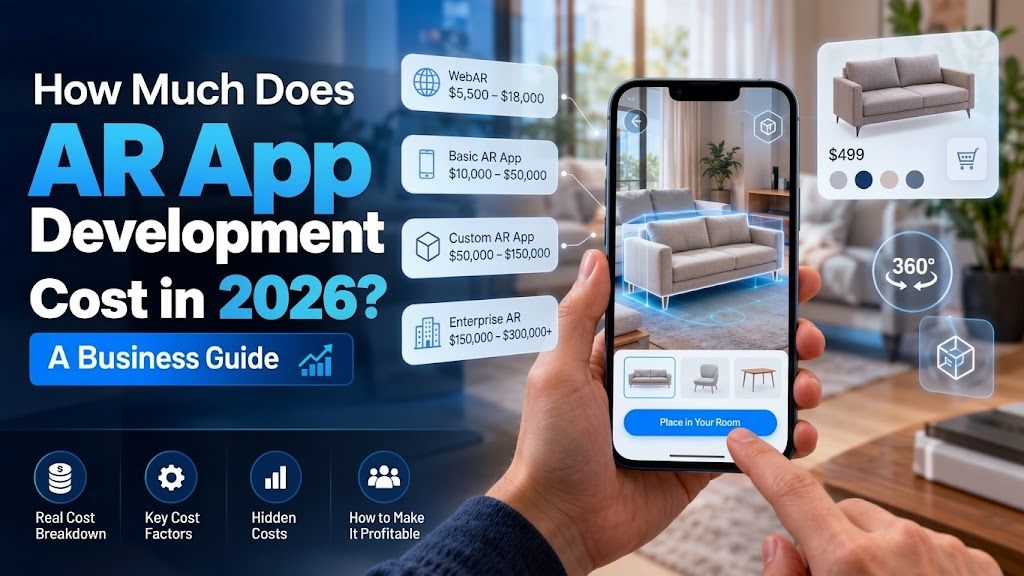
Your competitor just launched an app that lets customers “place” products in their living room before buying. Now your sales team is asking, “Can we do that too?” And your CFO is asking the harder question: “What’s it going to cost?” Fair enough. Augmented reality isn’t a novelty anymore; it’s a sales tool. But pricing for AR development services is all over the map, and most quotes leave you more confused than when you started. In this guide, we’ll break down real 2026 price ranges, what drives them, the hidden costs nobody mentions, and how to make an AR app pay for itself.
How Much Does AR App Development Cost in 2026?
Short answer: Most business AR apps in 2026 cost somewhere between $10,000 and $300,000+. A simple browser-based experience sits at the low end, a custom mobile app with 3D content lands in the middle, and an enterprise platform with integrations and AI features sits at the top.
That’s a wide range, so let’s narrow it down. Across the top-ranking cost guides this year, the numbers line up fairly closely. One industry breakdown places basic AR apps at roughly $10,000 to $50,000, mid-range custom apps at $50,000 to $150,000, and advanced enterprise builds at $150,000 to $300,000 and up.
Here’s how that looks in practical terms:
| AR App Type | Typical Cost Range | Typical Timeline | Good Example |
|---|---|---|---|
| WebAR Experience (No Download) | $5,500 – $18,000 | A Few Weeks | Scan-a-QR Product Demo, Packaging Activation |
| Basic AR App (MVP) | $10,000 – $50,000 | 2–4 Months | Marker-Based Catalogue, Simple 3D Viewer |
| Mid-Range Custom AR App | $50,000 – $150,000 | 4–8 Months | Virtual Try-On, Furniture Placement, AR Training |
| Enterprise AR Platform | $150,000 – $300,000+ | 6–12+ Months | Field Service Guidance, AI Object Recognition, Headset Apps |
The WebAR figure reflects one 2026 pricing guide, which puts WebAR development between $5,500 and $18,000. Your actual quote will depend on scope.
What Actually Drives the Price Up or Down?
Two apps can look similar in a demo and still be $100,000 apart. Here’s why.
1. The Type of AR You Choose
- Marker-based AR triggers content when the camera sees an image or QR code. It’s the most affordable.
- Markerless AR uses surface detection to place objects anywhere, like on your floor or table. More flexible, more costly.
- Location-based AR ties content to GPS coordinates. Great for tourism and events.
- Face and body tracking powers virtual try-ons for eyewear, makeup, and apparel.
2. 3D Content Creation
This is the budget line that catches most businesses off guard. Your app is only as good as the 3D models inside it. Experts reviewing this market warn that custom 3D asset work can cost as much as the code itself. If you have 500 products, you need 500 accurate, lightweight models.
3. Platforms and Devices
- iOS only (ARKit): lower cost, strong reach in the U.S. market
- Android only (ARCore): lower cost, broader device range
- Both platforms: higher cost unless you use a cross-platform engine like Unity
- Headsets (Apple Vision Pro, Meta Quest): specialised skills, higher price
4. Features and Integrations
Every connection adds hours. Think user accounts, payment checkout, CRM syncing, inventory data, analytics dashboards, AI-powered object recognition, and multi-user sessions.
5. Where Your Team Is Located
Rates vary sharply by region. One market overview notes that U.S.-based firms generally charge $100 to $200 per hour, while offshore teams cost less. Cheaper hourly rates can save money, but time-zone gaps and rework can quietly eat into those savings.
What Hidden Costs Should You Budget For?
The development quote is rarely the full picture. Plan ahead for:
- Maintenance and updates: Unity and Google update their AR frameworks yearly. Budget for ongoing work; Business of Apps estimates annual app maintenance at 15–25% of the original build cost.
- Cloud hosting: Storing and streaming 3D models isn’t free.
- App store fees: Developer accounts and revenue share on in-app sales.
- Content updates: New products mean new 3D models.
- Device testing: AR behaves differently across phones, lighting, and surfaces.
- Marketing: An app nobody downloads doesn’t generate a dollar.
- Our rule of thumb: set aside 20–30% beyond your build quote for your first year of ownership.
Can an AR App Actually Generate Leads for Your Business?
Yes, and this is where the conversation shifts from cost to investment.
At TechReforms, we don’t build AR apps just to look impressive. We build them to bring in leads and close sales. A well-planned AR experience can work at every stage of your funnel:
Top of Funnel: Grab Attention
- Interactive AR ads and social filters that people share
- Trade show and event activations that stop foot traffic
- Packaging that comes alive when scanned
Middle of Funnel: Capture Interest
- “Try before you buy” experiences that require a quick email signup to save or share results
- Virtual product demos that collect contact details before showing pricing
- Built-in analytics showing exactly which products people interact with most
Bottom of Funnel: Close the Deal
- In-app “Request a Quote” or “Book a Consultation” buttons
- Direct CRM integration so your sales team gets warm, qualified leads in real time
- Fewer returns and more confident purchases, especially in furniture, home improvement, and retail
That’s the difference between an app that costs money and an app that makes money. We plan lead capture into the build from day one, not as an afterthought.
How Can You Lower Your AR Development Cost Without Cutting Corners?
Smart businesses don’t always start big. Here’s what we recommend to our clients:
- Start with an MVP or WebAR pilot. Test real customer response before investing six figures.
- Launch on one platform first. Pick where your customers actually are.
- Reuse existing 3D assets. Your CAD files or product renders may be convertible.
- Use proven SDKs and engines. ARKit, ARCore, Unity, and 8th Wall save months of custom work.
- Define success metrics upfront. Leads, conversions, time-in-app. Build only what moves those numbers.
- Get a phased roadmap. Spread costs across releases instead of one massive invoice.
Should You Hire a Freelancer, an In-House Team, or an Agency?
Each path has its place:
- Freelancers: good for small prototypes, but AR usually needs several skills at once (3D artists, developers, UX designers, QA testers).
- In-house team: full control, but recruiting AR talent is slow and expensive.
- AR development agency: a complete, experienced team ready to start now, with one point of accountability.
For most businesses launching their first AR product, an agency offers the best balance of speed, quality, and predictable pricing.
Why Choose TechReforms for Your AR App?
TechReforms is an AR development company focused on one outcome: business results. We don’t just hand over an app; we help you turn it into a lead-generation engine.
When you work with us, you get:
- A free discovery call and detailed estimate with no obligation
- Transparent, phased pricing so there are no surprise invoices
- Lead-capture and CRM integration built into your app from the start
- 3D modelling, development, testing, and launch under one roof
- U.S.-friendly hours and communication, plus ongoing maintenance and support
If you’re comparing partners for AR development USA businesses can rely on, let’s talk. Tell us your idea, your audience, and your budget range, and we’ll show you exactly what’s possible and what it’ll realistically cost.
Book your free AR consultation with TechReforms today.
Frequently Asked
Questions
A simple AR app often takes 2 to 4 months. Mid-range apps typically take 4 to 8 months, and enterprise platforms can take a year or more depending on integrations and content.
Yes. AR apps can connect to platforms like Salesforce, HubSpot, Shopify, and custom systems, so leads and orders flow straight to your team.
Track leads captured, conversion rates, average order value, product return rates, and engagement time. Setting these metrics before development makes ROI much easier to prove.