
How Much Does It Cost to Develop an App in 2026? A Detailed Guide
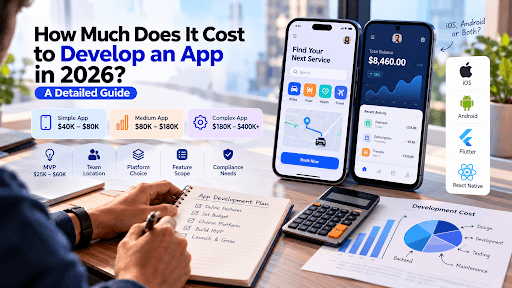
In 2026, mobile app development costs in the US range from about $40,000 for a simple app to $400,000+ for a complex, regulated platform. Most funded business apps land between $80,000 and $180,000, and a focused MVP can launch for $25,000 to $60,000.
Four things decide where you land: feature scope, platform choice, team location, and compliance needs. After launch, plan on another 15–20% of the build cost every year to keep the app running well.
Below, we break down every line item, price out apps you already know, like Uber and Tinder, and show you how to read a quote before you sign one.
Key Takeaways
- Simple apps: 40K–80K · Medium: 80K–180K · Complex: 180K–400K · Enterprise/regulated: $400K+
- MVPs: 25K–60K, usually live in 8–14 weeks
- An Uber-style app costs 150K–350K for version one; a Tinder-style app costs 60K–160K
- Cross-platform builds typically cost 25–40% less than two separate native apps
- Year-one running costs add roughly 20–35% of the build
- Team location moves your price more than platform choice does
How Much Does It Cost to Build an App in 2026?
Every honest estimate starts with the same formula:
Total build cost = Development hours × Blended hourly rate
“Blended” is the key word. Your app is built by a team (a strategist, designers, engineers, QA testers, and a project lead), and each role bills differently. The figures in this guide assume a US-managed team with a blended rate of about $100 per hour, which is typical for a hybrid onshore/offshore partner.
Here’s what that formula produces at each complexity level:
| App Tier | What It Typically Includes | Hours | Cost (USD) | Timeline |
|---|---|---|---|---|
| Simple | Login, profiles, content screens, basic forms | 400–800 | $40,000–$80,000 | 3–4 Months |
| Medium | Payments, push alerts, chat, maps, admin panel, APIs | 800–1,800 | $80,000–$180,000 | 5–8 Months |
| Complex | Real-time features, video, AI or AR, multiple user roles | 1,800–4,000 | $180,000–$400,000 | 8–12 Months |
| Enterprise / Regulated | HIPAA or PCI compliance, legacy integrations, SSO, audit trails | 4,000+ | $400,000+ | 12+ Months |
Independent marketplace data supports these tiers. Clutch reports that app projects reviewed on its platform average about $90,780 over roughly 11 months, which sits squarely in our medium tier.
Where These Numbers Come From
We built these ranges from hours logged on real projects, published US wage data, and independent pricing surveys, not from competitor pages.
US wages set the floor for onshore pricing. The Bureau of Labor Statistics puts the median software developer wage at $135,980 a year, or $65.38 an hour, as of May 2025. Agencies must also cover benefits, tools, overhead, and margin, so US agency rates sit well above that wage.
Offshore pricing pulls the blended average down. Clutch puts the typical rate for app development companies on its platform at 25–49 per hour, though many of those firms are based outside the US.
What Does an MVP Cost?
The typical MVP app development cost is $25,000 to $60,000, which covers about 250–600 hours. An MVP isn’t a cheap version of your app. It’s the smallest version that proves people will use it and pay for it.
A good MVP nails one core journey. For a booking app, that’s signing up, finding a slot, paying, and getting a confirmation. Ratings, loyalty points, and referrals can wait for version two.
Most successful apps started this way. Uber launched in a single city with black-car rides only, and Instagram began as a simple photo-filter app. Both expanded only after users proved demand.
How Much Would Popular Apps Like Uber or Tinder Cost to Build?
Comparing your idea to an app you already know is the fastest way to estimate a budget. The figures below estimate what a version one with each app’s core features would cost today.
They are not what these companies spent. Their current products reflect years of work by large teams.
| App Type | Similar To | Core V1 Features | Estimated Cost | Timeline |
|---|---|---|---|---|
| Messaging | 1:1 and group chat, media sharing, voice notes, encryption | $70,000–$180,000 | 5–7 Months | |
| Ride-Hailing | Uber, Lyft | Rider app, driver app, live tracking, fare logic, payouts, admin | $150,000–$350,000 | 7–11 Months |
| Dating | Tinder, Hinge | Profiles, swipe matching, geolocation, chat, subscriptions | $60,000–$160,000 | 4–7 Months |
| Photo Social | Feed, uploads, filters, likes, comments, follows, stories | $90,000–$250,000 | 6–9 Months | |
| Video Streaming | Netflix | Catalog, profiles, adaptive streaming, downloads, subscriptions | $120,000–$350,000 | 7–11 Months |
| Food Delivery | DoorDash | Customer, courier, and restaurant apps, tracking, payouts | $150,000–$350,000 | 7–11 Months |
| Rental Marketplace | Airbnb | Listings, search, calendars, bookings, reviews, host payouts | $120,000–$300,000 | 6–10 Months |
| Language Learning | Duolingo | Lessons, streaks, gamification, progress, subscriptions | $80,000–$220,000 | 5–8 Months |
| AR Shopping | IKEA Place, Warby Parker Try-On | 3D product placement or try-on, catalog, checkout | $70,000–$200,000 | 4–8 Months |
| Stock Trading | Robinhood | Brokerage integration, real-time quotes, KYC, trading, security | $250,000–$500,000+ | 10–14 Months |
Why Uber-Style Apps Cost More Than They Look
Uber looks simple from the rider’s seat: tap a button and a car arrives. Behind that button are two separate apps, an admin dashboard, real-time GPS for every driver, dynamic pricing, and automated payouts.
Every app on this list with multiple user roles (Uber, DoorDash, Airbnb) is really three products in one. Each role needs its own screens, permissions, and testing, which is why they start in the medium-to-complex range.
Why a Tinder-Style App Can Stay Affordable
A dating app has one user type and a tight core loop: create a profile, swipe, match, chat. That focus keeps a Tinder-style v1 near the medium tier.
Costs rise with safety features. Photo verification, content moderation, and reporting tools add real hours, and in 2026 they’re expected rather than optional.
Why Netflix- and Robinhood-Style Apps Need Bigger Budgets
Streaming apps carry costs beyond the build. Video encoding, content delivery networks, and DRM protection add monthly bills that grow with every viewer.
Trading apps sit at the top because of regulation. Brokerage integrations, identity verification, and SEC and FINRA expectations make security and compliance a large share of the budget.
Why AR Shopping Apps Are More Accessible Than You’d Think
AR apps like IKEA Place let shoppers see a sofa in their living room before buying. Modern frameworks such as Apple’s ARKit and Google’s ARCore have made this far more affordable than it was a few years ago.
The biggest variable is 3D content. Creating accurate 3D models for a catalog of 50 products costs far less than doing it for 5,000, so catalog size often drives the budget more than the app itself.
What Drives Your Price? 8 Factors Affecting App Development Cost
Two apps that sound identical can differ in price by 3x. The gap almost always traces back to these eight factors.
1. Scope and Feature Requirements
Scope is the biggest cost driver. Every screen, user role, and business rule adds hours to design, build, and test.
Clear feature requirements protect your budget. “Users can message each other” could mean a $5,000 contact form or a $30,000 real-time chat with read receipts and media sharing.
2. Platform Choice
Building for iOS, Android, or both changes your bill significantly. The platform section below covers this in detail.
3. Design Complexity
Typical mobile app design cost runs $8,000 to $45,000, or about 10–15% of the build. A clean interface built on standard iOS and Android components sits at the low end.
Custom illustrations, animation, and a full design system push it higher. For consumer apps like Tinder or Duolingo, that investment usually pays off, because users judge an app within seconds.
App prototyping belongs in this phase. A clickable prototype costs a few thousand dollars and lets you test the flow with real users before any production code is written.
4. Backend Complexity
The backend is everything users don’t see: servers, databases, APIs, and the admin panel your team uses every day. App backend development cost ranges from about $10,000 for a simple setup to $100,000+ for real-time, high-traffic systems.
A content app with a few thousand users needs modest backend infrastructure. An Uber-style app tracking hundreds of drivers live needs event-driven architecture, caching, and load testing, and each of those adds weeks.
5. Third-Party Integrations
Integrations save time because you’re not reinventing payments or maps. Each one still needs setup, error handling, and testing, typically 40–160 hours apiece.
Watch the licensing side too. Mapping APIs, SMS verification, and identity services usually bill monthly by usage, which turns part of your build cost into a running cost.
6. Security and Compliance
Apps that handle health records, payments, children’s data, or financial details must meet US rules such as HIPAA, PCI DSS, COPPA, and state privacy laws like the CCPA. Compliance work alone can add $20,000 to $60,000.
Strong app security matters even without regulation. Encryption, secure authentication, and penetration testing cost far less up front than a data breach costs later.
Accessibility is the item many US buyers overlook. Building to WCAG standards from day one is much cheaper than retrofitting after an ADA complaint.
7. Development Team Location
Development team location moves your price more than almost any technical decision. The same 1,200-hour app costs very different amounts depending on who builds it:
| Team Model | Typical Blended Rate | 1,200-Hour App | Best For |
|---|---|---|---|
| US-Based Agency | $120–$250/hr | $144,000–$300,000 | Regulated, complex products needing close collaboration |
| US Freelancers | $55–$150/hr | $66,000–$180,000 | Small, well-defined projects with an in-house manager |
| Hybrid (US-Led, Offshore Engineering) | $60–$110/hr | $72,000–$132,000 | Most growing businesses |
| Offshore Agency | $25–$50/hr | $30,000–$60,000 | Tight budgets with strong internal oversight |
US agency rates reflect full-team delivery. Full-service agencies commonly charge 100–250 per hour because they supply a complete team and a structured delivery process.
Freelance rates vary even more widely. US freelance mobile developers charge from $55 to $450 per hour in 2026, with a median senior rate of $145.
The cheapest rate rarely produces the cheapest app. Missed requirements, time-zone gaps, and rework can erase an offshore discount, which is why many US companies choose a hybrid model with US-based leadership.
8. Your Industry
Industry shapes cost through regulation, integrations, and user expectations. Here’s how common categories compare:
| Industry | Typical Range | What Drives the Cost |
|---|---|---|
| Retail & E-commerce | $60,000–$250,000 | Catalogs, checkout, inventory sync, personalization |
| Healthcare & Telehealth | $150,000–$450,000+ | HIPAA, EHR integration, video visits |
| Fintech & Banking | $150,000–$500,000+ | PCI DSS, KYC, fraud prevention, bank integrations |
| On-Demand Services | $120,000–$350,000 | Multiple apps, live tracking, dispatch, payouts |
| Education & E-Learning | $60,000–$220,000 | Video lessons, progress tracking, gamification |
| Social & Community | $80,000–$250,000 | Feeds, media storage, moderation, scaling |
How Much Do Individual App Features Cost?
Feature-level pricing shows where your money goes and which items to save for version two. These estimates include design, development, and testing at a $100 blended rate.
| Feature | Hours | Estimated Cost | Notes |
|---|---|---|---|
| Sign-Up, Login & Social Login | 40–80 | $4,000–$8,000 | Lower with providers like Firebase Auth or Auth0 |
| User Profiles & Settings | 30–60 | $3,000–$6,000 | Rises with photo upload and privacy controls |
| Push Notifications | 30–60 | $3,000–$6,000 | Segmentation and scheduling add more |
| Payment Gateway Integration | 80–160 | $8,000–$16,000 | Stripe, Apple Pay, Google Pay; subscriptions cost more |
| Search & Filters | 60–150 | $6,000–$15,000 | AI-powered search sits at the top |
| Maps & Live Tracking | 100–250 | $10,000–$25,000 | Plus monthly mapping API fees |
| In-App Chat | 150–300 | $15,000–$30,000 | Media sharing and read receipts add hours |
| Admin Dashboard | 150–400 | $15,000–$40,000 | Often underestimated; your team uses it daily |
| Offline Mode & Data Sync | 120–300 | $12,000–$30,000 | Handling sync conflicts is the hard part |
| Video Calls or Streaming | 200–500 | $20,000–$50,000 | Plus per-minute streaming costs |
| AI Chatbot or Assistant | 200–500 | $20,000–$50,000 | Plus monthly model usage fees |
| AR Features (Try-On, 3D View, Placement) | 250–700 | $25,000–$70,000 | Depends on 3D assets and device support |
| HIPAA / PCI Compliance Layer | 200–600 | $20,000–$60,000 | Includes audits and documentation |
Features don’t simply add up. Combining chat, payments, and live tracking also means more backend work, more test scenarios, and more admin tooling, so complex combinations cost more than the sum of their parts.
How Does Your Monetization Model Change the Build Cost?
How your app earns money affects what you need to build. This is an area most cost guides skip.
| Revenue Model | Example Apps | Extra Build Work | Added Cost |
|---|---|---|---|
| Subscriptions | Netflix, Duolingo | In-app purchases, receipt validation, paywalls, trials | $8,000–$20,000 |
| Freemium | Spotify, Tinder | Feature gating, upgrade flows, plan management | $8,000–$18,000 |
| In-App Ads | Mobile games, news apps | Ad SDKs, placement logic, consent screens | $3,000–$8,000 |
| Marketplace Commission | Uber, Airbnb | Split payments, payouts, invoicing, tax handling | $10,000–$25,000 |
| One-Time Purchase | Utility and pro tools | Store purchase setup, license checks | $2,000–$5,000 |
| Direct Sales | Ecommerce brands | Cart, checkout, order management, shipping integration | $15,000–$40,000 |
Your revenue model also affects your margins. App stores take a commission on digital purchases, which we cover in the maintenance section below.
The Step-by-Step Build Process and What Each Step Costs
Knowing where the hours go helps you spot a lopsided quote. Here’s how a $120,000 medium-tier app typically spends its budget, step by step. The phases share our app development cost breakdown and add up to 100%.
Step 1: Discovery and Prototyping (8–12% · ~$12,000)
This is where your idea becomes a plan. The team maps user journeys, confirms technical feasibility, estimates scope, and builds a clickable prototype.
Skipping discovery doesn’t save money. It moves the cost to the build phase, where every misunderstanding is more expensive to fix.
Step 2: UI/UX Design (10–15% · ~$14,400)
Designers turn the prototype into wireframes, then into polished screens and a reusable design system. Good design here reduces development time, because engineers aren’t guessing.
Step 3: Mobile App Development (30–35% · ~$39,600)
Engineers build the screens, logic, and on-device features users interact with. Work runs in two-week sprints, so you see progress and give feedback throughout.
Step 4: Backend and Integrations (20–25% · ~$26,400)
This step covers the servers, database, APIs, admin panel, and connections to services like Stripe, Google Maps, or your CRM.
Step 5: Quality Assurance (15–20% · ~$18,000)
Testers check functionality, performance, security, and behavior across real devices. Professional QA testing services catch issues before your users do, which matters because under-tested apps collect one-star reviews. If a quote shows QA under 10% of the budget, treat it as a warning sign.
Step 6: Launch, DevOps, and Project Management (5–10% · ~$9,600)
This covers release pipelines, monitoring, app store submission, and the project leadership that keeps everything on schedule.
Is It Cheaper to Build for iOS, Android, or Both?
Per platform, build costs are now nearly equal. Clutch’s pricing data shows developers generally charge the same hourly rate whether an app targets iOS, Android, or cross-platform.
The real difference comes from how many platforms you build for, and how.
iOS App Development Cost
For most business apps, iOS app development falls in the same cost tiers as Android. Apple’s limited device range keeps testing lean, which helps hold the budget steady.
The trade-off is Apple’s review process. Stricter App Store guidelines can mean extra revision rounds, so build in a week or two of buffer.
In the US, iOS often comes first. iPhone users tend to spend more on subscriptions and in-app purchases, which is why many American consumer apps launch on iOS first.
Android App Development Cost
Android app development cost usually matches iOS for the build itself. The extra effort is in QA, because Android runs on thousands of device models with different screens and OS versions.
Expect testing to take 10–20% longer on Android. It’s the better first choice if your users skew toward enterprise field teams, global markets, or budget devices.
Native vs Cross-Platform: Which Saves More?
Native app development means writing separate apps in Swift for iOS and Kotlin for Android. Cross-platform uses one shared codebase, usually Flutter or React Native, for both.
| Approach | Relative Cost | Strengths | Trade-offs |
|---|---|---|---|
| One Native Platform | 1.0× | Best performance, full device access | Reaches only one audience |
| Two Native Apps | 1.6–1.9× | Best experience on both platforms | Two codebases to build and maintain |
| Cross-Platform (Flutter / React Native) | 1.2–1.4× | One codebase, faster releases, lower upkeep | Heavy 3D or deep hardware work may need native modules |
| Progressive Web App (PWA) | 0.6–0.9× | No app store needed, lowest cost | Limited device features, weaker iOS support |
That table answers the native vs cross platform app development cost question. Cross-platform typically saves 25–40% compared with two native builds, and the savings continue every year in maintenance.
Native still wins for AR, advanced camera work, heavy 3D, and high-performance gaming. Many teams combine both: a cross-platform app with native modules for the demanding parts.
For most business apps (booking, ecommerce, field service, internal tools), cross platform app development cost makes it the smarter starting point.
What Do Real Projects Cost? Three Detailed Budgets
The popular-app table gives you a ballpark. These three scenarios show the line-item detail behind a real estimate.
Scenario 1: Appointment Booking App (Simple Tier)
The brief: A regional chain of wellness clinics wants customers to book, pay, and get reminders. It needs one cross-platform app plus a staff admin panel, with no health records stored.
| Line Item | Cost |
|---|---|
| Discovery & Clickable Prototype | $6,000 |
| UI/UX Design | $8,000 |
| Cross-Platform App Development | $26,000 |
| Backend & Admin Panel | $16,000 |
| Payments & Push Notifications | $8,000 |
| QA & Testing | $9,000 |
| Launch & Store Submission | $3,000 |
| **Total** | **~$76,000 · 14–16 weeks** |
This is a realistic, simple app development cost for a business that values reliability over flash. Booking apps don’t need custom animation; they need fast checkout and reminders that actually arrive.
Scenario 2: Home Services Marketplace (Medium Tier)
The brief: A two-sided marketplace, like a local Thumbtack, connecting homeowners with contractors. It needs a customer app, a provider app, an admin panel, payouts, live tracking, and chat.
| Line Item | Cost |
|---|---|
| Discovery & Prototyping | $10,000 |
| UI/UX Design (Two User Roles) | $15,000 |
| Cross-Platform Development (Two Apps) | $45,000 |
| Backend & Admin Panel | $32,000 |
| Split Payments, Payouts & Invoicing | $12,000 |
| Maps & Live Job Tracking | $12,000 |
| In-App Chat | $14,000 |
| QA & Testing | $20,000 |
| DevOps & Launch | $6,000 |
| **Total** | **~$166,000 · 6–8 months** |
Scenario 3: Telehealth Platform (Complex Tier)
The brief: A virtual care provider, similar to Teladoc, needs video visits, scheduling, EHR integration, and full HIPAA compliance across native iOS and Android apps.
| Line Item | Cost |
|---|---|
| Discovery, Compliance Planning & Prototyping | $20,000 |
| UI/UX Design (Patient + Clinician Apps) | $25,000 |
| Native iOS & Android Development | $80,000 |
| Backend, Admin & Clinician Portal | $60,000 |
| HIPAA-Compliant Video Visits | $35,000 |
| EHR Integration | $40,000 |
| Security, Compliance & Penetration Testing | $40,000 |
| QA & Testing | $45,000 |
| DevOps & Launch | $15,000 |
| **Total** | **~$360,000 · 10–12 months** |
This is where complex app development cost lives. Regulation, not screen count, drives the price: about 30% of this budget goes to integration, security, and compliance work that users never see.
Your scope will differ from all three. That’s why any custom mobile app development cost estimate should come from your actual feature list, not a template.
Should You Build In-House, Outsource, or Use No-Code?
Who builds your app changes your total cost of ownership, not just your hourly rate.
In-House Team
An in-house team gives you full control, but the costs add up quickly. With US developers earning a median of $135,980 a year before benefits, a loaded cost of roughly 170,000–190,000 per engineer is common.
A typical app team (two engineers, a designer, a QA specialist, and a product manager) can cost $650,000+ a year before you ship anything. That makes sense for companies whose app is the business, and rarely for a first launch.
Outsourced Partner
An outsourced team gives you a complete, experienced team from day one, priced per project or per month. You pay only for the work your app needs, and you can scale the team up or down between phases.
The common middle path: outsource the build, then keep product ownership in-house. Many companies later hire internal engineers once the product is proven.
No-Code App Builders
No-code tools like Bubble, Adalo, or FlutterFlow can get a basic app live for $5,000 to $25,000. They work well for testing an idea, internal tools, or simple directories.
The limits show up as you grow. Custom features, performance at scale, complex integrations, and owning your code are hard on no-code platforms, and many teams eventually pay to rebuild.
How Much Does It Cost to Maintain an App After Launch?
Launch is where ongoing spending starts. Budget for post launch maintenance from day one, or your app will slowly break as phones and operating systems change around it.
The industry benchmark for mobile app maintenance cost is 15–20% of the original build per year. For a $150,000 app, that’s 22,500–30,000 annually.
That budget covers:
- OS updates: Apple and Google ship major releases every year
- Bug fixes: Real users always find edge cases
- Security patches: Libraries and dependencies need regular updates
- Small improvements: UI tweaks and minor features based on feedback
Year-One Running Costs at a Glance
Here’s what a medium-tier app with a $150,000 build typically costs to run in its first year:
| Cost Item | Typical Annual Range |
|---|---|
| Maintenance & Updates (15–20%) | $22,500–$30,000 |
| Cloud Hosting & Backend | $3,000–$24,000 |
| Third-Party Services (Maps, SMS, Email, Analytics) | $1,200–$12,000 |
| Security Audits & Monitoring | $5,000–$15,000 |
| App Store Developer Accounts | ~$125 |
| AI Model Usage (If Applicable) | Usage-based; $500–$10,000+ per month |
| **Total (Excluding AI and Marketing)** | **~$31,800–$81,100** |
App Hosting Cost
App hosting cost scales with users, data, and features. An early-stage app on AWS, Google Cloud, or Azure often runs $250 to $2,000 a month.
Streaming, real-time features, and large media libraries push it higher. A well-architected app pays more only when more people use it, so rising hosting bills usually mean the app is succeeding.
App Store Fees and Commissions
Store fees are small, but commissions aren’t. Google Play charges a one-time $25 registration fee, while Apple’s developer program costs $99 a year, or $299 for enterprise accounts.
If you sell digital goods or subscriptions in-app, the stores take a cut. Apple’s Small Business Program lowers its commission from 30% to 15% for eligible developers earning under $1 million a year.
Google’s structure is more complex. Since mid-2026, Google Play’s commission has been split into a service fee and a billing fee that vary by transaction type, revenue, install timing, and region, so check the current rates in Play Console before building your revenue model.
What If You’re Updating an Existing App?
Not every project starts from zero. Updating an existing app typically costs 10,000–50,000 for a feature release or redesign.
A full rebuild usually costs 60–90% of building new. Rebuilds make sense when the codebase is outdated, unstable, or blocking growth. A short technical audit, usually a few thousand dollars, tells you which path is cheaper.
Hidden Costs of App Development Most Quotes Miss
The hidden costs of app development aren’t really hidden; they just get left off the first quote. These catch US buyers most often:
Scope creep. Small “can we also add…” requests compound fast. Ten minor changes can quietly add 15–25% to a budget without a managed change log.
Usage-based fees. Maps, SMS verification, email delivery, and AI APIs are often free to start and billed per use later. A successful launch can multiply these overnight.
Store rejections. An App Store rejection means revision work and a delayed launch. Designing to Apple’s and Google’s guidelines from the start avoids most of them.
Data migration. Moving customers, orders, or content from an old system into a new app often takes weeks, and it’s rarely in the first estimate.
Legal groundwork. Privacy policies, terms of service, and data-processing agreements need legal review, typically $1,500 to $10,000 for most US apps.
Accessibility retrofits. Adding screen-reader support and contrast fixes after launch costs several times more than designing for them up front.
Marketing and user acquisition. This is the highest cost outside development. A great app with no launch plan gets no users, so budget for it separately.
Does AI Make Apps Cheaper to Build in 2026?
Partly, but less than the headlines claim. AI coding assistants genuinely speed up routine work like standard screens, unit tests, and documentation.
Developers use these tools widely but verify everything. Stack Overflow’s 2025 survey found 84% of developers use or plan to use AI tools, yet more of them distrust AI’s accuracy (46%) than trust it (33%).
That caution has a cost. AI-written code still needs senior review, security scanning, and testing, so time saved in typing is partly spent on checking.
Our experience matches the data. AI trims hours on new, well-defined features but saves little on complex integrations, legacy systems, or compliance work. Be cautious of any vendor promising 50% off “because of AI” without explaining how quality is protected.
Adding AI features to your app is a different story, because it raises costs. Chatbots, smart search, and personalized recommendations add build hours plus monthly usage fees that grow with every active user.
How to Read an App Development Quote (and Spot a Bad One)
Most buyers compare quotes by the bottom line, which is the fastest way to pick the wrong partner. Compare what each quote includes, and what it quietly leaves out.
Pricing Models Compared
| Model | How You Pay | Who Carries the Risk | Best For |
|---|---|---|---|
| Fixed Price | One agreed price for a defined scope | Mostly the vendor | MVPs and well-defined projects |
| Time & Materials | Actual hours × rates | Mostly you | Evolving scope, early discovery |
| Dedicated Team | Monthly fee per team member | Shared | Long-term products with a steady roadmap |
| Milestone-Based | Payments tied to delivered milestones | Shared | Most projects; keeps both sides accountable |
What a Trustworthy Quote Includes
- An hours breakdown by phase and feature, not just a total
- Stated assumptions, such as which platforms, devices, and integrations are covered
- Clear exclusions, such as hosting, third-party fees, content, or legal work
- A QA allocation of 15–20%, with named testing types
- Post-launch terms, including the warranty period and maintenance pricing
- Full IP ownership: your code, designs, and store accounts belong to you
Red Flags to Watch For
- A firm quote delivered within hours of a one-line brief
- No discovery phase, which means the vendor is guessing at your scope
- A price far below every other bid, with no explanation
- Vague line items like “development: $90,000”
- Source code or app store accounts registered in the vendor’s name
Questions to Ask Every Vendor
- Can I see a similar app you’ve built and speak with that client?
- Who exactly will work on my project, and where are they based?
- How do you price and approve change requests?
- How do you review and test AI-assisted code?
- What happens if you miss a milestone?
A vendor that answers these clearly is usually worth more than one that’s 20% cheaper.
How to Reduce App Development Cost Without Cutting Corners
Real savings come from better decisions, not cheaper people. Here’s how to reduce app development cost while protecting quality.
Start with an MVP. Launch the single journey that proves your idea, then let user data decide what comes next. This alone can cut first-phase spend by 40–60%.
Prototype before you build. A clickable prototype costs a few thousand dollars and catches flaws that would cost tens of thousands to fix in code.
Choose cross-platform when it fits. One codebase for iOS and Android saves on both the build and every year of maintenance.
Use proven building blocks. Off-the-shelf services for login, payments, and notifications are cheaper and more secure than custom versions.
Invest in discovery. Spending 8–12% upfront to define scope prevents far higher costs from rework and change requests.
Test early and continuously. Bugs caught during development cost a fraction of bugs found by users.
Pick the right team model. A hybrid team with US-based leadership often delivers onshore accountability at near-offshore prices.
Enroll in store programs. If you earn under $1 million a year, Apple’s and Google’s reduced-commission programs save money on every sale.
Every dollar saved should come from scope and process, never from skipping QA or security. That’s the difference between a lean app development budget and a fragile one.
Why US Businesses Choose TechReforms to Build Their Apps
Choosing the right partner is the biggest cost decision you’ll make. The right team saves you from rework, missed deadlines, and an expensive rebuild a year later.
Transparent, line-item estimates. Every TechReforms quote shows hours, assumptions, and exclusions, just like the budgets in this guide. You’ll know exactly what you’re paying for before you commit.
Deep AR expertise. Augmented reality is our specialty. We build virtual try-ons, 3D product views, and immersive experiences that most general agencies hand off to subcontractors, so AR features cost you less and work better.
Built for US businesses. We understand the compliance, accessibility, and user expectations American customers bring, and we plan for them from the first workshop.
Honest advice on scope. If an MVP, a cross-platform build, or a smaller first release will get you to market faster for less, we’ll tell you, even when it means a smaller project for us.
You own everything. Your source code, designs, and app store accounts belong to you from day one.
Support beyond launch. We offer ongoing maintenance and growth support, so your app stays secure, current, and ready for its next feature.
Get your free app cost estimate. Tell us about your idea, and our team will send you a detailed, line-item estimate with no obligation and no sales pressure. Talk to TechReforms today.
Final Word: Budget for the Whole Life of Your App
The average app development cost tells you where most projects land, not where yours will. Your real number comes from your scope, platform, team, and compliance needs, plus the running costs that begin on launch day.
The smartest buyers plan for the full lifecycle: a focused first release, a realistic maintenance budget, and a partner who’s honest about both. That turns your mobile application development cost from an expense into an investment you can measure.
Ready to find out what your app will cost? Contact TechReforms today and get a transparent, line-item estimate built around your goals.
Frequently Asked
Questions
The build cost is roughly the same, since developers charge similar rates for both. Android usually needs 10–20% more testing because of device variety, and a cross-platform build saves 25–40% compared with two native apps.
Most US business apps fall between $80,000 and $180,000. Marketplace data supports that range: Clutch reports an average project cost of about $90,780.
Simple apps take three to four months, medium apps five to eight months, and complex apps eight to twelve months or more. Healthcare and finance apps take longer because of compliance testing.
Yes, with trade-offs. No-code tools or a narrow prototype can test an idea for 5,000–25,000. For a secure, scalable app your customers will rely on, $25,000 is a realistic starting point.
AR features like virtual try-on or 3D product placement typically add $25,000 to $70,000. The biggest variable is how many 3D models you need and how realistic they must look.