
How Much Does It Cost to Hire a Game Development Company to Build a Game Like GTA 6 in 2026?
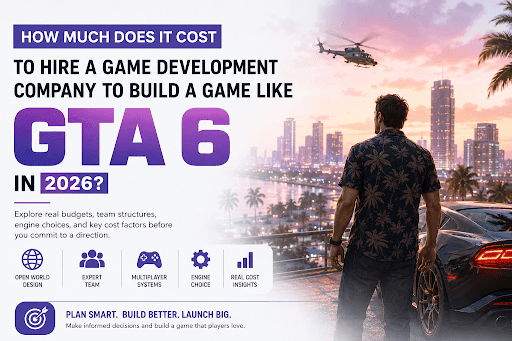
Nobody in the gaming industry was surprised when GTA 6 development costs crossed $2 billion. What surprised people was how that number entered mainstream conversation suddenly; everyone from startup founders to enterprise investors wanted to understand what large-scale game development actually costs, and whether something in that league was within reach.
The honest answer is: it depends almost entirely on decisions made in the first few months of a project. This guide walks through those decisions and what it normally costs for game development services.
Why does GTA 6 cost so much Money
Rockstar spent over a decade building GTA 6 with thousands of people across multiple studios. The budget reflects a living open world with AI-driven NPCs, a full multiplayer ecosystem, cinematic production quality, and a post-launch content infrastructure that was engineered in from day one, not added later.
That context matters because most teams asking about GTA-style development are not trying to replicate all of that. They want to understand which parts of that cost structure apply to their project, and which parts can be approached differently without gutting the product.
Where the Money Actually Goes
Open-World Design
This is almost always the biggest line item. Building a world that feels real means generating thousands of individual assets, programming NPC behavior across hundreds of character types, running physics systems continuously, and testing performance across different hardware. The studios that manage this well focus on density over scale; a smaller, richly detailed environment consistently outperforms a large empty one, and costs significantly less to build.
Engine Selection
In 2026, most serious projects are choosing between Unreal Engine and Unity. Unreal Engine game development makes sense when visual fidelity is central to the product; its rendering tools let smaller art teams achieve results that previously required much larger departments. Unity game development is the better fit when cross-platform game development across mobile, PC, and console is the goal. Wider talent availability, lower licensing costs at mid-scale, and faster iteration cycles make it practical for teams where reach matters more than raw visual quality.
Building the Right Team
A GTA-style project needs people with specific skills, such as systems programmers, AI engineers, 3D artists, character animation specialists, multiplayer developers, QA professionals, and someone experienced enough to manage the full game development lifecycle without losing control of scope. Assembling this team before production begins is genuinely one of the highest-leverage decisions in any project. Teams that get built mid-production spend months catching up.
Multiplayer Architecture
GTA Online generated billions for Rockstar over a decade. That kind of system server infrastructure, anti-cheat, real-time synchronization, live content pipelines, has to be designed into the game from the start. Studios that treat multiplayer game development as a feature to add later consistently run into expensive rework. It is infrastructure, not a module.
Characters and Animation
In any action-adventure or RPG game development project, character quality is one of the first things players notice and remember. Motion capture pipelines, facial animation systems, cloth and hair simulation, and unique NPC libraries. These are expensive, and the shortcuts are immediately visible. Reviews reflect it, and so does long-term player retention.
QA and Platform Certification
Game testing and QA get underbudgeted on almost every large project. A real QA operation means automated regression suites, platform certification compliance across PlayStation, Xbox, and PC storefronts, and structured performance profiling, not playthrough sessions. Getting this wrong means shipping a broken product into a launch window you cannot recover.
Monetization
How a game makes money shapes how it gets built. A one-time premium release, a live service model, and seasonal battle passes each carry different technical requirements and content pipeline demands. These decisions belong in pre-production, not after the game ships.
What Projects Actually Cost in 2026
| Scale | Timeline | Budget Range |
|---|---|---|
| Indie Open-World | 1 – 2 years | $300K – $1.5M |
| Mid-Tier Action-Adventure | 2 – 4 years | $3M – $20M |
| AAA Open-World RPG | 4 – 7 years | $20M – $150M |
| GTA 6 Scale | 7 – 10 years | $500M – $2B+ |
These cover development, game asset creation, infrastructure, QA, and game publishing costs. Marketing budgets are separate at the AAA scale; they routinely match production spend.
Choosing a Game Development Partner
Not every studio is equipped for a project of this scale. A few things worth evaluating before you commit:
Genre experience matters most: Look for a custom game development agency that has actually shipped open-world or action-adventure titles, not just an impressive general portfolio
Ask for relevant work: reels and case studies from similar projects tell you far more than agency credentials
Milestone-based pricing is a non-negotiable: structured contracts with defined deliverables protect both sides; open-ended billing on large projects almost always ends badly
Process transparency is a signal: studios running structured sprints with regular builds catch problems early; those that cannot describe their workflow tend to find problems late
End-to-end capability reduces risk: a partner covering the full game development lifecycle from pre-production through post-launch is worth more than managing three separate vendors
Post-launch planning should start now: studios that think beyond launch day build games that sustain revenue; ones that do not create expensive content scrambles later
TechReform works across the full production cycle from game design and development through multiplayer systems and post-launch support. For teams still figuring out scope and budget, an early conversation can save months of misdirection.