
How Much Does Mobile App Development Cost in 2026?
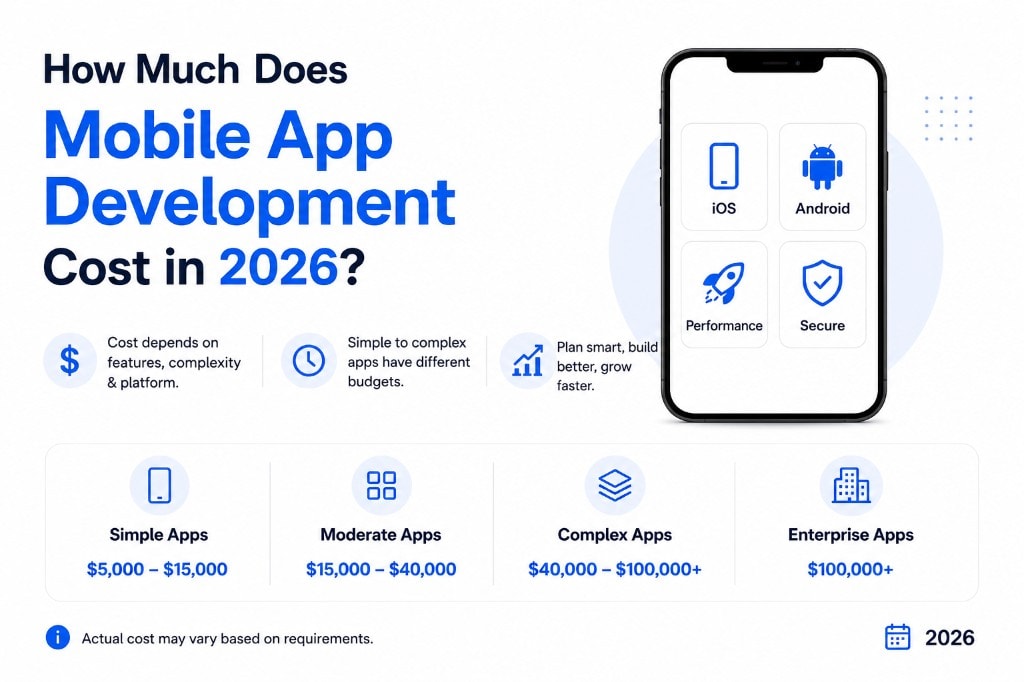
Let's Be Honest About the "How Much" Question
Ask ten different mobile app development companies how much an app costs, and you'll get ten different answers. Some say $10,000. Some say $500,000. Both are technically right, and that gap is exactly what makes this question so hard to research.
The cost of mobile app development in 2026 isn't something you'll find on a pricing page. It's the result of a real decision- platform, features, design depth, and team structure. This guide walks through every factor so you can have an informed conversation with any mobile app development company without drowning in vague estimates.
Average Mobile App Development Cost in 2026
Here's a realistic starting point:
| App Complexity | Estimated Cost |
|---|---|
| Simple / MVP | $10,000 – $50,000 |
| Mid-Level App | $50,000 – $150,000 |
| Complex / Enterprise App | $150,000 – $500,000+ |
These figures cover design, development, testing, and basic deployment. Post-launch maintenance and marketing are separate; we'll get to those.
What Actually Drives the Cost to Develop an App
Platform: Android, iOS, or Cross-Platform?
Going native on both Android and iOS means two separate codebases, essentially two projects running in parallel. Mobile app pricing for a dual-native build reflects that directly.
Flutter and React Native solve this. Both cross-platform frameworks deploy a single codebase across Android and iOS, typically cutting the cost to develop an app by 30–40% compared to dual native builds. For most app types, the performance difference is negligible. Unless your app needs deep hardware-level integration, cross-platform is almost always the smarter financial call in 2026.
Features and Complexity
This is where mobile app cost estimates diverge the most. A basic informational app is a completely different project from one handling real-time payments, IoT device connectivity, or AI-driven personalization.
Features that push up application development costs include real-time chat, payment gateways, GPS tracking, role-based access, cloud data sync, and wearable integration. The goal isn't to strip features out; it's to launch with what users genuinely need and build from there.
UI/UX Design
Design adds $5,000–$30,000 to the average cost of mobile app development and is consistently the most under-budgeted line item. Users judge an app within seconds. Clunky navigation doesn't get a second chance. Template-based design saves money upfront, but usually triggers expensive redesigns after launch when retention numbers disappoint.
Freelancer, Agency, or In-House?
This decision shapes outcomes more than most people realize.
Freelancers look cheapest on paper, but coordinating independent contractors across design, backend, and mobile is a project management burden with no real accountability after launch.
In-house teams offer control but carry high fixed costs, salaries, benefits, and a slow hiring process before development even starts.
Mobile app development services through an established agency bring a structured team, defined processes, and post-launch support under one roof. The hourly rate is higher, but the total cost of building an app without rework cycles is typically lower.
Regional rates also affect the overall mobile application development cost:
| Region | Approximate Hourly Rate |
|---|---|
| North America | $100 – $200/hr |
| Western Europe | $80 – $150/hr |
| Eastern Europe | $40 – $80/hr |
| South/Southeast Asia | $20 – $50/hr |
Cloud Infrastructure and IoT
Any app storing user data or processing transactions needs a backend. Cloud hosting on AWS, Google Cloud, or Azure starts at $50–$300/month for early-stage apps and scales with usage.
IoT integration, connecting your app to wearables, smart sensors, or connected vehicles, adds real complexity to the cost of building an application. Communication protocols, security architecture, and data handling all need proper planning from day one to avoid expensive rebuilds later.
Cost Breakdown by Development Phase
Most app cost guides skip this entirely. Understanding how the budget is distributed across phases helps you evaluate quotes properly.
- Discovery & Planning (10–15%): Wireframes, scoping, architecture. Skipping this is how projects blow their budget.
- UI/UX Design (15–20%): Prototypes, visual design, interaction flows.
- Development (50–60%): Frontend, backend, API integrations, platform builds.
- QA & Testing (10–15%): Functional, performance, and device compatibility testing.
- Deployment & Launch (5%): App store submissions and go-live support.
- If a vendor gives you a flat number with no phase breakdown, that's worth questioning.
Mobile App Cost by Industry
The cost of a mobile app varies significantly depending on the industry, primarily because each sector carries its own compliance requirements, integration complexity, and feature expectations.
- Retail & eCommerce: $30,000 – $150,000+ — Product catalogs, payment systems, and order tracking.
- Healthcare: $60,000 – $300,000+ — Compliance, EHR integrations, and IoT wearable connectivity push this higher.
- Real Estate: $40,000 – $180,000 — Listings, virtual tours, map integration, and mortgage tools.
- Food & Delivery: $25,000 – $120,000 — Ordering systems, real-time tracking, and kitchen management.
- Fintech: $80,000 – $400,000+ — Security, compliance, and real-time processing make this the most investment-heavy category.
- Fitness: $30,000 – $130,000 — Wearable sync, workout libraries, and subscription billing.
- Insurance: $50,000 – $200,000 — Policy management, claims processing, and document handling.
- Dating: $40,000 – $170,000 — Matching logic, real-time messaging, and moderation systems.
- Entertainment: $35,000 – $200,000+ — Streaming infrastructure and content delivery vary widely.
- Event Management: $25,000 – $100,000 — Ticketing, scheduling, and QR check-in.
- Car Wash & Automotive: $15,000 – $60,000 — Booking, loyalty programs, and location features.
- Enterprise: $100,000 – $500,000+ — Custom workflows, complex integrations, and compliance requirements.
How to Reduce App Development Cost Without Cutting Corners
- Start with an MVP. Build the core features that solve the primary problem. The cost of creating an app based on assumptions is almost always higher than building a focused MVP and iterating from real feedback.
- Go cross-platform. Flutter or React Native delivers a comparable experience at significantly lower mobile app pricing for most use cases. It's the single most effective way to reduce the cost of making an app without sacrificing quality.
- Don't skip discovery. Fixing something misunderstood at the planning stage costs far more than getting it right up front. A proper scoping process pays for itself.
- Take QA seriously. A bug found in testing costs a fraction of what it costs when a user finds it publicly. A broken app on the App Store is a reputation problem before it's a technical one.
Hidden Costs After Launch
The cost to create an app doesn't end at launch. These are what catch first-time app owners off guard:
- Maintenance: Budget 15–20% of your original development cost annually for OS updates, security patches, and bug fixes.
- App Store fees: Apple charges $99/year. Google Play is a one-time $25 fee.
- Scaling infrastructure: More users mean higher cloud costs. Build with this in mind from the start.
- Marketing and ASO: Getting the app discovered is a separate investment from building it.
For a $60,000 app, realistic annual upkeep runs $10,000–$15,000 before any active new development.
Choosing the Right Mobile App Development Company
The team you choose has more influence over the final outcome than any other single factor. Look for real portfolio depth in your industry, fluency across modern frameworks, transparent scoping, and genuine post-launch support.
Techreforms provides end-to-end mobile app development in usa across Android, iOS, Flutter, React Native, cross-platform, cloud, and IoT, serving industries including fintech, healthcare, real estate, eCommerce, fitness, insurance, enterprise, dating, entertainment, automotive, and more. Every project starts with honest scoping: understanding what the business actually needs before writing a single line of code. That's what keeps projects on budget and built to last.