
How Much Does Restaurant App Development Cost?
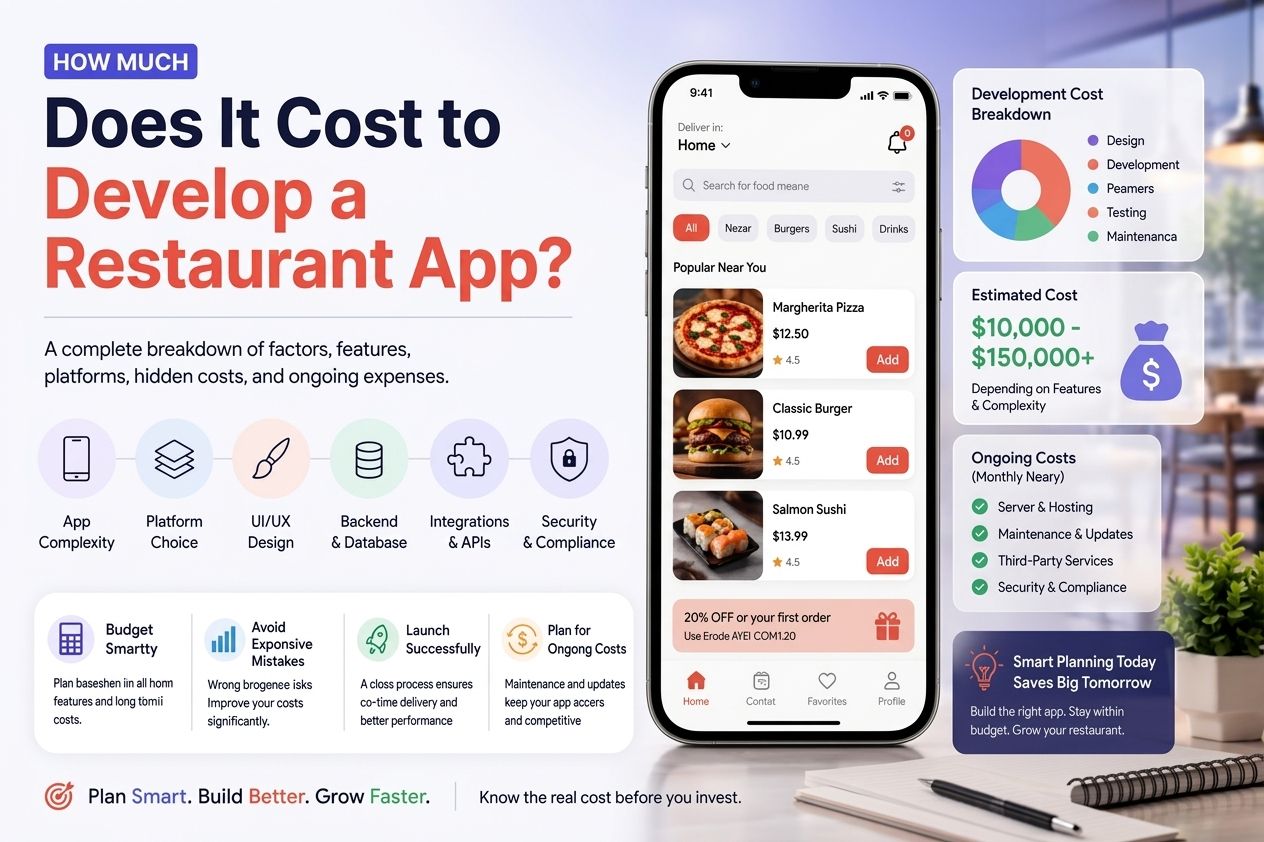
The global Meal Delivery market is expected to reach around 2.5 billion users by 2030, according to Statista, the global Meal Delivery market is on track to reach 2.5 billion users within this decade. Restaurants that ignore this shift are already falling behind.
Platforms like Uber Eats, DoorDash, and Glovo have already proven the model works. Now local restaurants, growing food chains, and grocery brands are all moving in the same direction. They want their own apps. They want direct orders, loyal customers, and freedom from third-party commissions. But one question most owners often ask is: How much does restaurant app development actually cost?
The cost of restaurant app development services depends on your feature list, platform choice, and technology stack. Hidden costs also show up later and catch many owners off guard. Understanding these factors upfront helps you budget smartly. It also helps you avoid expensive mistakes that will cost you later.
In our blog, we cover average app prices from your first MVP to a full-scale multi-location platform, so you know exactly where your budget goes and what you get in return.
Core Factors That Impact Restaurant App Development Cost
Building an app is not a fixed-price decision. Every choice you make, from features to platforms, directly affects your food delivery app development cost.
App Complexity and Feature Scope
A simple app and a complex platform share one thing: both start with a feature list. That list controls everything. The longer it gets, the more your app development budget grows. Feature scope is the first number that moves your total cost.
| Feature Tier | Features Included | Estimated Cost |
|---|---|---|
| Basic | Digital menu, table booking, user registration, push notifications, ratings | $10,000 – $25,000 |
| Intermediate | Online payments, order tracking, loyalty programs, coupon management, admin dashboard | $25,000 – $60,000 |
| Advanced | AI recommendations, geolocation, multi-restaurant management, AR menus, cloud kitchen integration | $60,000 – $150,000+ |
Platform Choice
Your platform decision hits your budget before a single line of code is written. Android covers more devices, so testing takes longer and costs more. iOS moves faster but comes with strict App Store rules. Cross-platform development can reduce duplicated development effort and may lower costs when targeting both iOS and Android.
Quality of UI/UX Design
Users judge your app in three seconds. First impressions decide if they stay or leave. Here is what drives your UI/UX cost:
- Custom animations and transitions.
- Brand colors, fonts, and logo work.
- Food photography and menu visuals.
- User flow and navigation testing.
- Mobile screen responsiveness.
Backend Infrastructure & Database
Your backend is the core of your app. It processes every order, stores user profiles, and handles payments in real time. Building it right costs money. Skipping corners costs more. Peak hours and holiday rushes hit hard, and only a strong backend survives. More users mean more load, and more load means higher backend costs.
Integration with Third-Party
Third-party integrations in the smart restaurant mobile application improve the features your users expect most. However, each integration adds to your total development cost.
- Payment Gateways (Stripe, Razorpay, PayPal).
- Delivery APIs (Google Maps, Route Optimization).
- CRM Systems for customer data.
- Marketing Platforms for email and SMS campaigns.
Project Timeline
Every extra feature you add extends the timeline. A long timeline means more developer hours. More hours mean a costly invoice. A basic restaurant app takes 3 to 4 months. Add delivery tracking, loyalty programs, and multi-location support, and that timeline stretches to 9 months or more. Every added month pushes your total cost.
Maintenance and Updates
Launching your app is not the finish line. It is the starting point. Technology moves fast. AI features evolve. OS updates roll out. User expectations shift constantly. Regular maintenance keeps your app secure and fast. And every update you need means your development team gets back to work. That ongoing relationship with developers is a real and recurring cost most owners underestimate.
Compliance and Data Security
Your application collects sensitive data, including card numbers, home addresses, and order histories. Protecting that data is not optional. GDPR, PCI DSS, and local data protection laws require proper encryption, secure authentication, and regular audits. Each compliance layer adds development hours. Those hours add to your final bill. Skipping compliance saves money now but costs far more after a breach.
Restaurant App Development Cost by Category
The app type you pick decides your budget before development even starts. Here are the three main categories.
Food Ordering & Delivery Apps
Food and delivery apps are the most complex to build. They connect customers and restaurants and work in real time. Every order placed, tracked, and delivered runs through layers of backend logic that directly affect the development cost.
| App Type | Approx. Cost (USD) | Development Timeframe |
|---|---|---|
| Single-Restaurant Ordering App | $35,000 – $70,000 | 3–4 months |
| Multi-Restaurant Aggregator App | $70,000 – $120,000 | 5–8 months |
| Full Platform (AI + Loyalty + Multi-City) | $140,000 – $240,000+ | 8–12 months |
Table Booking & Dine-In Apps
Dine-in apps focus on one thing: filling tables. Customers browse availability, pick a time, and confirm in seconds. Simple to use on the front end, but the backend logic for real-time seat management adds huge cost.
| App Complexity | Estimated Cost (USD) |
|---|---|
| Basic Reservation System | $20,000 – $40,000 |
| Advanced with Pre-Order & Payment | $40,000 – $80,000 |
| Enterprise with CRM & Multi-Location | $80,000 – $150,000+ |
Customer Loyalty & Rewards Apps
Winning a new customer costs five times more than keeping an existing one. A loyalty rewards app turns one-time buyers into regulars through points, perks, and exclusive offers. Building one adds to your overall budget, but the long-term return on retention makes it worth every dollar.
| App Type | Estimated Cost (USD) |
|---|---|
| Basic Loyalty System | $30,000 – $50,000 |
| Mid-Tier with Referral & Redemption Programs | $50,000 – $100,000 |
| Advanced AI-Driven Rewards App | $100,000 – $250,000+ |
Restaurant App Feature Development Cost Breakdown
We covered app types and their costs. Now let's talk about feature costs. The restaurant mobile app features have their own price tag. The more complex it gets, the more it adds to your final bill. Here is exactly what each one costs.
| Feature | Complexity | Estimated Cost (USD) |
|---|---|---|
| User Registration & Login | Low | $500 – $1,500 |
| Menu Management | Medium | $1,000 – $2,500 |
| Payment Gateway Integration | High | $1,500 – $4,000 |
| Real-Time GPS Order Tracking | High | $25,000 – $50,000 |
| Push Notifications | Medium | $500 – $1,500 |
| Loyalty & Rewards System | High | $3,000 – $6,000 |
| Admin Dashboard | High | $4,000 – $10,000 |
| Multi-Language Support | Medium | $1,500 – $4,000 |
| AI Recommendations | High | $3,000 – $8,000 |
| Table Reservation System | Medium | $2,000 – $4,000 |
| Customer Analytics & Reports | High | $3,000 – $7,000 |
| In-App Chat or Chatbot | High | $3,000 – $6,000 |
| Delivery Partner Module | Very High | $30,000 – $60,000 |
These are broad estimates. Final costs vary based on scope, technology, integrations, location, and development team.
Freelancer vs Agency: Restaurant App Development Cost
Choosing the right team affects your budget. Before you hire anyone, understand what each option actually costs you in time, control, and money.
Hiring a Freelancer
- Lower hourly rates ranging from $20 to $80 depending on location.
- Flexible engagement with no long-term commitment.
- Best suited for small projects or specific feature builds.
- Communication gaps and time zone differences can slow progress.
- No guaranteed availability once the project wraps up.
Hiring a Development Agency
- Experienced restaurant app developers handle design, development, and testing under one roof.
- Higher cost but faster delivery with a structured team.
- A dedicated project manager keeps communication clear and on track.
- Best suited for complex, multi-feature builds that need long-term support.
- Agencies provide post-launch maintenance, which freelancers often skip.
How the Restaurant App Development Process Works
Building an online food ordering app is not a one-step process. Each phase has its own timeline, team requirements, and cost.
Research Phase
Every successful app starts with in-depth research. This stage defines the "why," "what," and "how" behind your mobile application. The team studies the market, analyzes competitors, and maps out user needs. It sounds simple, but skipping it is the fastest way to build the wrong product.
UI/UX Design
After the research, designers turn ideas into visual prototypes. A user-friendly interface makes menu browsing, ordering, and table booking feel effortless. In the restaurant space, good design directly affects how long users stay and how often they return.
Frontend & Backend Development
This is where your app comes to life. Frontend developers build everything users see and tap. Backend developers power everything running behind the screen. Orders get processed, user data gets stored, and menus stay updated in real time. At this stage, payment gateway integration connects your app to secure transaction systems. When both work in sync, your app runs without friction.
API & Third-Party Integrations
Not every restaurant app needs API and third-party integrations. It depends on your budget, business scale, and feature requirements. Small or new restaurants often launch with a basic setup. Larger chains and growing brands rely on integrations to handle payments and manage customer data at scale.
QA & Testing
Before your app goes live, QA engineers put it through every possible scenario. They test broken links, slow load times, payment failures, and order glitches. One bug at checkout costs you a customer. Thorough testing catches problems before users do. This stage protects your reputation and saves you from expensive post-launch fixes.
Launch & Deployment
Testing done, your application is ready to go live. Developers deploy it to the App Store and Google Play. This stage also covers server setup, domain configuration, and final performance checks. A smooth launch takes careful coordination between your team and your hosting infrastructure to ensure everything runs on day one.
What Mistakes Can Increase Restaurant App Development Costs?
Most restaurant applications go over budget because of avoidable decisions made early in the process. Here is what drives costs higher than planned.
- Skipping the research phase to save time upfront.
- Adding too many features before testing the core product.
- Choosing the cheapest developer without checking their past work.
- Ignoring post-launch maintenance costs during budget planning.
- Changing requirements mid-development, which restarts entire modules.
Why Choose TechReforms as Your Restaurant Mobile App Development Partner?
Now you have a complete picture of what restaurant application development actually costs. The next step is finding a team that delivers without hidden charges or surprise invoices. That is where TechReforms comes in.
We bring years of hands-on mobile app development experience to every project. Our developers have built apps across multiple markets and understand exactly what drives costs up and how to keep them in check. We work with clear pricing, defined timelines, and zero hidden fees. We test, optimize, and deliver every project on time.
Conclusion
Every dollar you spend on your food ordering platform should have a purpose. Features, platform choices, team structure, and ongoing app maintenance costs all determine what you pay at the end. We covered app types, feature pricing, development phases, and the mistakes that push budgets over the limit. Now you know exactly where your money goes and why it matters. Ready to build? TechReforms brings the experience, transparency, and technical depth your project deserves. Reach out today and let's get started.