
How to Build a Future-Ready Doctor App in 2026
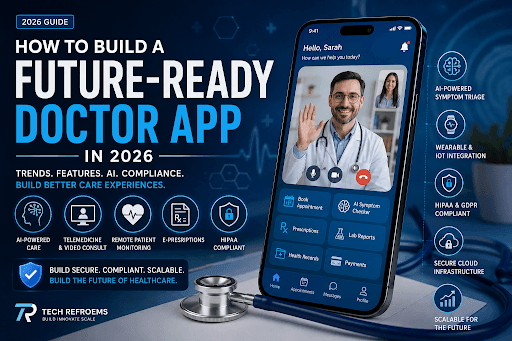
Healthcare has quietly become a digital-first industry. Patients now expect to book a consultation, talk to a physician on video, receive an e-prescription, and pay their bill all from a single screen. That expectation is exactly why doctor app development has moved from a "nice-to-have" investment to a core growth strategy for clinics, hospitals, and health-tech startups in 2026.
But here's the catch: most doctor apps launched over the past five years already feel outdated. They were built for appointment booking, not for AI-assisted care, wearable data, or voice-driven interactions. Building a future-ready doctor app means designing for where healthcare is going, not where it's been.
At Tech Refroems, we've helped healthcare organizations plan, build, and scale telemedicine platforms and on-demand doctor apps. This guide distills that hands-on experience into a practical roadmap you can actually follow.
What Is a Doctor App in 2026?
A modern doctor app is no longer a simple doctor appointment booking app. It's a connected digital care platform that typically combines:
- Telemedicine and video consultations with in-app chat and secure file sharing
- AI-powered symptom checkers that triage patients before they ever meet a physician
- Electronic Health Record (EHR) integration so doctors see complete patient history
- E-prescriptions and pharmacy connectivity
- Remote patient monitoring (RPM) through wearables and IoT medical devices
- Digital payments, insurance claims, and billing automation
In short, the app becomes the front door to the entire care journey discovery, diagnosis, treatment, follow-up, and payment.
Why 2026 Is a Turning Point for Healthcare Apps
Three shifts make this year different from any before it.
1. AI has moved from experiment to expectation
Patients and providers now treat AI-driven features smart triage, clinical documentation assistants, medication interaction alerts as standard. Apps without intelligent features feel incomplete, the way an app without push notifications felt a decade ago.
2. Regulators have caught up
Data privacy frameworks such as HIPAA (US), GDPR (EU), and regional health-data laws are being enforced more aggressively, and AI-specific healthcare regulations are emerging. Compliance is no longer a checkbox at launch; it's an architectural decision made on day one.
3. Answer engines are the new search engines
Patients increasingly find healthcare providers through AI assistants and answer engines, not just Google's ten blue links. A future-ready doctor app strategy includes structured data, verified provider profiles, and content designed to be cited the foundations of AEO (Answer Engine Optimization) and GEO (Generative Engine Optimization).
Step-by-Step: How to Build a Future-Ready Doctor App
Step 1: Validate the problem, not just the idea
Start with a narrow, painful problem. Are patients in your region struggling with specialist wait times? Are chronic-care patients missing follow-ups? A doctor app that solves one problem exceptionally well will always outperform a bloated "super app" at launch. Interview physicians, clinic administrators, and patients before writing a single line of code.
Step 2: Choose the right app model
Most healthcare mobile app projects fall into one of four models:
- Clinic/hospital-branded apps — extending an existing practice digitally
- On-demand doctor app marketplaces — aggregating independent physicians
- Specialty-focused telehealth apps — dermatology, mental health, women's health
- Chronic care & RPM platforms — continuous monitoring for diabetes, cardiac care, and more
Your model determines everything downstream: features, compliance scope, monetization, and technology stack.
Step 3: Define the must-have features
A future-ready feature set for 2026 typically includes:
For patients: smart onboarding, AI symptom triage, doctor search with verified credentials, video/audio/chat consultations, e-prescriptions, lab report uploads, medication reminders, and multilingual support.
For doctors: calendar and availability management, AI-assisted clinical notes, patient history dashboards, secure messaging, and earnings analytics.
For admins: provider verification workflows, revenue reporting, dispute handling, and audit logs.
Resist the urge to build everything at once. Ship a focused MVP, then expand based on real usage data.
Step 4: Design for trust and accessibility
Healthcare UX design carries higher stakes than any other category. Users are often anxious, unwell, or elderly. Prioritize large touch targets, plain-language copy, dark-mode support, screen-reader compatibility, and a booking flow that takes under 60 seconds. Trust signals verified doctor badges, transparent pricing, visible security certifications directly influence conversion.
Step 5: Get the architecture and tech stack right
A future-ready architecture in 2026 usually looks like this:
- Frontend: Flutter or React Native for cross-platform development, or native Swift/Kotlin for performance-critical apps
- Backend: Node.js, Python, or Go with a microservices architecture for scalability
- Real-time communication: WebRTC-based video infrastructure with end-to-end encryption
- Interoperability: HL7 FHIR APIs for EHR integration
- AI layer: LLM-powered triage and documentation tools with human-in-the-loop safeguards
- Cloud: HIPAA-eligible hosting on AWS, Azure, or Google Cloud with regional data residency
Interoperability deserves special emphasis. An app that can't exchange data with hospital systems, labs, and pharmacies will hit a growth ceiling fast.
Step 6: Build compliance into the foundation
Security and compliance in healthcare app development are non-negotiable:
- End-to-end encryption for data in transit and at rest
- Role-based access control and multi-factor authentication
- Detailed audit trails for every data access event
- Signed Business Associate Agreements (BAAs) with all vendors
- Explicit patient consent flows for data sharing and AI features
Engaging experienced doctor app development services early is the most reliable way to avoid the costly rework that comes from retrofitting compliance after launch.
Step 7: Test with real clinical workflows
Standard QA isn't enough. Run pilot programs with actual doctors and patients, test video quality on low-bandwidth networks, simulate emergency escalation paths, and validate AI triage outputs against clinical review. Load-test for appointment surges Monday mornings in healthcare are brutal.
Step 8: Launch, measure, and iterate
Track metrics that matter: consultation completion rate, average booking time, patient retention at 30/90 days, doctor utilization, and Net Promoter Score. Feed these insights into a quarterly roadmap. The best healthcare apps in 2026 ship meaningful improvements every few weeks, not every few years.
How Much Does It Cost to Build a Doctor App in 2026?
Costs vary widely by scope and region, but as a realistic benchmark:
| App Scope | Estimated Cost | Timeline |
|---|---|---|
| MVP (Booking + Video Consultations) | $30,000–$60,000 | 3–4 months |
| Mid-Range Platform (AI Triage, EHR, Payments) | $60,000–$150,000 | 5–8 months |
| Enterprise Platform (Remote Patient Monitoring, Multi-Region, Full Compliance) | $150,000–$400,000+ | 9–14 months |
Ongoing costs for cloud infrastructure, third-party APIs, compliance audits, and support typically run 15–25% of the initial build cost per year.
Future Trends to Design For
- Ambient AI documentation that writes clinical notes from consultation audio
- Predictive care using wearable data to flag risks before symptoms appear
- Voice-first interfaces for elderly and accessibility-focused users
- Hyper-personalized care plans generated from longitudinal patient data
- Blockchain-backed consent and health-record portability
You don't need to build all of these on day one, but your architecture should never block them.
Why Partner with Tech Refroems
Building a doctor app in usa is equal parts product design, engineering, and regulatory navigation. Tech Refroems brings all three together: healthcare-domain UX expertise, secure and interoperable engineering, and compliance-first delivery. Whether you're a clinic going digital or a startup building the next telehealth marketplace, our team helps you move from concept to a scalable, future-ready product without the guesswork.
Ready to build? Talk to TechReforms about your doctor app vision today.