
Is VR Still Relevant in 2026?
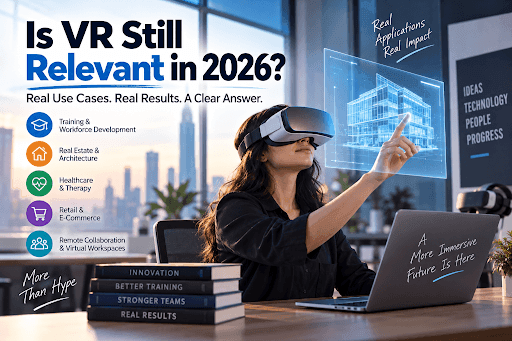
Remember when virtual reality was going to change everything and then suddenly it felt like nobody was talking about it anymore? That cycle of hype and silence has left a lot of business owners and decision-makers genuinely confused. Is VR actually delivering results, or is it an expensive experiment that never quite landed? The answer might surprise you. Businesses investing in VR development services today are seeing real returns in training, sales, healthcare, and customer experience. This guide cuts through the noise, looks at where VR stands in 2026, and helps you decide whether it belongs in your business strategy.
The VR Hype Cycle And Where We Actually Are Now
Every transformative technology goes through the same pattern: explosive excitement, inevitable disappointment, quiet maturation, and then real, sustainable adoption. VR has completed that full cycle.
The early years were dominated by consumer gaming headsets and overpromised metaverse visions that never materialized the way their architects predicted. That created understandable skepticism. But while the headlines moved on, something important happened quietly: VR became genuinely useful.
Hardware got lighter. Costs came down dramatically. Enterprise adoption accelerated. And the use cases that actually work training simulations, virtual product demos, remote collaboration, therapeutic applications have proven their value with measurable data.
VR in 2026 isn't the VR of 2019. It's more mature, more practical, and more accessible than it's ever been
Where VR Is Delivering Real Results in 2026
1. Corporate Training and Workforce Development
This is arguably the strongest VR use case of the decade. Companies across manufacturing, healthcare, aviation, and retail are using VR to train employees in high-stakes scenarios without the cost or risk of real-world practice.
The results are compelling:
- Employees trained in VR demonstrate significantly higher knowledge retention compared to traditional methods
- Training time is reduced by 40 to 60 percent in many documented enterprise deployments
- Costly errors during real-world onboarding decrease measurably
For industries where a mistake costs lives, or millions of dollars, surgical training, heavy equipment operation, and emergency response VR isn't a nice-to-have. It's becoming the standard.
2. Real Estate and Architecture
Virtual property tours have moved from novelty to expectation in the US real estate market. Buyers, particularly those relocating from another state, now routinely expect to walk through a property virtually before committing to an in-person visit.
For architects and developers, VR allows clients to experience a building before a single foundation is poured. Design changes that would cost thousands to make during construction cost almost nothing to make in a virtual environment.
3. Healthcare and Therapy
VR therapy for PTSD, anxiety disorders, and chronic pain management has moved from clinical trials into mainstream treatment protocols. The US Department of Veterans Affairs has deployed VR therapy programs at scale. Medical schools are using VR for anatomy education and surgical simulation.
This is one of the fastest-growing segments of the VR market and one where the human impact is genuinely profound.
4. Retail and E-Commerce
Virtual try-on, immersive product demos, and VR showrooms are giving retailers measurable lifts in purchase confidence and reductions in return rates. Furniture brands, automotive companies, and fashion retailers are among the early adopters seeing the strongest ROI.
5. Remote Collaboration and Virtual Workspaces
With distributed teams now a permanent feature of American business, VR collaboration platforms are offering something video calls fundamentally cannot: spatial presence. The feeling of being in the same room even when your team is spread across five time zones changes the quality of creative and strategic work in ways that are difficult to quantify but easy to feel.
What's Holding Some Businesses Back And Whether It Should Hold You Back
The Cost Concern
VR development has become significantly more affordable since 2020. A well-scoped VR training module or product demo that might have cost $150,000 to build five years ago can now be developed for $30,000 to $80,000 depending on complexity. The hardware cost per headset has also dropped substantially.
The real question isn't whether VR is expensive. It's whether the ROI justifies the investment, and for most enterprise applications, the math works.
The Adoption Concern
Getting employees or customers to actually use VR is a legitimate challenge. The businesses that succeed with VR invest in onboarding, keep experiences short and purposeful, and measure engagement data obsessively. The ones that fail treat VR as a one-time installation rather than an ongoing experience that needs iteration.
The "Is This Just a Trend?" Concern
This one deserves a direct answer: no. The global VR market is projected to exceed $70 billion by 2028. Major technology companies Apple, Meta, Sony, and Microsoft are all deepening their VR investments, not retreating from them. The enterprise adoption curve is accelerating, not flattening.
Is VR Right for Your Business? A Quick Self-Assessment
Ask yourself these questions:
- Do you train employees in high-risk or high-cost scenarios?
- Do your customers make purchase decisions that benefit from spatial visualization?
- Do you have remote teams who need richer collaboration than video calls provide?
- Are you in healthcare, real estate, manufacturing, education, or retail?
- Do you want to differentiate your brand experience in a crowded market?
If you answered yes to two or more of these, VR deserves a serious conversation, not a dismissal based on headlines from 2021.
Why TechReforms Is the VR Partner Serious Businesses Choose
Here's where most VR development agency conversations go wrong: a business gets excited about VR, contacts a generalist app development shop, and ends up with an underwhelming experience that confirms their skepticism and wastes their budget.
TechReforms is built differently. As a dedicated VR development company with deep roots in enterprise and commercial VR, TechReforms brings strategic thinking to every project, not just technical execution. They don't build VR experiences for the sake of novelty. They build VR solutions that solve specific business problems and deliver measurable outcomes.
For businesses across the USA looking for a VR development USA partner that understands both the technology and the commercial reality behind it, TechReforms offers:
Core VR Services:
- Custom VR training simulations for manufacturing, healthcare, retail, and corporate
- VR product visualization and virtual showrooms
- Architectural and real estate VR walkthroughs
- VR therapy and wellness applications
- Remote collaboration environment development
- Cross-platform VR deployment: Meta Quest, Apple Vision Pro, PC VR
What Makes TechReforms Different:
- Every project starts with a business outcome, not a technology choice
- Transparent, milestone-based delivery with no surprise costs
- In-house design, development, and QA no outsourced corners
- Post-launch optimization included as standard
- Proven track record across multiple US industries
If you're evaluating VR for your business and want an honest assessment of what's possible, what it costs, and what ROI looks like for your specific use case, TechReforms is the conversation worth having first.
The Bottom Line: Is VR Still Relevant in 2026?
Yes. Unambiguously yes, but with important nuance.
VR is not relevant as a gimmick. It's not relevant as a flashy trade show demo that lives in a glass case. It's relevant as a practical business tool that solves real problems in training, visualization, healthcare, retail, and collaboration.
The businesses getting the most out of VR in 2026 are the ones who approached it strategically with clear objectives, the right development partner, and a commitment to measuring results.
The ones still sitting on the sidelines, waiting for VR to "prove itself," are watching their competitors move ahead.
VR has moved past the question of whether it works. The only question now is whether you're ready to use it. If the answer is yes, make sure the team you choose understands your business as well as they understand the technology.