
Questions an App Development Company Should Ask You (and Why It Matters If They Don’t)
If an agency quotes your app after a 15-minute call, be worried. A fast quote feels exciting, but it’s usually a guess.
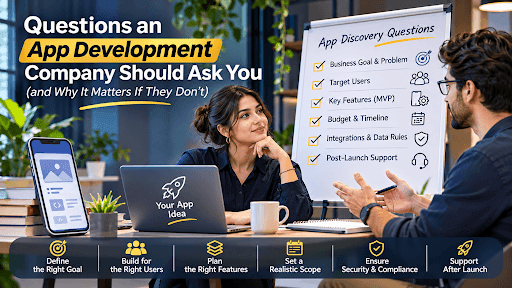
Here’s the short answer. Before any work begins, a reliable partner offering app development services should ask about your business goal, your users, your must-have features, your budget and timeline, your integrations and data rules, and what happens after launch.
These questions shape your cost, your timeline and whether the finished app actually works for your business. When a company skips them, you pay for it later. This guide shows you what to expect, how to prepare and how to spot a team that’s guessing.
What Questions Should an App Development Company Ask Before Giving You a Quote?
A serious app development company asks enough questions to understand your business, not just your feature list. The quote should come after that conversation, not before it.
This isn’t a small detail. In PMI’s Pulse of the Profession research, 37% of organizations named inaccurate requirements as the main reason their projects failed. The same research found that poor requirements management was behind 47% of unmet project goals.
Good questions at the start are how requirements get right. Here’s an overview of the ones that matter most:
| Question they should ask | Why it matters | Risk if they skip it |
|---|---|---|
| What problem does the app solve? | Ties every feature to a business goal | You pay for features nobody uses |
| Who are your users? | Shapes design, platform and accessibility | The app feels wrong for your audience |
| How will you measure success? | Sets clear targets before development | No way to tell if the app is working |
| What must be in version one? | Controls cost and speeds up launch | Budget runs out before launch |
| What systems must it connect to? | Uncovers hidden technical work early | Surprise costs halfway through |
| What data will you collect? | Flags privacy and compliance needs | Legal and security exposure |
| What’s your budget and deadline? | Lets the team plan a realistic scope | Unrealistic promises and missed dates |
| What happens after launch? | Plans for updates, fixes and growth | The app breaks with the next OS update |
Let’s walk through each group of questions and why it matters to you.
What Business Questions Should an App Developer Ask First?
The first questions should be about your business, not about code. An app is a business tool, and a developer who doesn’t understand the business can’t build the right tool.
What Problem Does Your App Solve, and for Whom?
This is the most important question in the whole process. A clear answer keeps the project focused when new feature ideas start piling up.
A good team will push past “we need an app.” They’ll ask what’s broken today, who feels that pain and what changes once the app exists.
How Will You Measure Success?
Success should be defined before development starts. It might be downloads, bookings, fewer support calls, faster order processing or monthly revenue.
These targets, often called KPIs, decide which features matter most. They also tell the team which analytics to build in from day one.
How Will the App Make Money or Save Money?
Your revenue model changes the build. Subscriptions, in-app purchases, ads and paid downloads each need different screens, payment logic and app store rules.
Internal business apps work differently. For those, a good developer will ask how much time or money the app should save your team.
What Should an App Development Agency Ask About Your Users and Features?
Once the business goal is clear, the questions shift to the people using your app and the features they need. This is where your scope and budget really take shape.
Who Are Your Users, and What Devices Do They Use?
Your audience decides your platform. A consumer app for US users may need both iOS and Android, while an internal tool for a sales team might only need one.
A good app development agency will also ask about age, comfort with technology and accessibility needs. These details affect everything from font size to navigation.
Should You Build Native or Cross-Platform?
This question usually follows the one about devices. Native apps are built separately for iOS and Android, while cross-platform frameworks share much of one codebase across both.
There’s no single right answer. The best choice depends on your performance needs, budget and timeline, and a trustworthy developer will explain the trade-offs instead of pushing whatever they prefer to build.
What Must Be in Version One?
Most successful apps launch as a minimum viable product, or MVP. That’s the smallest version that solves the core problem well enough for real users.
A good developer will help you sort your ideas into three groups:
- Must-have: features the app can’t launch without.
- Should-have: features that add clear value soon after launch.
- Nice-to-have: ideas worth testing once real users give feedback.
This one exercise can cut months and tens of thousands of dollars from your first release.
What Technical and Security Questions Should They Ask?
Technical questions reveal hidden work early. Skipping them is how a “simple” app turns into an expensive surprise halfway through the project.
What Systems Does the App Need to Connect With?
Many apps need to talk to other software. Common examples include payment processors, CRMs, scheduling tools, inventory systems and existing websites.
Each connection, usually built through an API, adds time and testing. A developer who doesn’t ask about integrations can’t give you an honest estimate.
What Data Will You Collect, and What Rules Apply?
This question protects your business. Depending on your industry and users, US apps may need to follow rules such as HIPAA for health information, COPPA for children under 13 and California’s privacy laws for consumer data.
A careful team will ask what personal data you plan to store, where it will live and who can access it. They’ll also ask about login security, encryption and how user data gets deleted on request.
Do You Have Existing Designs, Brand Guidelines or Code?
Existing assets can speed things up or slow them down. Brand guidelines save design time, while old code may need a review before anyone builds on it.
A good team asks to see what you already have. They’ll tell you honestly what’s worth keeping and what should be rebuilt.
What Should They Ask About Budget, Timeline and Ownership?
Some clients feel uneasy when a developer asks about budget. In reality, it’s a good sign, because it shows the team wants to fit the plan to your situation instead of padding a quote.
What Is Your Budget Range and Deadline?
Your budget doesn’t need to be exact. A range lets the team recommend the right scope, platform and launch plan for what you can invest.
Your deadline matters just as much. If you’re tied to a trade show, a funding round or a seasonal launch, the team needs to plan backward from that date.
How Do You Prefer to Work Together?
A good developer will ask how involved you want to be. Some clients want weekly demos, while others prefer a short update and a monthly review.
They should also explain their pricing model. Fixed-price contracts suit well-defined projects, while time-and-materials billing gives more flexibility when requirements are likely to change.
Who Will Own the Code and Accounts?
This question should come up before you sign anything. You want clear ownership of your source code, design files, app store accounts and hosting.
If a developer never raises ownership, raise it yourself. Your contract should state in writing what you own once the project is paid for.
What Happens After Launch?
Apps need care after release. Apple and Google update their operating systems every year, and apps that aren’t maintained can slow down, crash or fall out of line with store requirements.
A good team asks whether you want a maintenance plan, who will handle bug fixes and how new features will be added over time.
What Does It Mean If an App Developer Doesn’t Ask These Questions?
It usually means they’re guessing. And guessing in software is expensive, because every wrong assumption has to be fixed later, often after the budget is already spent.
Here’s how to tell the difference during your first few conversations:
| Green flag | Red flag |
|---|---|
| Asks about your business goal before features | Jumps straight to price and screens |
| Recommends an MVP and phased launch | Says “yes” to every feature without discussion |
| Asks about integrations and data | Never mentions security or compliance |
| Gives a range after discovery | Gives a fixed price on the first call |
| Explains trade-offs in plain English | Uses jargon to avoid direct answers |
| Talks about post-launch support | Treats launch day as the finish line |
If you see three or more red flags, keep looking. The cheapest quote often becomes the most expensive project once change requests start rolling in.
How Can You Prepare for Your First Call With an App Development Company?
You don’t need a technical document to get started. A few clear answers will make your first call far more productive and your estimate far more accurate.
Use this quick prep sheet before you talk to any developer:
| Topic | What to have ready |
|---|---|
| Goal | One or two sentences on the problem your app solves |
| Users | Who they are and which devices they use |
| Features | Your top five must-have features |
| Examples | Two or three apps you like, and why |
| Integrations | Any software the app must connect with |
| Data | What personal or sensitive data the app will handle |
| Budget | A realistic range, even if it’s broad |
| Timeline | Your ideal launch date and any fixed deadlines |
Don’t worry if some answers are unclear. Helping you work through them is part of what a good app developer in the USA should do.
Which Questions Should You Ask the App Development Company in Return?
A good conversation goes both ways. While they learn about your business, you should learn whether they’re the right team to trust with it.
Ask every company you’re considering these questions:
- Have you built apps similar to mine, and can I see them?
- Can I speak with one or two past clients?
- Who will be my main point of contact during the project?
- How often will I see progress, and in what form?
- How do you handle changes to the scope?
- How do you test the app before launch?
- Will you handle App Store and Google Play submission?
- Who owns the code, designs and accounts when we’re done?
- What does post-launch support include, and what does it cost?
Pay attention to how they answer, not just what they say. Clear, direct answers are a strong sign of how the whole project will feel.
How Does TechReforms Start Every App Project?
At TechReforms, the questions come first and the quote comes second. We’d rather spend an extra hour understanding your business than spend months fixing assumptions.
We’re a Los Angeles–based team founded in 2017, building iOS, Android, enterprise and progressive web apps. Our process is rooted in agile methods, so you see progress in short cycles instead of waiting months for a big reveal.
Here’s how a typical project begins:
- Discovery call: We learn your goal, your users and what success looks like.
- Scope workshop: Together, we sort features into must-have, should-have and later.
- Technical review: We map integrations, data needs and compliance requirements.
- Clear proposal: You get a realistic budget range, timeline and launch plan.
- Design and build in sprints: You review working progress regularly and give feedback early.
- Launch and support: We help with store submission and keep your app healthy after release.
Why Do Businesses Choose TechReforms Over Other App Development Companies?
Plenty of companies can write code. Fewer take the time to understand what the code is for. Here’s how we compare:
| What matters to you | Many app development companies | TechReforms |
|---|---|---|
| First conversation | A quick quote | Discovery before pricing |
| Scope | Everything at once | MVP first, then phased growth |
| Platforms | One specialty | iOS, Android, enterprise and PWA |
| Integrations | Discovered mid-project | Mapped before the proposal |
| Communication | Updates when you chase them | Regular check-ins and quick replies |
| After launch | You’re on your own | Maintenance and ongoing support |
Our clients’ words carry more weight than ours. Reviewers on Clutch regularly highlight our clear communication, quick responses and proactive updates. One healthcare client hired us to build their MVP, design the UI/UX and develop the app, then kept us on for maintenance and support.
The CEO of RealtyMogul put it simply: our team did a fantastic job managing the project. For a wealth management company, we built a real estate app that pulled in external data through API connectors and still kept the interface easy to understand.
If you’re comparing app development services and want a partner who asks the right questions before spending your budget, we’d love to hear about your idea.
Ready to talk about your app? Book a discovery call with TechReforms and get honest answers on scope, budget and timeline. No pressure, no jargon, just a clear plan.
Frequently Asked
Questions
The discovery phase is the planning stage before design and development begin. The team learns your goals, users, features, integrations and constraints, then turns them into a clear scope, timeline and budget.
Cost depends on features, platforms, integrations and compliance needs. Simple apps often start in the tens of thousands of dollars, while complex apps with custom backends or strict security requirements can reach six figures.
Most custom apps take about three to nine months from discovery to launch. An MVP with a focused feature set can launch faster, while apps with many integrations or compliance requirements usually take longer.
Ownership depends on your contract. Before signing, make sure the agreement states that you own the source code, design files and app store accounts once the project is paid for.