
Taxi App Development Cost in 2026 Complete Pricing Guide & Budget Breakdown
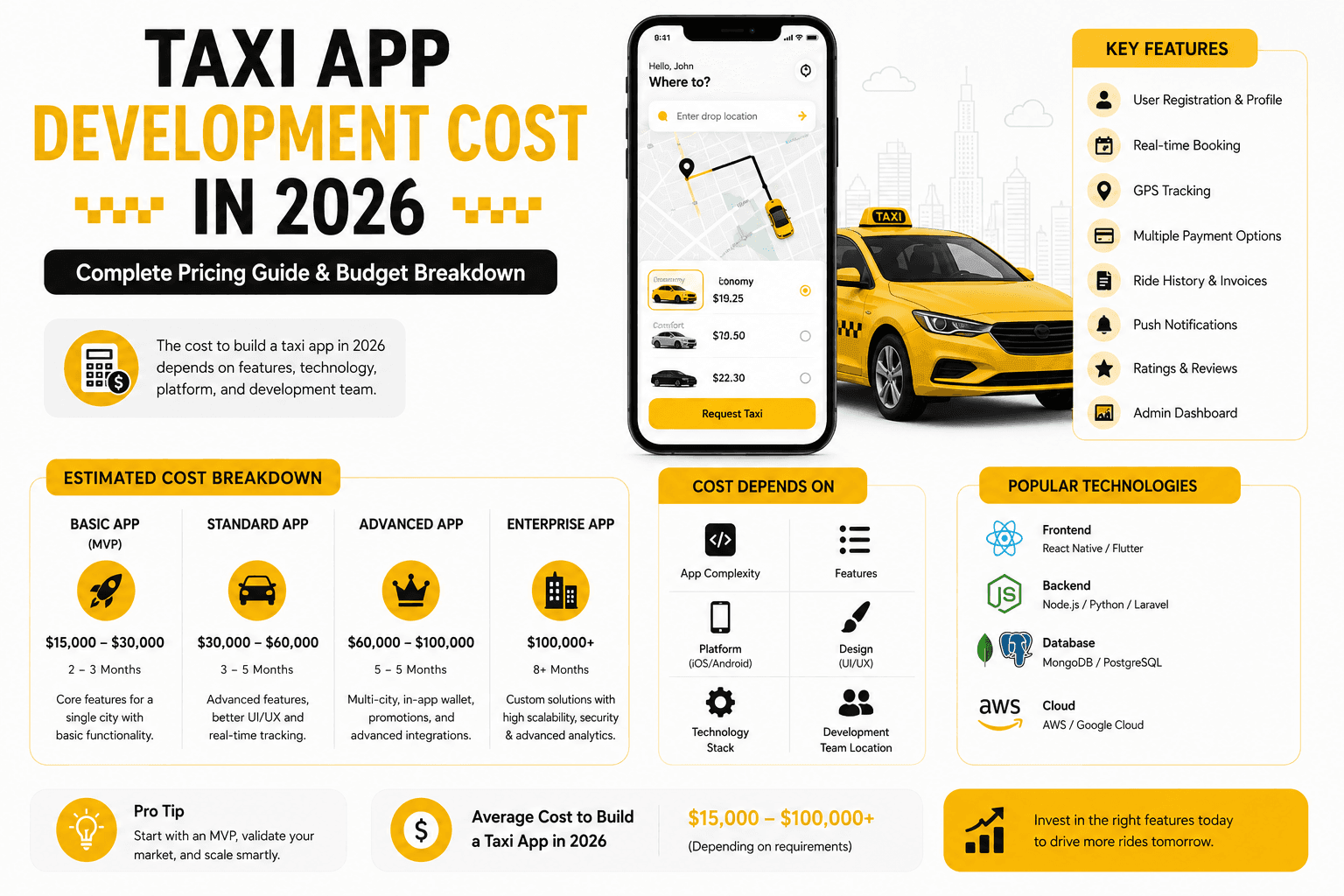
Every taxi app founder asks the same question first: "How much does it actually cost to build this?" The honest answer is that there isn’t one number — there’s a range, and where you land inside it depends on decisions you haven’t made yet.
The ride-hailing market is worth $184.49 billion in 2026 and is projected to reach $392.27 billion by 2031, growing at a 16.29% CAGR, according to Mordor Intelligence’s latest industry report. That growth is exactly why competition has intensified and why cutting corners on your build is riskier now than it was five years ago. Riders expect Uber-level polish. Investors expect a defensible tech moat. Cities expect regulatory compliance baked in from day one.
This guide breaks down real taxi app development cost data for 2026 — by app tier, by component, by region, by feature, and by hidden operating expense — so you can budget with confidence instead of guessing. We work daily with founders scoping exactly this kind of build, and the patterns below reflect what actually happens once a project moves from quote to code.
1. Taxi App Development Cost in 2026:
Taxi app development in 2026 costs between $30,000 and $300,000+, depending on scope:
- MVP (basic booking, GPS, one payment method): $30,000–$70,000
- Standard/Full-Featured app (dynamic pricing, chat, admin dashboard): $70,000–$150,000
- Enterprise/Scalable platform (AI matching, multi-service, multi-city): $150,000–$300,000+
White-label solution (rebranded existing platform): $10,000–$60,000
A taxi app is never really “one app.” You’re building three connected products — a rider app, a driver app, and an admin panel — that all need to talk to each other in real time. That’s the single biggest reason taxi app pricing sits well above a typical consumer app budget.
2. What Actually Determines Taxi App Development Cost
Before any number means anything, you need to understand what moves it. Five variables explain almost all of the variance between a $40,000 quote and a $250,000 quote:
1. App type and business model. A simple aggregator that routes requests to existing taxi companies costs far less than a full end-to-end platform with your own fleet management, driver onboarding, and payment settlement logic.
2. Feature depth. A basic app with auth, a map, booking, and payment takes roughly 400–600 developer hours. Add surge pricing, scheduled rides, ride-pooling, package delivery, and admin analytics, and that jumps to 1,500–3,000 hours — a 3-4x multiplier on labor alone.
3. Platform coverage. Building native iOS and Android apps separately means two codebases, two QA cycles, and two release pipelines. Cross-platform frameworks cut this by 30–40%.
4. Team location. Senior developers in North America and Western Europe charge $80–$200/hour. Offshore and nearshore teams in regions like India or Eastern Europe typically cost 40–60% less for comparable output.
5. Compliance and regulatory scope. Every taxi app handles sensitive financial and location data, which means GDPR, PCI DSS, and local transport-authority requirements aren’t optional — they’re line items. In markets like the US, features tied to ADA accessibility and state-level insurance rules add their own compliance layer.
3. Cost by App Tier: MVP vs Standard vs Enterprise
| Tier | Cost Range | Timeline | What's Included |
|---|---|---|---|
| MVP | $30,000–$70,000 | 3–4 months | User registration, GPS booking, one payment gateway, basic driver app, minimal admin panel |
| Standard / Full-Featured | $70,000–$150,000 | 5–8 months | Dynamic pricing, in-app chat, multiple payment options, push notifications, advanced admin dashboard, ratings & reviews |
| Enterprise / Scalable | $150,000–$300,000+ | 8–14 months | AI-powered matching & dispatch, multi-service support (taxis, scooters, freight), multi-city architecture, advanced analytics, EV fleet management |
Expert insight: Most first-time founders anchor on the MVP number and forget that an MVP is a testing tool, not a growth engine. If your MVP validates demand, you should expect to reinvest in a Standard-tier rebuild within 12–18 months. Budget for both phases from the start, even if you only fund the first one immediately.
4. Cost Breakdown by Component
Here's roughly how a taxi app budget splits across the three connected products:
| Component | Share of Budget | What Drives the Cost |
|---|---|---|
| Rider App | 30–35% | UI/UX design, ride booking flow, real-time tracking, and payment integration |
| Driver App | 25–30% | Navigation, earnings dashboard, availability management, and document verification |
| Admin Panel | 20–25% | Fleet management, dispatch system, analytics, reporting, and dispute resolution |
| Backend & Infrastructure | 15–20% | Real-time matching engine, database architecture, APIs, cloud infrastructure, and scalability |
Core booking, GPS, and payment integrations typically account for 60–70% of the total build. The remaining 30–40% goes to differentiating features — the ones that determine whether your app feels like a generic clone or a genuine competitor to established players.
5. Custom Build vs White-Label vs SaaS: Which Costs Less
| Approach | Upfront Cost | Time to Launch | Ownership | Best For |
|---|---|---|---|---|
| White-Label / Uber Clone | $10,000–$60,000 | 2–4 weeks | Limited — shared codebase with generic branding | Bootstrapped founders validating the market quickly |
| SaaS Taxi Platform | Low upfront cost with recurring subscription | 1–4 weeks | Platform is rented; IP remains with the provider | Businesses that want to launch without an in-house development team |
| Custom Development | $70,000–$300,000+ | 5–14 months | Full IP ownership with complete customization | Startups building differentiated products with long-term scalability |
The decision isn't really about which is "cheaper" — white-label always wins on that metric in year one. The real question is whether your business model is standard (riders book, drivers drive, you take a commission) or genuinely different. If it's standard, ready-made gets you to market for a fraction of custom cost. If your model doesn't exist yet in any off-the-shelf product — freight integration, corporate mobility, a hyper-local niche — custom development is the only path that doesn't box you in later.
6. Taxi App Development Cost by Region
| Region | Hourly Rate | Relative Total Cost |
|---|---|---|
| United States / Canada | $100–$200/hr | Highest — baseline pricing |
| Western Europe (UK, Germany) | $80–$180/hr | High |
| Eastern Europe (Poland, Ukraine) | $40–$80/hr | 40–50% lower than North America |
| India | $25–$60/hr | 50–60% lower than North America |
| Southeast Asia | $25–$55/hr | 50–60% lower than North America |
Offshore and nearshore staff augmentation isn't just about saving money — it's often the only realistic way to assemble a full team fast enough given the app developer shortage in North American and Western European mobile-engineering talent pools. Many founders run design and product strategy locally while partnering with an experienced offshore team for engineering execution.
7. Feature Add-On Costs
Base app pricing covers the essentials. Here's what advanced features add on top:
| Feature | Additional Cost | Why It Costs More |
|---|---|---|
| AI-Based Dispatch & Dynamic Pricing | $15,000–$150,000 | Requires AI models, real-time demand forecasting, and dynamic pricing algorithms |
| Ride-Sharing / Carpooling | $18,000–$40,000 | Complex routing and matching algorithms to group riders efficiently |
| Geofencing | Included in the above range | Map-based logic for service zones, pricing regions, and regulatory compliance |
| In-App Voice & Video Calling | Included in the above range | Integration with communication APIs (e.g., Twilio) plus ongoing usage costs |
| EV-Specific Features (Charging Finder & Battery Tracking) | 15–30% of base development cost | Requires integrations with EV charging networks, battery monitoring, and route optimization |
Expert tip: AI integration was optional in 2025. In 2026, it's close to mandatory for competitive positioning — platforms with AI-based dispatch report meaningfully shorter wait times and better driver utilization. But it's also the single feature most founders should defer until they have real trip volume to train against. Building a sophisticated matching model before you have 500+ daily rides is optimizing for a problem you don't have yet.
8. Hidden and Ongoing Costs Nobody Budgets For
Development cost is only the entry fee. Here's what runs every month after launch:
- Cloud hosting and server infrastructure: $500–$5,000+/month, scaling with active users and ride volume.
Mapping and location APIs: This is the cost teams underestimate most. Google Maps Platform uses per-SKU, pay-as-you-go pricing, with rates commonly running $2–$32 per 1,000 calls depending on the API (Maps, Places, Geocoding, Directions) after free monthly usage caps are exhausted. A taxi app pings location data constantly, so this line item can rival your cloud bill at scale.
- Payment processing: Standard gateway fees (roughly 2–3% per transaction) plus payout infrastructure for driver earnings.
App store fees: Apple charges $99/year for the Apple Developer Program; Google charges a one-time $25 fee for the Google Play Console. Both platforms also take a 15–30% commission on in-app purchases where applicable.
- Annual maintenance: Budget 15–20% of your initial build cost every year for OS updates, bug fixes, and security patches. iOS and Android both ship major updates annually, and an unmaintained taxi app breaks fast.
- Compliance and insurance: Driver background checks, data privacy audits, and regional insurance minimums vary by state and country but consistently add 10–20% to total program cost.
9. Flutter vs React Native vs Native: Cost Impact
Flutter
- Development Cost: Lower (single codebase)
- Time to Market: Faster
- Real-Time Map & Animation Performance: Strong
- Developer Ecosystem: Growing
- Best Fit: Ride-hailing apps with heavy live map interaction
React Native
- Development Cost: Lower (single codebase)
- Time to Market: Faster
- Real-Time Map & Animation Performance: Good
- Developer Ecosystem: Largest ecosystem with extensive JavaScript libraries
- Best Fit: Teams prioritizing rapid development and JavaScript interoperability
Native (Swift/Kotlin)
- Development Cost: Highest (separate iOS and Android development)
- Time to Market: Slowest
- Real-Time Map & Animation Performance: Strongest
- Developer Ecosystem: Mature, platform-specific
- Best Fit: Enterprise-grade apps requiring maximum performance and deep platform integration
For the majority of 2026 taxi app builds, cross-platform frameworks are the financially sound choice — they cut 30–40% of development time compared to building fully native, without a meaningful trade-off for most feature sets. Native development still makes sense for enterprise platforms pushing the absolute limit of real-time map rendering or deeply integrating platform-specific hardware.
10. Development Timeline in 2026
White-label Launch
- Typical Timeline: 2–4 weeks
- Best For: Businesses that want the fastest launch with a pre-built solution.
MVP (Minimum Viable Product)
- Typical Timeline: 3–4 months
- Best For: Startups validating their idea with core features and a limited budget.
Standard / Full-Featured App
- Typical Timeline: 5–8 months
- Best For: Businesses needing advanced features like real-time tracking, payments, notifications, and analytics.
Enterprise / Custom Platform
- Typical Timeline: 8–14 months
- Best For: Large-scale platforms requiring custom workflows, AI features, high scalability, and enterprise-grade security.
Timeline isn't just a scheduling detail — it's a cost driver in its own right. A senior developer at $80–$200/hour means a 12-month project can cost roughly double a 6-month project in labor alone, before counting the opportunity cost of a competitor launching first.
11. Common Budgeting Mistakes Founders Make
- Quote only build, not operating cost. Founders budget for development and forget that server, API, and maintenance costs start accruing the day the app goes live.
- Underestimating edge cases. Lost GPS signal handling, offline mode, multi-currency support, and failed-payment retry logic rarely appear in a first-draft quote but consistently show up in production.
- Going custom when white-label would do. If your business model is standard, paying for a from-scratch rebuild of screens that already exist in mature templates is money spent on zero differentiation.
- Cutting the discovery phase. Skipping requirements scoping to "save time" almost always produces a less accurate estimate and more expensive mid-project scope changes.
- Treating AI as a launch-day requirement. Building matching algorithms before you have ride volume to train them wastes budget on a feature with no data to prove itself against.
- No maintenance war chest. Many apps don't fail because the build was bad — they fail because the founder spent the entire budget on development and had nothing left for the first year of operations and marketing.
12. How to Control Taxi App Development Cost Without Cutting Corners
- Start with a documented feature list and business model before requesting quotes. Vendors give more accurate estimates — and you avoid scope creep — when requirements are locked before development begins.
- Sequence your roadmap. Launch with the core loop (book, ride, pay) and add AI, ride-pooling, and EV features once you have usage data to justify them.
- Invest in backend efficiency early. Well-optimized code uses less compute, which directly lowers your monthly cloud bill — spending slightly more on architecture upfront often saves more over 12 months than it costs.
- Choose a cross-platform framework unless you have a specific native-performance requirement. It's the single highest-leverage cost decision most founders make.
- Negotiate a staff augmentation or nearshore model if in-house hiring in a high-cost market is stretching your runway — this is frequently the difference between shipping in 6 months and shipping in 12.
- Plan for 15–20% annual maintenance from day one so post-launch reality doesn't derail your first year of growth.
13. 2026 Trends Reshaping the Cost Structure
- AI is moving from differentiator to baseline expectation. AI-driven dispatch and dynamic pricing are approaching mainstream adoption industry-wide, and platforms without it are starting to look dated to riders and investors alike.
- EV integration is becoming a regulatory and consumer expectation, not just a nice-to-have — expect charging-station finders, battery-status tracking, and emissions reporting to become standard tasks in RFPs.
- Autonomous and robotaxi pilots are influencing platform architecture, even for founders with no near-term autonomous plans, because investors increasingly ask how a platform's data model would extend to driverless fleets.
- API costs are rising as a share of total spend. With mapping platforms shifting to more granular, usage-based billing, teams that don't actively manage and cache API calls are seeing mapping costs creep toward parity with cloud hosting.
- Regulatory complexity is increasing city-by-city, particularly around driver verification, data localization, and insurance minimums — budget compliance as an ongoing line item, not a one-time cost.
14. Why the Right Taxi Development Services Partner Changes the Math
The numbers in this guide are ranges, not guarantees — and the gap between the low end and the high end of each range is almost entirely explained by the quality of the team executing the build. A vendor that skips discovery, underscopes edge cases, and hands you a "cheap" quote is rarely cheap by the time you've paid to fix what broke in production.
Experienced taxi app development services bring three things a generic app agency usually can't: pre-built familiarity with real-time matching architecture, working knowledge of regional compliance requirements (insurance minimums, driver verification, data privacy law), and the ability to scope your MVP so it's extensible into a Standard or Enterprise build later — instead of requiring a rebuild from zero.
If you're comparing quotes right now, the question worth asking every vendor isn't "what's your price" — it's "what happens to this codebase when I need to add ride-pooling, AI dispatch, or a second city." The answer tells you more about total cost of ownership than the first invoice ever will.
Ready to Build Your Taxi App the Right Way?
Getting an accurate taxi app development cost estimate starts with a proper discovery session — not a generic quote pulled from a price list. Our team has built and scaled ride-hailing platforms across MVP, standard, and enterprise tiers, and we scope every project against your actual business model, target regions, and growth plan before we talk numbers.
Talk to our taxi app development in usa team today for a free, no-obligation cost and architecture consultation tailored to your market — and get a realistic budget you can actually plan around.