
Taxi App Development Trends in 2026: What Every Business Needs to Know
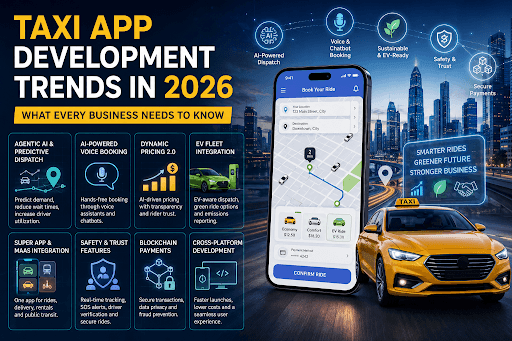
The ride-hailing industry is evolving faster than at any point in the last decade. Riders now expect instant driver matching, transparent fares, and eco-friendly options as standard, while regulators demand tighter compliance and data protection. For fleet owners, startups, and enterprises, taxi app development in 2026 is no longer about simply connecting a passenger to a driver; it's about building an intelligent mobility ecosystem powered by AI, automation, and sustainability. At TechReforms, we've watched these shifts reshape client requirements in real time, and this guide breaks down the trends that will define who wins in 2026.
Why 2026 Is a Turning Point for the Ride-Hailing Industry
- The global ride-hailing market is projected to cross $188 billion in revenue in 2026, with the online taxi app development services segment growing at a CAGR of over 10%. Three forces are converging at once:
- AI has moved from "nice-to-have" to the backbone of dispatch, pricing, and personalization.
- Electric vehicles and smart-city integration are becoming regulatory and consumer expectations, not differentiators.
- Market consolidation is favoring AI-first platforms and white-label taxi solutions that let local operators launch quickly.
The message for businesses is simple: the apps that dominated 2020 won't survive 2027 without reinvention.
Top Taxi App Development Trends in 2026
1. Agentic AI and Predictive Dispatch
Traditional dispatch waits for a booking request. In 2026, agentic AI acts before demand appears, analyzing weather, local events, traffic patterns, and historical ride data to pre-position drivers where surges are about to happen. The results speak for themselves:
- Wait times are cut dramatically through intelligent driver allocation
- Reduced driver idle time, which directly improves driver earnings and retention
- Fewer surge-pricing spikes, which improves rider trust
Demand forecasting is now the most requested AI feature among businesses upgrading legacy taxi booking software.
2. AI-Powered Voice Booking and Conversational Interfaces
Riders increasingly book through voice assistants and WhatsApp AI chatbots instead of tapping through screens. Conversational booking removes friction for elderly users, commuters on the move, and first-time users, expanding your addressable market without expanding your marketing budget.
3. Dynamic Pricing 2.0
Surge pricing isn't new, but explainable surge pricing is. Modern fare engines use machine learning to balance supply and demand while showing riders why a price changed. Transparency is now a retention feature: riders abandon platforms that feel arbitrary.
4. Electric Vehicle (EV) Fleet Integration
Sustainability has shifted from branding to infrastructure. Taxi platforms in 2026 need:
- EV-specific dispatch logic that accounts for battery range and charging station locations
- Green ride categories that let eco-conscious riders choose electric options
- Emissions reporting dashboards for corporate accounts and regulators
Cities across Europe, the Middle East, and Asia are introducing low-emission zones, making EV readiness a compliance issue as much as a marketing one.
5. Super App and MaaS (Mobility-as-a-Service) Integration
Standalone taxi app development company are giving way to integrated mobility platforms. Riders want one app that combines ride-hailing, rentals, package delivery, and public transit connections. Businesses that build modular, API-first architecture can plug into MaaS ecosystems, those that don't risk becoming invisible.
6. Safety and Trust as Product Features
Safety features have moved from the settings menu to the home screen:
- Real-time ride tracking shared with trusted contacts
- AI-based route deviation alerts
- In-app SOS with automatic location sharing
- Driver identity verification with document checks and periodic re-verification
7. Blockchain Payments and Data Security
With data protection laws tightening globally, blockchain-backed payment records, encrypted rider data, and audit-ready compliance tooling are appearing in enterprise-grade platforms. Regulators want proof, not promises.
8. Cross-Platform Development as the Default
Building separate native iOS and Android apps is increasingly rare. Cross-platform frameworks like Flutter and React Native deliver near-native performance at 30–40% lower cost, critical for startups entering competitive markets.
Trends at a Glance: What to Prioritize
| Trend | Business Impact | Priority Level | Best For |
|---|---|---|---|
| Agentic AI Dispatch | Lower wait times and higher driver utilization | Critical | All operators |
| Voice & Chatbot Booking | Expands accessibility and reduces booking friction | High | Consumer-facing apps |
| Explainable Dynamic Pricing | Improves rider trust and long-term retention | High | High-demand urban markets |
| EV Fleet Integration | Supports regulatory compliance and sustainability goals | Critical | Europe, Middle East, and smart cities |
| MaaS (Mobility-as-a-Service) / Super App Readiness | Creates new revenue opportunities through multi-service platforms | Medium–High | Enterprises and scale-ups |
| Advanced Safety Suite | Improves rider trust, safety, and liability management | Critical | All operators |
| Blockchain Payments | Enables secure, transparent, and borderless transactions | Medium | Cross-border mobility platforms |
| Cross-Platform Development | Reduces development costs by 30–40% and speeds up launches | High | Startups and growing businesses |
What This Means for Different Business Models
Startups Entering the Market
Speed matters more than perfection. White-label and on-demand taxi app solutions allow launch in weeks rather than months, with a modular architecture that lets you add features, multi-city support, corporate accounts, and ride scheduling as you grow. The startup segment is booming precisely because Gen Z riders default to digital-first, instant services.
Traditional Fleet Owners Going Digital
Legacy operators hold an underrated advantage: existing drivers, vehicles, and local trust. Pairing that with modern taxi dispatch software and a rider app closes the gap with global platforms, and local operators often win on service quality once the technology playing field is level.
Enterprises and Aggregators
For large operations, 2026 is about platform thinking: open APIs, corporate travel integrations, delivery verticals, and data infrastructure that supports autonomous vehicle pilots as that segment grows at an estimated 16%+ CAGR.
How to Choose the Right Development Partner
Selecting a technology partner determines whether these trends become advantages or expensive experiments. Evaluate partners on:
- Proven ride-hailing experience — ask for live apps, not mockups
- AI capability in-house — dispatch intelligence can't be bolted on later
- Scalable cloud architecture — your platform should survive a 10x demand spike
- Regulatory readiness — driver verification, fare controls, and data protection built in
- Post-launch support — development doesn't stop at launch; updates, monitoring, and feature rollouts are ongoing
At TechReforms, our taxi app development services are built around exactly this lifecycle from discovery and MVP launch to AI-driven optimization and long-term scaling because in this market, the app you launch is only the starting line.
Final Thoughts
2026 rewards businesses that treat their taxi platform as a living product, not a one-time build. AI-driven dispatch, EV readiness, conversational booking, and airtight safety features aren't future concepts anymore they're the baseline riders and regulators expect. The businesses that act now will spend the next five years scaling; the ones that wait will spend them catching up.
Ready to build or modernize your ride-hailing platform? Talk to the TechReforms team and turn these trends into your competitive edge.