
The Hidden Reasons Your App Idea May Not Become a Successful Product
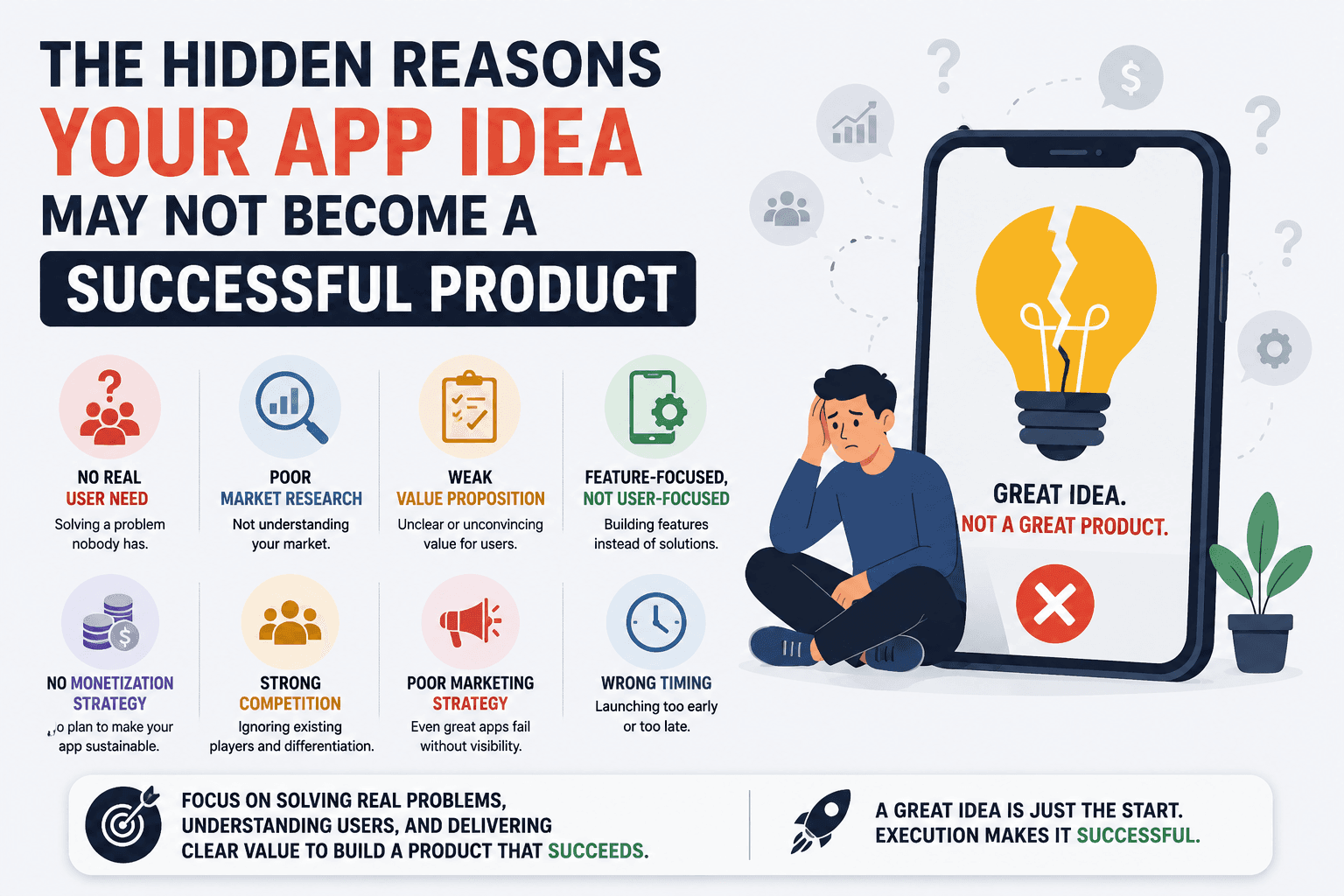
Every year, thousands of founders launch an app with genuine conviction that the idea is strong — and most of those apps quietly disappear within 12 months. Industry data from app analytics firms consistently shows that over 90% of apps are abandoned by users within the first 30 days, and the majority never reach meaningful revenue. The uncomfortable truth is that the idea is rarely the problem. What actually determines whether an app becomes a category leader or a forgotten download is what happens between the idea and the execution.
This article breaks down the hidden, often-overlooked reasons app ideas fail to become successful products — the structural, technical, and strategic gaps that founders don't see coming because they aren't visible until real users, real scale, or real competitors show up. If you are evaluating custom app development or comparing mobile app development services for your next build, this is the diagnostic you need before you write a single line of code.
Reason 1: You Validated an Idea, Not a Problem
Most founders validate enthusiasm, not demand. They ask friends, colleagues, and social media followers, "Would you use an app that does X?" and interpret polite agreement as market validation. That is not validation — it's confirmation bias wearing a survey's clothing.
Real validation looks uncomfortable. It means running smoke tests with a landing page and real ad spend to see if strangers will hand over an email address or a card number before the product exists. It means interviewing people who are actively experiencing the problem today, not people who might theoretically benefit from a solution. Companies offering serious custom app development engagements will typically insist on a discovery phase precisely because skipping it is the single highest-cost mistake in the entire product lifecycle — every downstream decision, from architecture to UX to go-to-market, inherits the risk of an unvalidated premise.
What genuine validation looks like
Identify the specific, painful, frequent problem — not a vague inconvenience.
Talk to 15–25 people who currently experience that problem, without pitching your solution first.
Test willingness to pay before writing code, through pre-orders, waitlists, or paid pilots.
Map how people solve this problem today, including manual workarounds and competitor tools.
Reason 2: Your MVP Isn't Minimal — It's Bloated
"MVP" gets misused constantly. Founders often build what is really a Version 1.5 — packed with nice-to-have features because it feels risky to launch anything that looks incomplete. This instinct is understandable and almost always wrong.
A bloated MVP does three things simultaneously: it extends time-to-market, it inflates the budget, and it dilutes the core value proposition so much that user feedback becomes noisy and hard to interpret. When everything is a priority, nothing is measurable. The teams that succeed treat the MVP as a hypothesis-testing instrument, not a finished product — its only job is to prove or disprove that people will adopt and pay for the core value, as fast and cheaply as possible.
A practical MVP scoping framework
Single focus: Only one core job-to-be-done per MVP release
Hypothesis-mapped scope: Every feature must map directly to validating your core hypothesis
Ruthless deferral: If a feature can wait until after user feedback, it waits
Instrumented from day one: Track activation, retention, and referral from day one, even manually
Reason 3: UX Was Designed for Investors, Not Users
There is a specific and common failure pattern: an app that looks stunning in a pitch deck and confuses real users within the first 30 seconds. This happens when design decisions are optimized for how the product photographs in a demo rather than how a first-time user actually navigates a decision under real conditions — on a smaller screen, with a spotty connection, distracted, and with zero patience for onboarding friction.
This is where experienced mobile app development company teams earn their fee. Good UX for a real product requires usability testing with actual target users — not internal stakeholders who already understand the product's logic. If your onboarding flow requires more than two screens of explanation before someone experiences value, you have a UX problem, regardless of how polished the visual design is.
Reason 4: Monetization Was an Afterthought
Plenty of apps generate genuine engagement and still fail commercially because the revenue model was never architected — it was bolted on after launch once the founders realized users weren't converting. Subscription pricing, in-app purchases, transaction fees, and freemium gating all have direct implications for backend architecture, UX flow, and even which platform APIs you need to integrate (App Store billing, Google Play billing, or a custom payment gateway).
Retrofitting monetization after launch means redesigning core user flows that users have already formed habits around — which almost always causes churn. The monetization model should be part of the same strategic conversation as the MVP scope, not a separate conversation that happens after the app is already live.
Reason 5: Wrong Tech Stack, Wrong Development Partner
Technology choice is a business decision disguised as a technical one. Choosing native iOS and Android development, Flutter, or React Native affects your budget, your time-to-market, your long-term maintenance cost, and your ability to hire talent to extend the product later. Founders frequently choose a stack because a developer recommended it, not because it matches the product's actual performance, integration, and scalability requirements.
Native vs cross-platform: how to actually decide
Native development (Swift for iOS, Kotlin for Android) delivers the best performance and full access to platform-specific hardware and APIs, which matters for apps like AR/VR, advanced camera processing, or gaming. It costs more because you're effectively building two apps.
Flutter and React Native let you maintain a single codebase across iOS and Android, which shortens development timelines and reduces long-term maintenance cost — ideal for most business apps, marketplaces, SaaS products, and MVPs where speed to market and budget efficiency outweigh marginal performance gains.
Beyond the stack, the development partner matters just as much. A vendor selling generic mobile apps without asking about your business model, your compliance requirements, or your growth plan is optimizing for a fast handoff, not for your product's long-term success. Ask potential partners how they've handled technical debt, what their post-launch support model looks like, and whether they've shipped apps in your specific industry — healthcare, fintech, and eCommerce all carry very different technical and regulatory demands.
Reason 6: Security and Compliance Gaps
Security is one of the most expensive things to bolt on after the fact, and one of the cheapest things to design in from day one. Apps handling healthcare data need HIPAA-aligned architecture. Fintech apps need PCI-DSS compliance, encryption standards, and fraud detection built into the transaction flow. eCommerce apps handling stored payment data carry similar obligations.
Founders often assume security is a checklist to complete right before launch. In reality, it shapes core architectural decisions — how data is stored, how APIs authenticate, how third-party integrations are sandboxed, and how user sessions are managed. A single publicized data breach can end a product's credibility permanently, regardless of how good the underlying idea was.
Reason 7: No Scalability Plan
This is the failure that looks like success right before it happens. The app gets traction — a viral moment, a press mention, a successful marketing campaign — and then the backend can't handle the load. Response times spike, the app crashes, and the exact users who were about to become loyal customers churn permanently, often within the same week they discovered you.
Scalable architecture means designing your cloud infrastructure, database schema, and API layer for 10x your current expected load, not for your launch-day estimate. This typically involves choosing cloud providers (AWS, Google Cloud, Azure) with auto-scaling capability, implementing caching layers, and designing APIs that don't create bottlenecks as concurrent users grow. This is infrastructure work that's dramatically cheaper to plan upfront than to retrofit under pressure during a traffic spike.
Reason 8: No Post-Launch Growth or Retention Strategy
A great app with no visibility strategy is a great app nobody finds. App Store Optimization (ASO), a structured onboarding funnel, push notification strategy, and lifecycle email or in-app messaging all need to be planned before launch, not improvised after. Development quality gets someone to download the app; retention strategy is what determines whether they're still using it in 90 days.
Analytics instrumentation deserves particular attention here. Many founders launch without event tracking for activation, retention, and feature usage, which means the first few months of real user data — the most valuable data the product will ever generate — is lost. You cannot optimize what you never measured.
Reason 9: Founder-Market Fit Gaps
This is the least discussed reason and often the most decisive one. Founder-market fit measures how deeply the founding team understands the specific customer, industry dynamics, and buying behavior of the market they're entering. A technically excellent app built by a team with no domain expertise in, say, clinical workflows or supply chain logistics, will consistently miss the operational nuances that determine whether real users adopt it.
This doesn't mean founders need to be domain experts themselves, but it does mean the product and development team need direct, ongoing access to domain expertise throughout the build — through advisors, early customers, or industry-experienced product consultants — rather than treating domain knowledge as something to acquire after launch through trial and error.
Comparison: Hidden Reasons vs Strategic Fixes
The table below maps each hidden failure point to its real-world impact and the strategic fix that experienced custom app development teams apply from the earliest planning stages.
| Hidden Reason | Real Impact on the Product | Strategic Fix |
|---|---|---|
| No Problem Validation | Users churn quickly because the app doesn't solve an urgent need | Validate demand through user interviews, landing pages, and pre-orders before development |
| Feature-Bloated MVP | Longer development time, higher costs, and a weaker value proposition | Focus the MVP on one core problem and launch faster |
| UX Built for Pitch Decks | High uninstall rates and poor user activation | Prototype and usability-test with real target users before development |
| Monetization as an Afterthought | Weak unit economics and delayed revenue generation | Define pricing and monetization strategy during MVP planning |
| Wrong Tech Stack or Development Partner | Technical debt, slower releases, and costly rebuilds | Choose the technology stack and development partner based on long-term product goals |
| Security Treated as Optional | Data breaches, compliance issues, and loss of user trust | Build security, privacy, and compliance into the architecture from day one |
| No Scalability Plan | Performance issues and outages as user growth increases | Design cloud infrastructure and APIs to support future growth |
| No Post-Launch Strategy | Strong product but poor visibility, retention, and growth | Plan ASO, analytics, user engagement, and lifecycle marketing before launch |
Common Mistakes to Avoid
- Treating enthusiasm as validation: Founders skip structured user interviews and rely on friends and family for feedback
- Scope creep during MVP build: Adding every requested feature instead of protecting a focused core value proposition
- Technology-first decision-making: Selecting a stack based on developer preference rather than product and business requirements
- Delayed monetization planning: Postponing pricing and revenue model decisions until after launch
- No UX validation before build: Skipping usability testing with real target users before development begins
- Security as an afterthought: Treating security as a pre-launch checklist rather than an architectural principle
- No scalability buffer: Designing infrastructure for launch-day traffic instead of growth scenarios
- No post-launch plan: Launching without ASO, analytics, or a retention plan in place
Expert Best Practices
- Run a structured discovery and validation phase before committing development budget
- Define your MVP around a single, measurable hypothesis
- Prototype and usability-test with real target users, not internal stakeholders
- Architect monetization, security, and scalability decisions during planning, not after launch
- Choose your tech stack and development partner based on product goals, not trends
- Instrument analytics from day one so early user data isn't lost
- Plan ASO and retention strategy in parallel with development, not after it
- Maintain access to domain expertise throughout the build, not just at the idea stage
2026 Industry Trends Shaping App Success
Several shifts are actively changing what "successful product" means for app founders this year. AI-native features — personalization engines, in-app copilots, and predictive recommendations — are increasingly expected rather than differentiating, which raises the baseline UX bar. Cross-platform frameworks like Flutter have matured to the point where performance trade-offs versus native are negligible for most business apps, shifting more founders toward faster, budget-conscious cross-platform builds. Privacy regulation continues to tighten globally, making privacy-by-design architecture a competitive advantage rather than just a compliance requirement. And App Store algorithm changes are placing more weight on retention and engagement signals over raw download volume, which means growth strategy and product quality are now more interdependent than ever.
Conclusion
Your app idea probably isn't the reason it might fail. The real risks live in the execution gaps most founders never see coming: unvalidated assumptions, bloated scope, UX built for the wrong audience, monetization bolted on too late, the wrong technical foundation, security treated as optional, no scalability plan, and no strategy for what happens after launch day. Every one of these is preventable with the right planning and the right partner.
If you're serious about turning your idea into a product that survives contact with real users and real scale, the difference comes down to who builds it with you and how rigorously the planning phase is handled before development starts.
Ready to Build an App That Actually Succeeds?
Our team specializes in custom app development and full-cycle hire mobile app developer — from problem validation and MVP scoping through architecture, security, scalable cloud infrastructure, and post-launch growth strategy. We've helped startups and enterprises avoid exactly the pitfalls covered in this article.
Book a free product strategy consultation with our team today and get a clear, honest assessment of what it will actually take to turn your app idea into a successful product.