
Top 10 Mobile App Development Companies in the USA (2026 Guide)
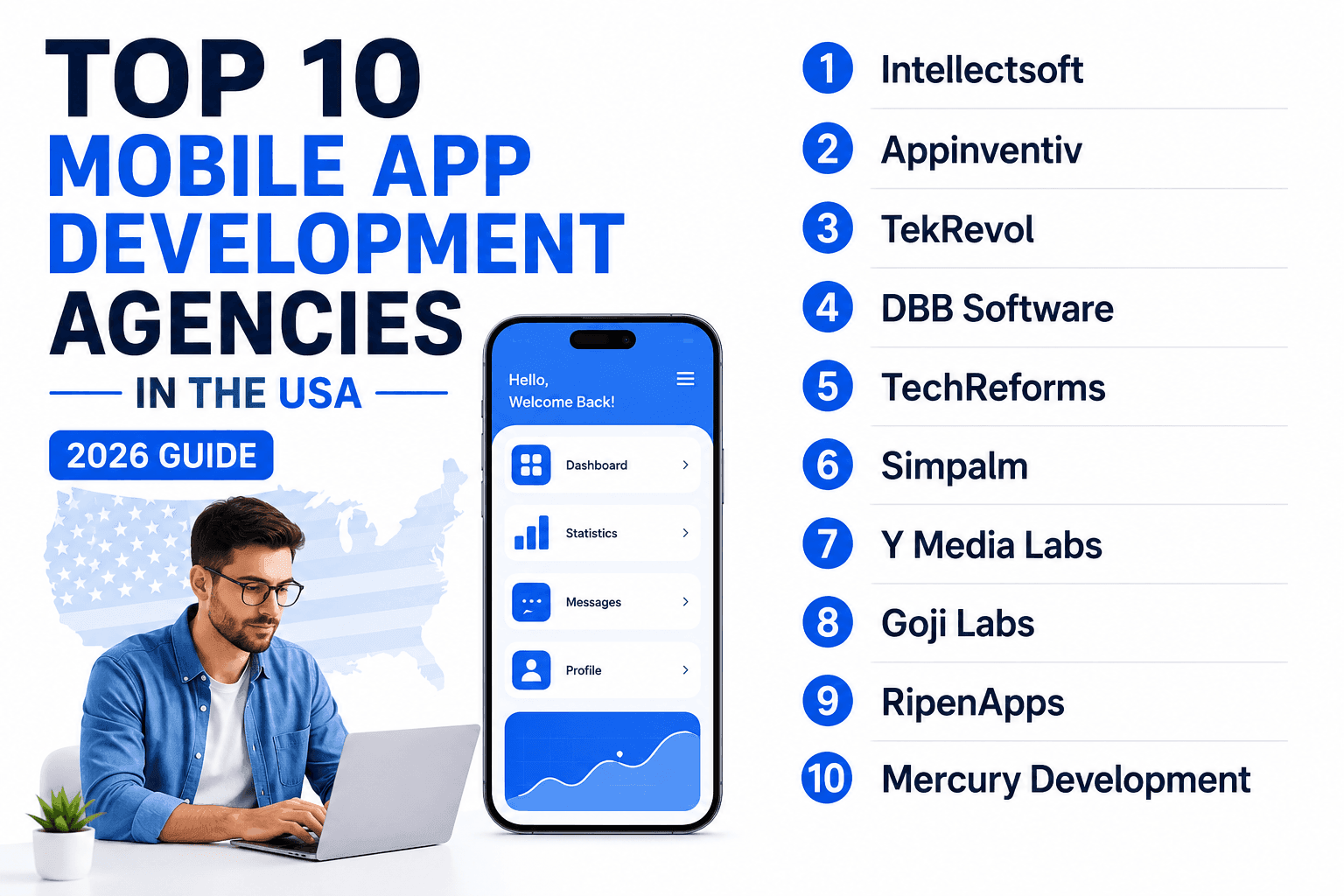
The United States remains the world's most competitive market for building digital products, and choosing the right mobile app development company can decide whether your product scales smoothly or stalls out after launch. With mobile app downloads and in-app spending both climbing again this year, businesses of every size, from early-stage startups to Fortune 500 enterprises, are investing in mobile app development to reach customers where they actually spend their time: on their phones.
But the U.S. market is crowded. Thousands of agencies claim to be "the best," and it's easy to get lost in marketing copy instead of real capability. This guide breaks down ten established U.S.-serving app development companies, what each one does well, and how to evaluate them so you can pick a partner that fits your product, budget, and timeline.
How We Evaluated These Companies
Before diving into the list, here's the criteria used to shortlist these firms:
- Portfolio depth — proven, shipped apps across iOS, Android, and cross-platform frameworks
- Client reviews — verified feedback on platforms like Clutch and GoodFirms
- Technical range — native (Swift, Kotlin) and cross-platform (Flutter, React Native) capability
- Industry experience — healthcare, fintech, retail, logistics, and enterprise SaaS
- Post-launch support — maintenance, scaling, and long-term partnership track record
Top 10 Mobile App Development Agencies in the USA
1. Intellectsoft
Founded in 2007, Intellectsoft has built a reputation for enterprise-grade mobile products for Fortune 500 clients and fast-growing startups alike. With development hubs across the U.S. and Europe, the company handles complex, compliance-heavy builds particularly well, think healthcare platforms and logistics systems that need to scale globally.
Best for: Enterprise digital transformation and large-scale custom apps
2. Appinventiv
Headquartered in New York with a global engineering team exceeding 1,000 developers, Appinventiv has delivered thousands of projects across healthcare, fintech, sports, and education. The firm has picked up industry recognition for AI product engineering, and its scale makes it a solid option when you need speed without sacrificing quality control.
Best for: Mid-market to enterprise apps with AI or data-heavy features
3. TekRevol
TekRevol brings strategy, design, and engineering under one roof, positioning itself as an accountability-first partner rather than a pure execution vendor. The company works across most major U.S. markets and emphasizes staying involved from the idea stage through post-launch iteration.
Best for: Founders who want a strategic partner, not just a build team
4. DBB Software
DBB Software focuses on full-cycle product engineering discovery, build, launch, and long-term scaling for startups, SMBs, and enterprise clients. Rather than treating an app as a one-off MVP project, the team is built around treating mobile products as core, long-term digital assets.
Best for: Startups planning for long-term product growth, not just a quick MVP
5. TechReforms
Based in Los Angeles, California, TechReforms is a digital agency offering mobile app development, e-commerce solutions, and IT staff augmentation services under one roof. The team builds native iOS and Android apps as well as cross-platform products, and client feedback consistently points to responsive communication and staying on schedule and budget.
Best for: Startups and SMBs that want mobile app development plus e-commerce, security, or staff augmentation from one accountable partner
6. Simpalm
A U.S.-based firm with 14+ years in the market, Simpalm has shipped 350+ mobile applications for clients across healthcare, government, and enterprise sectors. Its developers work across both native and cross-platform stacks, and the company has a strong reputation for responsive, collaborative project management.
Best for: Businesses that prioritize U.S.-based teams and hands-on communication
7. Y Media Labs
Known for design-forward thinking, Y Media Labs takes products from early ideation through to market success, with a focus on user experience as a competitive differentiator. This is a strong pick for consumer-facing brands where design polish directly drives adoption.
Best for: Consumer apps where UX and brand experience are the priority
8. Goji Labs
Goji Labs builds native iOS and Android apps, custom web platforms, and AI-powered products using agile delivery. Its portfolio spans healthcare, fintech, and media, with particular strength in product strategy and UX work alongside core engineering.
Best for: Startups needing strategy, design, and engineering combined
9. RipenApps
With a team of 150+ developers, RipenApps has launched over 1,000 web and mobile apps for startups, SMEs, and larger brands. The company covers iOS, Android, and cross-platform work with a strong emphasis on user-first UI/UX and engagement-driven design.
Best for: SMEs needing a high-volume, experienced delivery team
10. Mercury Development
Mercury Development has years of experience delivering custom software and mobile solutions across healthcare, finance, education, retail, and logistics. The firm focuses on building secure, scalable applications that address specific business problems rather than generic app templates.
Best for: Industry-specific apps with complex business logic
Quick Comparison Table
| Company | Best For | Core Strength |
|---|---|---|
| TechReforms | Startups & SMBs | Mobile app development, e-commerce solutions, staff augmentation |
| Intellectsoft | Enterprise transformation | Compliance-heavy and enterprise-grade software development |
| Appinventiv | Mid-market to Enterprise | AI product engineering and digital transformation |
| TekRevol | Founders & Startups | Product strategy, MVP development, and execution |
| DBB Software | Long-term product growth | Full-cycle software engineering and product scaling |
| Simpalm | U.S.-based clients | Native and cross-platform mobile app development |
| Y Media Labs | Consumer brand apps | Design-led UX and digital product innovation |
| Goji Labs | Startups | Product strategy, MVPs, and AI-powered solutions |
| RipenApps | SMEs & High-Volume Apps | UI/UX design and user engagement optimization |
| Mercury Development | Industry-specific applications | Secure, scalable, and enterprise-ready software builds |
Founding years reflect publicly available company information at the time of writing and may not be exact for every firm.
How to Choose the Right Mobile App Development Services
Picking from this list or any list comes down to a few honest questions:
- What platform do you actually need? Native iOS and Android offer the best performance but require separate codebases; cross-platform frameworks like Flutter and React Native suit most everyday use cases.
- How complex is your app? A consumer social app is a very different brief from a HIPAA-compliant healthcare platform. Firms with vertical experience in your industry will move faster and avoid costly mistakes.
- What does your internal team look like? If you already have a product manager and design lead, you mainly need execution capacity. If you don't, you need a partner that brings strategic direction too.
- What's your realistic budget? In the U.S., mobile app development typically ranges from $25,000 for a simple MVP to $300,000+ for a complex, multi-platform enterprise application.
Current Trends Shaping Mobile App Development in 2026
Leading mobile app development firms are actively building around a few key shifts:
- AI integration — personalization, predictive analytics, and conversational interfaces embedded directly into apps
- Cross-platform dominance — Flutter and React Native continue gaining ground for faster, more cost-efficient builds
- IoT and wearable connectivity — apps increasingly talk to smart devices, not just phones
- AR/VR experiences — growing adoption in retail, training, and real estate
- 5G-powered performance — enabling richer real-time and streaming features
Final Thoughts
There's no single "best" mobile app development agency; it's only the best fit for your specific product, budget, and timeline. Use this list as a starting point, but do your own due diligence: review live portfolios, talk to past clients where possible, and ask each firm how they handle the parts that matter most after launch, maintenance, scaling, and long-term support.