
White Label Taxi App vs Custom Taxi App: Which One Actually Fits Your Business in 2026?
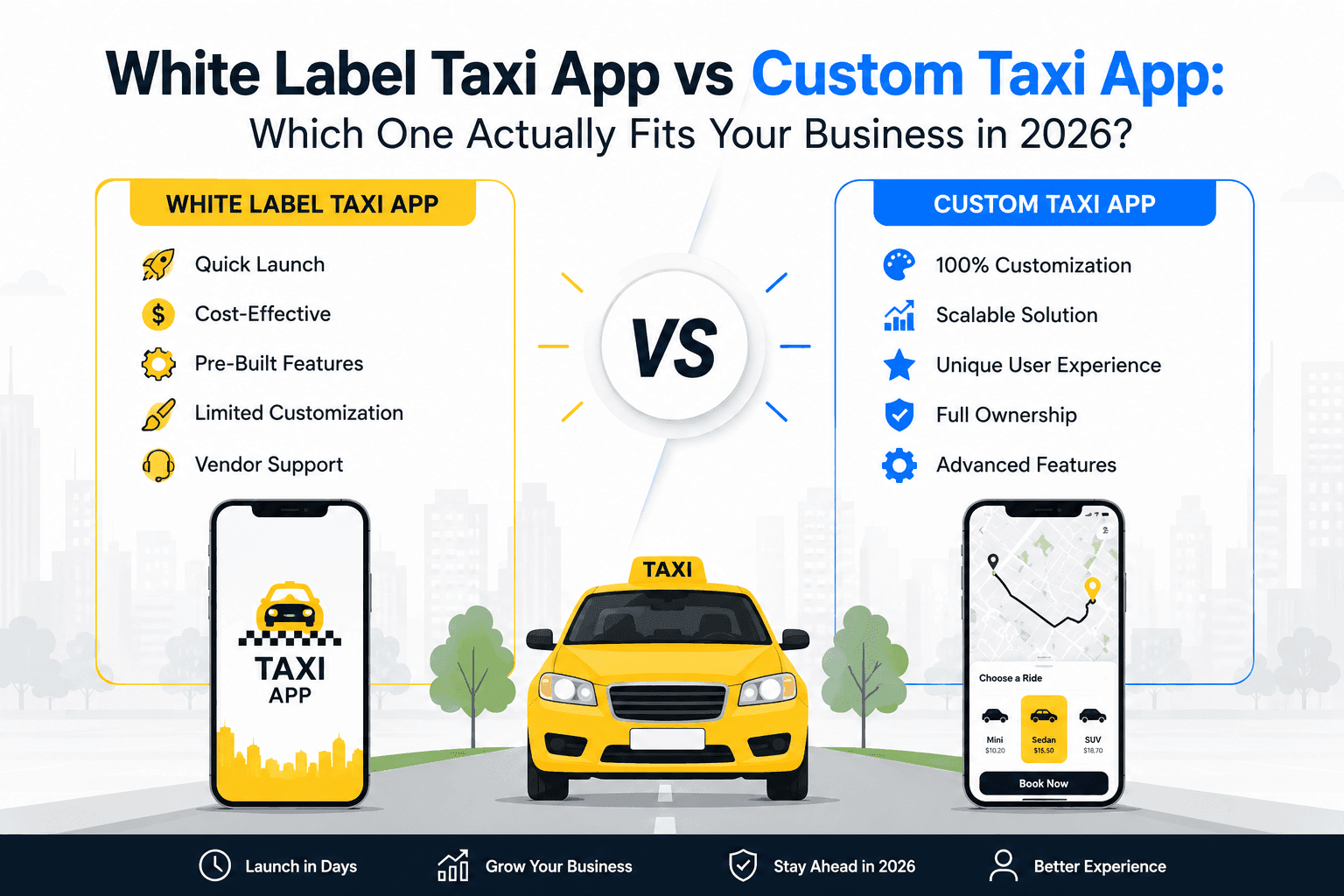
Every founder who wants to launch a ride-hailing business eventually hits the same fork in the road: buy a ready-made white label taxi app, or invest in a custom-built platform from scratch.
It looks like a simple budget decision on the surface. It isn't. The choice you make here determines how fast you launch, how much control you have over your product roadmap, whether you can scale into new markets or verticals, and — critically — whether you actually own the technology your business depends on.
The taxi and ride-hailing industry isn't slowing down. The global taxi market is projected to grow from roughly USD 255.4 billion in 2025 to USD 383.1 billion by 2034, and hire mobile app-based booking is now the fastest-growing segment within it, according to industry forecasts. That growth is exactly why the white label vs custom decision matters more now than it did five years ago — the market has matured, rider expectations are higher, and "good enough" apps get outcompeted fast.
This guide breaks down both models with zero fluff: real cost ranges, technical trade-offs, business scenarios where each option wins, and the mistakes that cost founders time and money. By the end, you'll know exactly which path fits your business stage, budget, and long-term ambition — and what to ask any taxi app development services provider before you sign a contract.
1. What Is a White Label Taxi App?
A white label taxi app is a pre-built ride-hailing platform — rider app, driver app, and admin dashboard — developed by a vendor and licensed to you under your own brand name, logo, and color scheme. The core functionality (booking, GPS tracking, fare calculation, payments, driver assignment) is already built and tested. You're essentially renting or buying a license to a proven engine and putting your badge on it.
Think of it as the SaaS model applied to mobile app ownership. You don't own the source code outright in most licensing arrangements — you own the right to use and rebrand it, often with a recurring license fee or revenue share attached.
What you typically get:
- Rider app (iOS + Android)
- Driver app (iOS + Android)
- Admin/dispatch dashboard
- Payment gateway integration
- Basic analytics and reporting
- Standard features: live tracking, fare estimation, ratings, in-app chat
What you usually don't get: deep customization, proprietary algorithms, exclusive features competitors can't replicate, or full source code ownership (unless you negotiate a buyout clause).
2. What Is a Custom Taxi App?
A custom taxi app is built from the ground up by a mobile app development company based entirely on your business model, target market, and feature roadmap. Nothing is templated. Every screen, workflow, and backend service is designed around how your business actually operates.
This is the route companies like Uber, Bolt, and Careem took — and it's the route regional operators take once they've outgrown what a template can offer.
What custom development enables:
- Fully proprietary matching, pricing, and dispatch algorithms
- Custom UI/UX aligned to your brand and user research
- Integration with any third-party system (ERP, fleet management, loyalty programs, local payment rails)
- Unique features competitors on the same white label platform cannot copy
- Full IP ownership of the source code
- Architecture built specifically for your scale, region, and compliance needs
The trade-off is obvious: more time, more budget, more upfront planning. But you're not renting infrastructure — you're building an asset.
3. White Label vs Custom Taxi App: Head-to-Head Comparison
| Factor | White-Label Taxi App | Custom Taxi App |
|---|---|---|
| Time to Launch | 4–8 weeks | 4–9 months |
| Upfront Cost | $3,000–$25,000 (license + branding) | $40,000–$250,000+ |
| Ongoing Cost | Recurring license fee or revenue share | Maintenance only (~15–20% of development cost per year) |
| Source Code Ownership | Usually license-based; full ownership is rare | Full source code ownership |
| Customization | Limited by the vendor's framework | Unlimited customization |
| Scalability | Constrained by the vendor's architecture | Designed to scale with your business |
| Competitive Differentiation | Low — similar platform used by other businesses | High — proprietary features and unique user experience |
| Vendor Lock-In Risk | High | None — you own the codebase |
| Best For | MVPs, local launches, and market validation | Funded startups, enterprises, and multi-market expansion |
| Feature Updates | Dependent on the vendor's release cycle | Fully controlled by your development team |
This table is the fastest way to answer the question, but the real decision depends on your growth stage — which is what the next sections unpack.
4. Cost Breakdown: What You're Really Paying For
Cost is where most founders get misled, because a "$5,000 taxi app" and a "$5,000 app" are not the same purchase.
White label pricing usually includes:
- One-time license fee ($2,000–$15,000 depending on the vendor and feature set)
- Branding and app store submission fee
- Monthly or annual license renewal (often $200–$1,500/month)
- Per-transaction fee or revenue share (commonly 1–5% of GMV)
Over 2–3 years, a white label app that looked cheap upfront can cost more in cumulative license fees than a custom build would have, especially once you factor in per-ride commissions the vendor takes indefinitely.
Custom development pricing usually includes:
- Discovery and UX research
- Rider app, driver app, admin panel (native or cross-platform)
- Backend infrastructure and LLM development
- Third-party integrations (payments, maps, SMS/OTP)
- QA, security testing, and app store deployment
- Ongoing maintenance (industry standard: 15–20% of initial build cost annually)
Expert insight: Ask any experienced taxi app development company provider, and they'll tell you the real cost differentiator isn't the app itself — it's the backend architecture for real-time dispatch, surge pricing, and driver-rider matching at scale. That's the part templates struggle to handle once you exceed a few thousand daily rides.
5. Time to Market: Weeks vs Months
If speed is your only constraint — say, you're testing demand in one city before raising funding — white label wins decisively. You can be live on app stores in 4–8 weeks.
Custom development realistically takes 4–9 months depending on scope, because you're building and testing dispatch logic, payment flows, driver onboarding (including background verification), and admin tooling from zero.
The strategic question isn't "which is faster" — it's "what does speed cost me later?" A white label launch validates demand quickly, but if you find product-market fit, you'll likely need to migrate to custom infrastructure within 12–18 months anyway. Some businesses budget for that migration from day one; others get blindsided by it.
6. Scalability and Long-Term Growth
This is where white label platforms show their limits fastest. Most white label vendors architect their systems for the average customer — a single-city, moderate-volume operation. When your ride volume spikes, when you expand into a second country with different payment regulations, or when you want to add a delivery vertical alongside rides, the template often can't flex.
Custom-built platforms, especially those using cloud-native infrastructure (AWS, GCP, or Azure with auto-scaling, load balancing, and microservices architecture), are designed to handle unpredictable demand spikes and multi-region expansion without a rebuild. This matters more than most founders initially assume — the Asia-Pacific region alone is forecast to hold over 54.5% of global taxi market share in 2025, and operators expanding across APAC's fragmented regulatory and payment landscape need architecture that adapts market by market.
If your five-year plan includes multiple cities, multiple countries, or multiple service lines (rides + deliveries + logistics), scalability isn't a nice-to-have — it's the deciding factor.
7. Ownership, Source Code, and Vendor Lock-In
This is the most underestimated risk in the white label model. When you license a white label taxi app in usa, you're building your business on top of someone else's asset. If the vendor:
- Raises license fees
- Discontinues the product
- Gets acquired and changes terms
- Has a security breach affecting all licensees
- Simply goes out of business
...your entire ride-hailing operation is exposed. You don't own the code, so you can't simply "take it and run" if the relationship sours.
Custom development eliminates this risk entirely. You own the intellectual property outright, and a competent development partner should hand over full source code, documentation, and deployment access as standard practice — not as a paid add-on.
Due diligence tip: Before signing any white label contract, get explicit written terms on source code escrow, data portability, and exit clauses. Many license agreements don't guarantee you can export your driver and rider data cleanly if you leave.
8. Security and Compliance Considerations
Ride-hailing apps handle sensitive data: real-time location, payment credentials, government ID verification for drivers, and personal contact information for both riders and drivers. Security isn't optional — it's foundational to trust and regulatory compliance.
With a white label app, your app's security posture is entirely dependent on the vendor's engineering standards. If they've cut corners on encryption, API security, or PCI-DSS compliance for payments, every licensee — including you — inherits that risk.
With a custom-built app, security is architected around your specific compliance needs: GDPR in Europe, data localization requirements in India or the Middle East, PCI-DSS for payment handling, and role-based access control for your admin team. This is especially critical as regulators tighten data governance — the EU's GDPR framework already constrains data retention periods and cross-border transfer protocols for location histories in ride-hailing platforms operating in Europe.
For any operator planning to scale beyond one market, compliance flexibility alone often justifies the custom development route.
9. Technology Stack: Native, Flutter, or React Native
Regardless of white label or custom, the underlying tech stack affects performance, cost, and maintainability.
- Native (Swift for iOS, Kotlin for Android): Best raw performance, deepest access to device APIs (GPS, background location, push notifications) — ideal for apps where real-time tracking accuracy is non-negotiable. Higher cost since you're maintaining two codebases.
- Flutter: Single codebase for iOS and Android, near-native performance, strong for startups that need to move fast without sacrificing UI quality. Increasingly the default choice for new custom taxi apps in 2026.
- React Native: Mature ecosystem, large developer talent pool, good for teams that want faster iteration and easier hiring, though real-time GPS-heavy features sometimes need native modules for optimal performance.
Most white label vendors lock you into whatever stack they originally built on — you don't get a say. With custom web development, your development partner should recommend the stack based on your budget, timeline, and long-term maintenance plans, not the other way around.
10. Which Businesses Should Choose White Label?
White label makes sense when:
- You're validating demand in a single city before committing serious capital
- You have a limited budget and need to launch within weeks, not months
- Your business model closely matches standard ride-hailing (no unusual pricing logic, no unique verticals)
- You're a traditional taxi cooperative digitizing operations quickly to stay competitive
- You don't yet need multi-country expansion or complex third-party integrations
11. Which Businesses Should Choose Custom Development?
Custom development is the right call when:
- You've validated demand and are ready to scale across cities or countries
- Your business model includes unique pricing, subscription plans, corporate accounts, or multi-service bundling (rides + delivery + logistics)
- You're raising investment, and investors expect proprietary technology as part of your valuation
- You need deep integrations with local payment systems, government ID verification, or fleet management software
- Long-term cost efficiency and full IP ownership matter more than initial speed
- You're building for enterprise clients or a regulated industry (healthcare transport, corporate travel) where compliance and customization aren't negotiable
12. Common Mistakes Founders Make
Choosing white label purely on price, ignoring long-term revenue share costs. A 3–5% commission on every ride adds up fast at scale.
Assuming white label apps are "fully owned" after purchase. Read the license terms carefully — most aren't.
Underestimating backend complexity in custom builds. Founders often budget for the app UI and forget dispatch algorithms, surge pricing engines, and admin tooling take the most engineering time.
Skipping a proper discovery phase. Jumping straight into development without mapping user flows, driver onboarding, and edge cases (cancellations, disputes, offline mode) leads to expensive rework.
Not planning for scale from day one. Even an MVP should be built on infrastructure that can grow — re-architecting later costs more than building it right the first time.
Ignoring driver-side UX. Rider experience gets all the attention, but driver retention depends heavily on how intuitive and reliable the driver app is.
13. Expert Tips Before You Commit
- Negotiate a source code escrow clause with any white label vendor — it protects you if they shut down or change terms.
- Ask for a live demo under real network conditions, not just a polished sales pitch. GPS accuracy and app responsiveness under poor connectivity reveal a lot about engineering quality.
- Get a clear maintenance SLA in writing, whether white label or custom — downtime in a ride-hailing app directly costs you revenue and driver trust.
- Budget for post-launch iteration. Plan at least 15–20% of your initial budget for the first 6 months of updates after launch.
- Choose a development partner with taxi/mobility domain experience, not a generalist agency.
14. 2026 Industry Trends Shaping This Decision
The ride-hailing technology landscape is shifting in ways that affect the white label vs custom decision directly:
- AI-driven dispatch is now standard, not a differentiator — meaning custom platforms need it built in from the start.
- Super-app convergence: operators are bundling rides with delivery, payments, and other services to increase platform stickiness — something white label platforms rarely support without heavy customization.
- Autonomous and EV integration: investment in electric and autonomous fleets is accelerating, with major platforms investing hundreds of millions into robotaxi partnerships for premium ride segments.
- Regional payment localization: markets like Brazil are prioritizing instant payment rails to reduce cash dependency, requiring flexible, custom-built payment integration.
- Faster rider-driver matching expectations: rising smartphone and 5G penetration have pushed average wait times down from 15–20 minutes to under 5 minutes in top-tier cities.
These trends favor businesses with flexible, custom architecture that can adapt quickly — which is why more funded startups are skipping white label entirely and going straight to custom builds once they've validated their model.
15. Conclusion
There's no universally "correct" answer between white label and custom taxi app development — there's only the answer that's correct for where your business is today and where you intend to take it.
If you need to test a market fast and capital is tight, white label gets you live in weeks and validates your idea without a massive upfront bet. If you've already proven demand, you're chasing multi-market growth, or your business model depends on proprietary features and full data ownership, custom development is the investment that protects your long-term competitive position.
The mistake to avoid: treating this as a purely financial decision. The real question is what your product roadmap requires, and which model lets you execute it without being constrained by someone else's architecture.
If you're weighing this decision for your own ride-hailing venture, talk to a team that's built both — one that can look at your business model, growth timeline, and budget honestly and tell you which path actually fits, not just sell you whichever option is easiest to deliver.