
Why Most Mobile Apps Fail Within the First Year (And How to Avoid It)
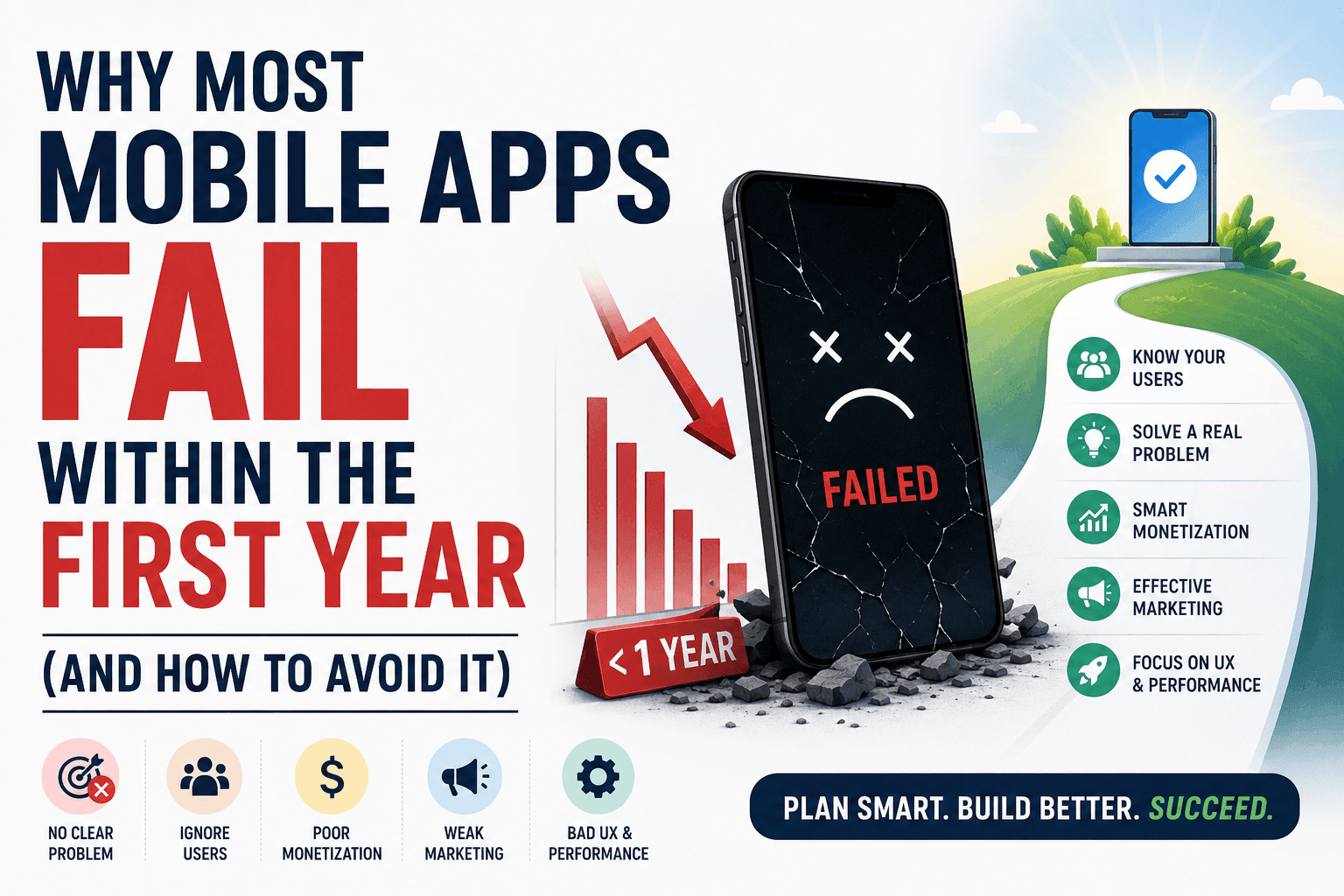
Roughly 90% of mobile apps are abandoned by users within the first 30 days, and a large share never generate enough traction to justify their build cost. That statistic alone should change how founders and product teams approach app development in 2026. The problem is rarely the idea. It's almost always the execution — validation skipped, UX rushed, the wrong development approach chosen, or launch treated as the finish line instead of the starting point.
This guide breaks down exactly why mobile apps fail in their first year, backed by patterns we see repeatedly across startups and enterprises, and gives you a practical framework to avoid becoming another statistic. If you're evaluating mobile app development services or vetting a mobile app development company for your next build, this is the operating knowledge you need before you sign a contract.
The Real Numbers Behind App Failure Rates
Before diagnosing causes, it helps to separate perception from data. "Failure" in mobile apps rarely means a catastrophic crash — it means slow, silent abandonment. Retention data across app categories consistently shows a steep drop-off: most apps lose the majority of their day-one users within a week, and by day 30 only a small fraction remain active.
This isn't unique to under-resourced startups. Enterprise apps fail too, often for different reasons — internal politics, unclear ownership, or building for a stakeholder's wish list instead of the end user's actual workflow. The common thread across both segments is that failure is rarely a single event. It's an accumulation of small, avoidable decisions made early in the build process.
Top Reasons Mobile Apps Fail in Year One
Most first-year app failures trace back to one or more of the following ten causes. Understanding each one is the first step toward building an app development strategy that survives contact with the real market.
1. No Genuine Market Validation
Founders frequently confuse enthusiasm from friends, colleagues, or LinkedIn comments with genuine market demand. Real validation means potential users have shown intent to pay, switch from a current solution, or actively seek out something like your app — not just said: "I'd use that."
Before writing a single line of code, run structured validation: landing page tests with real ad spend, waitlists with a conversion action, or paid pilot programs with 5–10 target customers. If nobody will commit time, money, or workflow change before launch, that's a signal worth listening to.
2. Solving a Problem Nobody Has (Or a Problem That's Already Solved Well)
Many apps fail not because the execution was poor, but because the underlying problem wasn't painful enough, frequent enough, or unaddressed enough to justify switching behavior. Users don't adopt new apps for marginal improvements — they adopt them when the current alternative is genuinely broken.
A useful test: can you name the specific workflow, spreadsheet, competitor app, or manual process your target user currently relies on, and articulate why your solution is at least 10x better on the dimension they care about most? If not, the product needs more discovery before development.
3. Poor UI/UX Design
Users decide whether an app is trustworthy and usable within the first 30–60 seconds. Confusing onboarding, unclear navigation, inconsistent design patterns, and friction-heavy sign-up flows are among the top reasons for immediate uninstalls — even when the core feature set is genuinely valuable.
UI/UX isn't decoration. It's the interface between your business logic and revenue. Apps that invest in usability testing, onboarding flow design, and platform-native interaction patterns (Material Design for Android, Human Interface Guidelines for iOS) consistently outperform functionally similar apps with weaker design.
4. Choosing the Wrong Development Approach
Native, Flutter, and React Native each solve different problems, and picking the wrong one creates cost and performance issues that surface months after launch.
Native Android and iOS development delivers the best performance and deepest access to platform-specific APIs, which matters for apps with heavy graphics, AR/VR, or hardware integration. Flutter offers strong UI consistency across platforms with a single codebase, which suits startups needing to move fast on a budget. React Native works well for teams with existing JavaScript/web expertise and apps that don't push hardware limits.
The mistake isn't picking cross-platform over native, or vice versa — it's picking based on developer familiarity or cost alone, without mapping the decision to performance requirements, target platforms, team long-term maintenance capacity, and how quickly the product needs to scale.
5. Weak MVP Strategy
Two failure patterns show up repeatedly: building too much before validating anything, and building an MVP so minimal it can't demonstrate real value. Both waste runway.
A well-scoped MVP includes only the features required to test the core value proposition with real users, ships in weeks rather than months, and is instrumented from day one to capture usage data. Feature requests that show up after launch based on actual behavior are almost always more valuable than the features planned in a pre-launch brainstorm.
6. Ignoring App Performance & Scalability
Apps that work fine with 50 test users often buckle under 5,000 real ones. Slow load times, laggy animations, API timeouts, and crashes under load are silent killers — users don't file bug reports; they just stop opening the app.
Performance and scalability need to be architectural decisions made early: efficient API design, proper caching, cloud infrastructure that scales elastically (AWS, Google Cloud, Azure), and load testing before any paid user-acquisition push. Retrofitting scalability after a growth spike is expensive and slow — exactly when speed matters most.
7. Security Gaps
Security is treated as an afterthought far more often than it should be, especially in healthcare, FinTech, and eCommerce apps handling sensitive personal or financial data. A single breach, or even a public vulnerability disclosure, can destroy user trust and trigger regulatory consequences (HIPAA, PCI-DSS, GDPR) that are far costlier than doing it right the first time.
Baseline practices — encrypted data at rest and in transit, secure authentication (OAuth 2.0, biometric options), regular penetration testing, and secure API integration — should be non-negotiable parts of the development process, not a post-launch checklist item.
8. No Post-Launch Maintenance & Updates Plan
Launch is the beginning of the product lifecycle, not the end of the project. OS updates, device fragmentation, third-party API changes, and evolving user expectations all require ongoing engineering attention. Apps that go quiet after launch degrade quickly — new OS versions break features, competitors ship improvements, and app store algorithms deprioritize stale apps.
Budget and plan for maintenance the same way you budget for the initial build: bug fixes, performance monitoring, OS compatibility updates, and a regular release cadence driven by user feedback and analytics.
9. Poor Marketing & App Store Optimization (ASO)
A well-built app with no visibility strategy still fails. App Store Optimization — keyword-optimized titles and descriptions, compelling screenshots, review and rating management, and category placement — directly affects organic discovery. Beyond ASO, most successful launches pair a pre-launch waitlist, targeted paid acquisition, and a retention-focused push notification and email strategy, rather than relying on organic downloads alone.
10. Hiring the Wrong Development Partner
This is the root cause behind many of the failures above. Agencies or freelancers that lack process discipline, communicate poorly, underestimate technical complexity, or disappear after launch leave founders with unmaintainable code, missed deadlines, and no post-launch support plan.
The right mobile app development company brings more than coding capacity — it brings product strategy, UX expertise, QA discipline, and a maintenance relationship that extends well past launch day. This is the single highest-leverage decision in the entire process, because it affects every other item on this list.
Industry-Specific Failure Patterns
Failure causes shift depending on the industry, because the stakes and constraints are different.
Doctor Apps
Doctor apps fail most often due to compliance gaps (HIPAA, data interoperability standards like HL7/FHIR) discovered late, clunky clinical workflows that don't match how providers actually work, and integration failures with existing EHR systems.
FinTech Apps
FinTech failures usually trace back to trust and security shortfalls, regulatory non-compliance (PCI-DSS, KYC/AML), and onboarding friction that causes high drop-off during account verification — the exact moment trust needs to be highest.
eCommerce Apps
eCommerce apps commonly fail due to slow checkout flows, poor product discovery/search, unreliable inventory sync with backend systems, and weak personalization compared to established marketplace apps users already trust.
AI-Powered Apps
AI apps fail when the AI feature is a novelty rather than a workflow improvement, when latency undermines the user experience, or when the underlying model isn't fine-tuned or grounded well enough to be reliably useful — leading to a credibility collapse after early trial use.
How a Professional Mobile App Development Company Prevents These Failures
A capable mobile app development company doesn't just execute a spec — it actively de-risks the build through a structured process. Here's what that looks like in practice:
- Discovery & validation workshops before any development begins, to pressure-test assumptions about the target user and problem
- UX research and prototyping to validate flows with real users before committing engineering time
- Technical architecture planning that accounts for scalability, security, and third-party integrations from day one
- A phased MVP roadmap with clear success metrics tied to user behavior, not just feature completion
- QA and security testing built into every sprint, not bolted on before launch
- A defined post-launch support and maintenance plan, including monitoring, analytics, and iteration cadence
Framework: The 90-Day Post-Launch Survival Plan
The first 90 days after launch determine whether an app builds momentum or quietly dies. This framework structures that window into three focused phases.
Days 1–30: Stabilize
Monitor crash rates, API error rates, and load performance daily. Fix critical bugs within 24–48 hours. Set up analytics (Firebase, Mixpanel, or Amplitude) to track activation, first-session behavior, and drop-off points precisely.
Days 31–60: Learn
Analyze retention cohorts and identify where users disengage. Run user interviews or in-app surveys with early adopters. Prioritize the two or three highest-impact UX or feature fixes based on data, not internal opinion.
Days 61–90: Iterate & Scale
Ship the prioritized improvements. Begin structured user-acquisition testing (paid channels, ASO refinement, referral loops) only once retention metrics show the product holds users — scaling acquisition before retention is solved just accelerates churn.
Build vs. Buy: In-House Team vs. Outsourcing to Mobile App Development Services
This is one of the highest-stakes decisions founders and product leaders make. Here's how the two approaches compare across the factors that actually determine outcomes.
| Factor | In-House Team | Outsourced Mobile App Development Services |
|---|---|---|
| Speed to Launch | Slower — hiring and onboarding take time | Faster — experienced team is ready to start |
| Upfront Cost | High fixed costs (salaries, benefits, tools) | Variable cost based on project scope |
| Expertise Breadth | Limited to the skills of hired employees | Access to specialists in UX, QA, security, DevOps, and more |
| Long-Term Ownership | Full internal knowledge and ownership | Requires clear documentation and IP transfer agreements |
| Team Scalability | Slower to expand or reduce the team | Flexible — team size can scale with project needs |
| Best Fit | Mature products with long-term development roadmaps | MVPs, startups, and businesses without an in-house tech team |
Common Mistakes Startups Make When Choosing App Development Services
- Choosing a vendor purely on the lowest quote without evaluating portfolio depth or technical due diligence
- Skipping a discovery phase and jumping straight into development based on a rough idea
- Not clarifying IP ownership, source code access, and post-launch support terms before signing
- Underestimating the maintenance budget needed after launch
- Prioritizing feature quantity over UX quality in the MVP
- Failing to define measurable success metrics before development starts
Expert Tips for Long-Term App Success
- Treat your first 1,000 users as a research group, not a growth milestone — their behavior data is more valuable than their download count
- Instrument analytics before launch, not after — you can't fix what you can't measure
- Budget 15–20% of your initial build cost annually for maintenance and iteration
- Choose a technology stack based on your 3-year roadmap, not just your MVP requirements
- Involve real users in usability testing before every major release, not just at launch
Industry Trends Shaping App Success in 2026
- AI-native features (personalization, predictive UX, in-app assistants) are becoming baseline user expectations rather than differentiators
- Cross-platform frameworks like Flutter continue closing the performance gap with native, making them viable for a wider range of use cases
- Privacy-first design and on-device processing are increasingly required by both regulation and user expectation
- Super-app style ecosystems and deep API integrations are replacing single-purpose apps in competitive categories
- Continuous, data-driven iteration is replacing the traditional "build, launch, forget" cycle as the standard operating model
Conclusion
Most hire app developer don't fail because the idea was bad. They fail because of avoidable execution gaps: skipped validation, weak UX, the wrong technical approach, no scalability planning, or a development partner without the process discipline to catch these issues before they become expensive.
The good news is that every failure pattern covered here is preventable with the right process and the right team. If you're planning a new app or trying to figure out why an existing one isn't gaining traction, the fastest path forward is a structured technical and UX audit — not more guessing.
Ready to build an app that survives past launch day? Talk to our team for a free consultation and app strategy audit. We'll assess your idea, technical approach, and go-to-market plan before you spend a single dollar on development — so your app is built to last well beyond year one.