
Why Most Restaurant Apps Get Deleted After the First Order (And How to Build One Guests Keep)
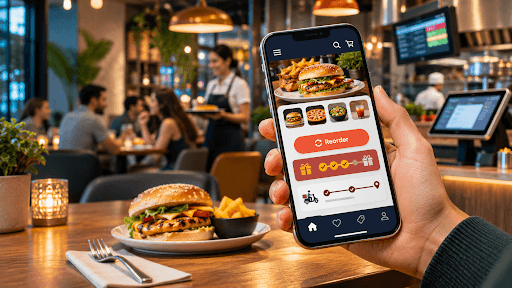
You paid for the app. You put the QR code on every table and offered 20% off the first order. Downloads came in.
Then the orders stopped.
If that sounds familiar, you're not alone. Food and drink apps keep fewer than 4 out of 100 users after 30 days. That's one of the lowest rates of any app category.
The good news is that this has much less to do with your food than with how the app was built. Here's why guests delete restaurant apps, and how smarter restaurant app development turns one-time downloads into regulars.
Why Do Restaurant Apps Get Deleted So Fast?
Quick answer: Most restaurant apps get deleted after the first order because they give guests no reason to come back. Common causes include slow or confusing checkout, forced account sign-ups, no loyalty rewards, weak or annoying notifications, prices that don't beat third-party apps, and buggy performance. If the second order isn't easier or more rewarding than the first, guests go back to DoorDash, Uber Eats, or a phone call.
Simply put, an app has to earn its place on someone's phone. A guest who orders once a month won't keep an app that feels like extra work.
The Numbers: How Bad Is Restaurant App Retention?
| Metric | Benchmark | Source |
|---|---|---|
| Food & Drink apps still in use after 30 days | 3.6% (iOS), 2.9% (Android) | Braze, 2026 |
| Food & Drink apps still in use the day after install | 13% | Adjust |
| Average Android apps uninstalled within 30 days | 46.1% (48% in the US) | AppsFlyer |
| Top uninstall reason: "never used it" | 26% of users | AppsFlyer |
| Loyalty members' return rate vs. non-members | Nearly 30% vs. 7% | Toast, Q1 2026 |
Read that last row again. According to Toast's Q1 2026 data, getting a guest into a loyalty program raises their return rate from 7% to nearly 30%, about four times higher.
In other words, retention isn't luck. It depends on what the app is designed to do after the first order.
7 Reasons Guests Delete Your App After One Order
1. Ordering Takes Longer Than Calling
If it takes ten taps, three screens, and a password reset to order a burrito, the guest won't do it twice. Compare that with third-party apps, where a reorder takes about two taps.
Fix: Add one-tap reorder, saved addresses, Apple Pay and Google Pay, and guest checkout.
2. You Forced an Account Before They Saw the Menu
Many apps ask for a name, email, phone number, and password before showing a single menu item. As a result, many guests close the app right there.
Fix: Let people browse and order first. Then ask them to create an account to save their order and earn rewards.
3. There's No Reason to Come Back
This is the biggest one. A first-order discount brings in downloads, but with nothing after it, there's no habit.
Meanwhile, guests are already juggling plenty of rewards apps. Upside's 2026 study found that 86% of consumers say loyalty rewards matter, yet only 38% use a restaurant program regularly.
Fix: Build loyalty into the app from day one. Use points, punch cards, a free item on the fifth order, or birthday rewards, and show progress every time the guest opens the app.
4. The App Doesn't Remember Them
Guests expect apps to know their usual order. In fact, PYMNTS reports that 68% of consumers are strongly interested in restaurant apps that remember past orders.
Fix: Save favorites, order history, dietary preferences, and "your usual" shortcuts.
5. Notifications Feel Like Spam
Some apps send nothing. Others send daily "Hungry? burger messages until the guest deletes the app. Both approaches lose people.
Fix: Send fewer, smarter messages: order updates, reward reminders ("You're one order away from a free dessert"), and offers based on what that guest actually orders.
6. It's Not Cheaper or Better Than Third-Party Apps
If your app costs the same as DoorDash but has fewer features, there's no reason to use it. On top of that, Restaurant Business reported that third-party service fees dropped to an average of $5.14, while first-party delivery fees averaged $5.96.
Fix: Give app users a clear advantage, such as member-only prices, free pickup upgrades, exclusive menu items, or early access to specials.
7. It Crashes, Lags, or Gets Orders Wrong
One failed payment or a wrong order at pickup can end the relationship. Usually it happens because the app isn't connected properly to the POS or the kitchen.
Fix: Integrate the app with your POS (Toast, Square, Clover) and kitchen display system, and test it under real Friday-night traffic.
What Do Guests Actually Want From a Restaurant App?
When you strip it down, guests want three things: speed, savings, and recognition.
| Guest Wants | Feature That Delivers It |
|---|---|
| Speed | One-tap reorder, saved payment, real-time order tracking |
| Savings | Loyalty points, member-only deals, rewards progress bar |
| Recognition | Saved favorites, personalized offers, birthday rewards |
| Reliability | POS integration, accurate wait times, stable performance |
| Control | Easy customization, allergen filters, scheduled pickup |
Loyalty matters most of all. The National Restaurant Association reports that 61% of delivery customers consider loyalty membership when choosing where to order.
How Do You Build a Restaurant App People Keep?
Here's the process we follow when building apps for restaurants:
- Start with the second order, not the first. Design every screen around one question: why would this guest come back?
- Map your real ordering flow. Look at how orders reach the kitchen, how pickup works, and where mistakes happen.
- Build a focused first version. Launch with ordering, payments, loyalty, and order tracking, and save the extras for later. Our MVP development approach keeps costs down and gets you live faster.
- Integrate with your POS and kitchen. That way, orders flow straight to the kitchen without someone retyping them.
- Set up smart notifications. Trigger them by behavior, such as reward milestones or a guest who hasn't ordered in 21 days, rather than on a schedule.
- Test under real traffic. Simulate dinner rushes before launch, not after.
- Track retention, not just downloads. Watch reorder rate, Day 30 retention, and loyalty sign-ups.
- Keep improving after launch. Regular updates, new rewards, and bug fixes keep the app fresh. Our app maintenance and support team handles this for you.
Branded App vs Third-Party Apps: Which Is Better?
You probably don't need to pick just one. Here's how they compare:
| Factor | Third-Party Apps (DoorDash, Uber Eats) | Your Own Branded App |
|---|---|---|
| Commission | Uber Eats charges 20–30% per delivery order | No per-order commission |
| Customer data | Owned by the platform | Owned by you |
| Discovery | Strong: 51% of US consumers browse third-party apps to choose | Weaker, so you need to promote it |
| Loyalty | Platform-wide, not yours | Fully yours to design |
| Branding | You're one listing among hundreds | 100% your brand |
| Best use | Finding new customers | Keeping repeat customers |
The smartest restaurants use both. They treat third-party apps as a way to find new guests, then move those guests to their own app with better rewards.
For example, a pizza chain might add a card to every DoorDash bag: "Order direct next time, get 2x points and free garlic knots." Each guest who switches saves the restaurant a commission on every future order.
Mistakes Restaurants Make When Launching an App
- Launching without loyalty. It's the main feature that brings guests back.
- Copying a template app. Generic apps feel generic, and guests notice.
- Skipping POS integration. Manual order entry causes delays and mistakes.
- Measuring downloads instead of reorders. 10,000 downloads mean nothing if only 300 people order again.
- Not promoting the app in the restaurant. Staff, receipts, table tents, and pickup bags should all mention it.
- Forgetting post-launch updates. An app that never changes slowly loses users.
How Much Does a Restaurant App Cost?
It depends on features, platforms, and integrations. As a guide, a focused ordering app with loyalty and POS integration is often a good place to start. More advanced features, such as multi-location support, delivery management, or AI recommendations, add to the cost.
For realistic ranges, check our cost and timeline benchmarks. Our fixed-price packages start at $15,000.
Why Restaurants Choose TechReforms
We don't build apps that just look nice in the App Store. We build apps designed to get the second, third, and tenth order.
Our restaurant app development services include:
- Online ordering and one-tap reorder for pickup, delivery, and dine-in
- Loyalty and rewards programs built right into the app
- POS and kitchen integrations with platforms like Toast, Square, and Clover
- Smart push notifications triggered by guest behavior
- Multi-location support for growing restaurant groups
- iOS and Android apps, often built cross-platform with Flutter or React Native
- Analytics dashboards that track reorders and retention, not just downloads
As a US-based restaurant app development company headquartered in Los Angeles, we've launched 350+ live apps and hold a 5.0★ rating on Clutch. Since our pricing is fixed, you'll know the cost before any work begins.
And because we work as a focused restaurant app development agency, you get senior developers and designers who understand how restaurants actually run, from the Friday dinner rush to the Monday slowdown.
Stop Paying for Downloads That Never Order Again
Your app should be your best-performing server. It should know every guest's favorite order, remind them when they're one meal away from a reward, and save you a commission every time.
Here's what you get with TechReforms:
- A free strategy call to review your current ordering setup
- A retention-first app plan built around repeat orders
- A fixed-price quote with no hidden fees
- POS integration, loyalty, and smart notifications included in your plan
- Support long after launch
Conclusion
Restaurant apps don't get deleted because guests dislike the food. They get deleted because the app makes the second order harder than it needs to be, or gives guests no reason to bother.
Fix the speed, reward the habit, and remember the guest, and you'll see an app that keeps people ordering for years.
If you're ready to build one that works, talk to the TechReforms team today. Let's turn your one-time downloads into regulars.
Frequently Asked
Questions
Most people delete restaurant apps because the app gives them no reason to return. Slow checkout, forced sign-ups, no loyalty rewards, spammy notifications, and no price advantage over third-party apps are the most common reasons.
Food and drink apps keep only about 3–4% of users after 30 days on average. Any rate above that beats the category benchmark. Apps with built-in loyalty programs usually do much better.
Yes. Toast's Q1 2026 data shows that enrolling a guest in a loyalty program raises their return rate from 7% to nearly 30%, about four times higher.
Most restaurants benefit from both. Third-party apps help new guests find you, while your own app avoids commissions of up to 30% and lets you own customer data and loyalty.
The essentials are fast ordering, one-tap reorder, saved payments, loyalty rewards, order tracking, smart notifications, and POS integration. Multi-location support and personalized offers are valuable next steps.