
Will AI Replace Mobile App Developers?
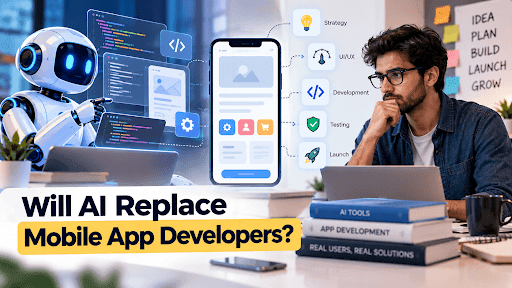
If you’ve watched an AI tool spit out a working login screen in thirty seconds, you’ve probably wondered whether anyone still needs to pay a developer. It’s a fair question, and the people asking it aren’t only developers. Founders, product managers and business owners are doing the same math on their budgets.
The short answer is no, AI isn’t going to replace mobile app developers. It is changing what they do all day, and that matters if you’re planning to build an app this year.
What AI Does Well in App Development
Let’s give AI its credit first. It’s good at:
- Generating repetitive code, such as forms, list views and API calls
- Explaining unfamiliar errors and suggesting fixes
- Writing first drafts of unit tests
- Producing quick UI prototypes for discussion
- Translating code from one language to another
Used well, this saves hours on routine work. A senior developer with AI tools simply gets more done in a day, which is good news for your timeline.
Where AI Still Falls Short
Here’s the part that rarely makes it into the hype.
It doesn’t understand your business. AI can build a checkout flow, but it can’t tell you that your customers abandon carts because they don’t trust unfamiliar payment screens. That comes from experience with real users.
It makes confident mistakes. AI-generated code often looks right and still hides security gaps or performance problems. Someone experienced has to catch them before your users do.
It struggles with architecture. An app built from stitched-together AI snippets may work in the demo and crumble at 50,000 users. Good structure is planned, not patched in.
It can’t carry responsibility. If you’re handling health records or payments, you need a team that can answer for compliance. “The AI wrote it” won’t satisfy an auditor, or the App Store review team.
How Mobile App Development Actually Works
To see why developers stay essential, look at what a real project involves. A proper mobile app development company follows roughly these stages:
- Discovery and requirements. Defining the problem, the audience, the must-have features and the risks.
- UI/UX design. Wireframes and mockups, so you see the experience before anything is built.
- Development. Building the front end, back end and integrations in short sprints.
- Testing and QA. Checking every flow on real devices, not just emulators.
- Launch. App Store and Google Play submission, which has its own rules and rejection traps.
- Support and updates. Fixing bugs, patching security issues and adding features after release.
AI can help at several of these steps. It can’t run the whole thing. Most of the value sits in judgment calls between the steps, such as what to cut, what to build first and what to leave alone.
Key Components of Modern Mobile App Development Services
When people search for mobile app development services, they’re usually looking for a mix of the following:
- iOS and Android development. Native apps built with tools like Apple’s Xcode and Android Studio for the best platform-specific performance.
- Cross-platform development. One codebase for both platforms using Flutter or React Native, which usually lowers cost and shortens timelines.
- Backend and API work. The servers, databases and integrations that make the app function.
- UI/UX design. Interfaces people can actually figure out.
- Security and compliance. Encryption, access control and privacy rules, especially for finance and healthcare.
- AI features. Chat assistants, smart search and recommendations, which is where AI becomes part of the product rather than a threat to the people building it. If that’s your plan, a team experienced in AI development can wire it in properly.
Businesses that want end-to-end app development services get all of this from a single team, so strategy, design, code and testing don’t get lost between vendors.
Benefits of Working With Human Developers (Who Use AI)
The best teams today aren’t choosing between people and AI. They use both. Here’s what that gets you:
- Faster delivery. AI handles routine tasks while developers focus on hard problems.
- Cleaner code. Experienced engineers review and fix everything the tools produce.
- Smarter decisions. Someone who has launched dozens of apps knows which features users ignore.
- Lower risk. Security, performance and store compliance get checked by people who’ve been burned before.
- Accountability. When something breaks, there’s a real team to fix it.
If you need extra capacity without a long hiring process, you can hire mobile app developers on a flexible basis through staff augmentation and plug them straight into your existing team.
Mobile App Development Cost: What to Expect
This is the question behind most searches, so let’s be direct. Mobile app development cost depends on complexity, platforms, design depth, integrations and the team you choose. If you’re wondering how much does it cost to build an app, these ranges are a realistic starting point:
| App Type | Typical Cost Range |
|---|---|
| Lean MVP | $15,000–$25,000 |
| Full-Featured Consumer App | $50,000–$120,000 |
| Enterprise or Fintech App | $150,000–$200,000+ |
App Development Cost Breakdown
- A solid app development cost breakdown usually splits like this:
- Discovery and planning
- UI/UX design
- Front-end and back-end development
- Third-party integrations (payments, maps, chat, analytics)
- Testing and QA
- Launch and store submission
Ask any vendor for a line-by-line version of these. If they can’t give you one, treat that as a warning sign.
iOS vs Android App Development Cost
When comparing iOS vs Android app development cost, the gap is smaller than people assume. Android often takes a bit longer because of the range of devices to test. iOS tends to cost more per hour in some markets but needs less device testing. Building both natively roughly doubles the front-end work, which is why many startups pick Flutter or React Native and cover both platforms from one codebase.
MVP Development Cost
MVP development cost is where smart founders start. A minimum viable product gets your core idea in front of real users in weeks, not months, before you commit to a bigger budget. Specialist MVP app development services like TechReforms’ MVP development offering focus on the one problem your app solves, so you learn fast and spend carefully.
App Maintenance Cost
Launch isn’t the finish line. App maintenance cost is commonly estimated at around 15–20% of the original build per year, covering OS updates, bug fixes, server costs and security patches. Skipping it is the quickest way to end up with a broken app and bad reviews. A dedicated app maintenance and support plan keeps that predictable.
App Development Hourly Rates by Country
App development hourly rates by country vary a lot. As rough, widely quoted ballparks:
- United States: about 100–200 per hour
- Western Europe: about 80–150 per hour
- Eastern Europe: about 40–80 per hour
- South Asia: about 20–50 per hour
Cheaper isn’t automatically better. Communication, time zones, code quality and post-launch support affect the real price far more than the hourly figure does. Treat these as estimates and always compare actual quotes.
Native vs Cross-Platform vs AI-Generated: A Quick Comparison
| Factor | Native | Cross-Platform | AI-Generated Only |
|---|---|---|---|
| Performance | Best | Near-Native | Unpredictable |
| Cost | Higher | Moderate | Low Upfront, High Later |
| Speed to Market | Slower | Faster | Fast for Demos |
| Scalability | Strong | Strong | Often Weak |
| Best For | Performance-Heavy Apps | Most Startups and Businesses | Throwaway Prototypes |
AI-generated code works as a starting point or a sketchpad. For anything customers will rely on, you still want an engineering team behind it.
Practical Examples
A startup MVP. A founder wants a fitness app. AI helps the developers scaffold screens in days instead of weeks. Developers still design the data model, set up secure logins and make sure the app doesn’t crash when 5,000 people sign up after a launch post.
An enterprise rollout. A logistics company needs a field-team app that works offline across warehouses. AI can draft sync logic, but a human engineer has to test it against dropped connections and edge cases. This kind of enterprise mobile app development involves integrations, permissions and compliance that no prompt covers.
A healthcare app. Patient data demands encryption, audit logs and HIPAA-aware design. Here the cost of an AI mistake is far too high to skip experienced review.
So What Happens to Developers?
The job is shifting, not vanishing. Developers who only copy and paste routine code will feel pressure, the same way every industry feels it when tools improve. The ones who understand architecture, users and business goals become more valuable, because they can deliver more with the same hours.
For businesses, the practical takeaway is simple. Pick a team that uses AI to work faster but still takes full responsibility for the result. For a broader look at how developers see this shift, the Stack Overflow Developer Survey tracks how widely AI tools are actually used in day-to-day work.
Frequently Asked
Questions
Unlikely. AI speeds up coding tasks, but planning, architecture, security, testing and accountability still need skilled people. The role is evolving rather than disappearing.
You can build a basic prototype, yes. A production app with payments, user data, store approval and long-term support needs experienced developers to make it reliable.
It can reduce the time spent on routine coding, which helps keep costs down. It doesn’t remove design, testing, compliance or maintenance costs, so total savings are modest rather than dramatic.
Freelancers suit small, well-defined tasks. An app development agency suits businesses that want strategy, design, development and QA from one accountable team. In-house works when app development is core to your company and you can afford long-term hiring.