
Your Doctor App Is Outdated Without These AI Features in 2026
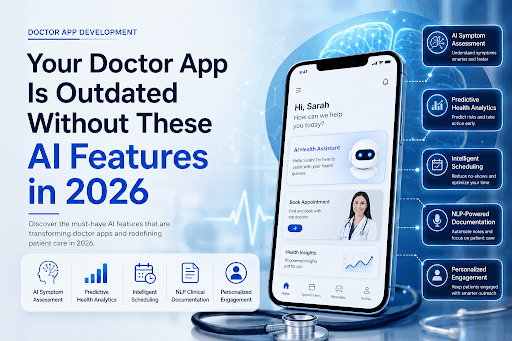
Digital health investment crossed $29 billion globally in 2025. Most of it went into AI. The platforms receiving that investment are not building smarter appointment systems; they are building clinical intelligence that predicts, personalizes, and prevents. If your doctor app was built before AI became the baseline expectation, it was not just left behind. It was lapped.
This is not about trends. What is happening in healthcare technology right now is structural: the entire relationship between patients and digital health platforms is being redefined by machine intelligence. The right medical app development company understands this is not about adding AI as a checkbox. It is about rebuilding the product philosophy around what AI makes possible. At TechReforms, that distinction drives every healthcare product we build.
The Patient Has Changed. Has Your App?
Today's patients do not evaluate doctor apps on whether they work. That is assumed. They evaluate them on whether the app feels intelligent, whether it learns from them, anticipates needs, and communicates like it understands their situation.
When a doctor app fails that benchmark- asking returning patients to re-enter information it already holds, sending identical reminders to every user, offering no intelligence beyond a booking calendar- patients do not complain. They leave quietly and find something better.
The platforms investing in doctor on demand app development with embedded AI have understood one thing: convenience was the entry fee. Intelligence is the retention strategy.
AI Features That Define a Competitive Doctor App in 2026
1. Clinical-Grade AI Symptom Assessment
The symptom checkers from five years ago were decision trees dressed as technology. Patients used them once, got told to consult a doctor regardless of input, and never returned.
What leading doctor apps deploy today is different. Natural language processing allows patients to describe symptoms conversationally while AI interprets clinical meaning from unstructured input. Contextual risk stratification ensures identical symptoms carry different weight depending on age, conditions, and medication history. Severity gets assessed before the patient reaches a clinician, so consultations begin with context already established.
Clinicians spend less time gathering information and more on actual diagnosis. Patients arrive less anxious because their concern has already been acknowledged intelligently.
2. Predictive Health Analytics
The most expensive healthcare is the kind nobody saw coming. Predictive analytics built into a doctor app directly attacks that cost for patients, providers, and the broader system.
Modern predictive systems monitor longitudinal patient data across appointments, lab results, and self-reported symptoms. They identify deterioration patterns before they become acute and generate automated proactive outreach triggered by AI-detected risk signals, not by patients deteriorating far enough to book their own appointment.
A patient managing hypertension has three consecutive readings trending upward over six weeks. They have not flagged it. The AI does. A coordinator follows up. Medication is adjusted. A cardiac event is interrupted. That is a clinical outcome, not a feature demonstration.
3. Intelligent Scheduling and No-Show Prevention
Appointment no-shows cost the healthcare industry billions annually. Most apps treat this as a logistics problem. It is a behavioral problem, and behavioral problems are where AI delivers disproportionate value.
AI-powered scheduling generates individual no-show probability scores based on each patient's specific history. Reminder logic, channel, timing, and frequency are determined by what has worked for each patient previously. Cancellation slots fill in real time through automated waitlist activation without staff involvement.
Any credible medical app development agency will confirm this: intelligent scheduling consistently recovers 15 to 25 percent of revenue lost to attrition, typically covering the entire AI investment within the first operating year.
4. NLP-Powered Clinical Documentation
Physicians spend nearly two hours on documentation for every one hour of direct patient care. That ratio has driven one of the worst burnout crises the profession has seen.
NLP integrated into a doctor app transcribes consultations in real time, auto-generates SOAP notes from conversation, recommends ICD-10 and CPT billing codes, and syncs with EHR systems to eliminate redundant data entry.
What changes beyond efficiency is harder to measure but more important. A physician not mentally composing notes is fully present. Subtle cues get caught. The patient feels genuinely heard. Clinical accuracy and satisfaction both improve because AI returned the clinician's attention to where it belongs.
5. Personalized Patient Engagement and Retention Intelligence
Patient acquisition is a marketing problem. Patient retention is a product quality problem. Most doctor apps invest heavily in the first and ignore the second.
Retention AI delivers dynamic content personalization based on where each patient is in their health journey. It calibrates reminders to individual behavioral patterns rather than broadcast schedules and monitors engagement signals to identify disengaging patients before they churn silently.
Platforms using medical app development services with retention AI consistently show twelve-month retention rates two to three times higher than platforms running generic strategies, translating directly into clinical outcomes and sustainable revenue.
6. AI-Integrated Mental Health Screening
The separation between physical and mental health in digital platforms has never reflected how human health works. In 2026, patients expect whole-person care from a single platform.
AI-powered mental health tools deliver validated PHQ-9 and GAD-7 screening conversationally so assessments feel like a genuine check-in. Longitudinal mood tracking identifies concerning trends across weeks. Between-appointment support uses evidence-based cognitive behavioral approaches for mild to moderate presentations. When screening indicates acute risk, escalation protocols notify the right clinical contact within a defined window.
7. Computer Vision for Remote Clinical Assessment
Computer vision AI in production doctor apps is performing real clinical work. Patients photograph skin concerns and receive preliminary analysis before teleconsultation begins. Post-surgical recovery gets documented through images analyzed for healing progression and infection indicators. Prescription photographs confirm dispensing accuracy against the record.
For rural patients, elderly patients, and anyone for whom an in-person visit represents a genuine barrier this is not a convenience feature. It is the difference between receiving care and not receiving care.
The Performance Gap Is Already Measurable
| Metric | Standard Doctor App | AI-Integrated Doctor App |
|---|---|---|
| 12-Month Retention | 28–34% | 72–81% |
| No-Show Rate | 18–23% | 7–11% |
| Documentation Time | 2 hrs per patient hour | 40 min per patient hour |
| Satisfaction Score | 3.4 / 5.0 | 4.6 / 5.0 |
Every number represents revenue, outcomes, and reputation. The gap widens every quarter.
Build It Right, Not Just Fast
At TechReforms, compliance architecture is established before design begins. HIPAA, GDPR, and regional regulations are embedded from week one. AI training data strategy is defined before models are built. EHR integrations are scoped against real clinical workflows. Testing happens with practicing clinicians and actual patients.
The doctor apps that define the next five years of digital health will be built by teams that answered these questions correctly at the beginning.
The Decision in Front of You
Your competitors are not waiting. Platforms already running AI-powered scheduling, predictive analytics, and NLP documentation are accumulating advantages that compound every month.
The question is not whether AI belongs in your doctor app. Patients have already answered that. The question is whether your organization leads this transition deliberately or reacts after the numbers make the cost of waiting impossible to ignore.
TechReforms builds healthcare technology that clinicians trust and patients actually use, from compliance architecture and clinical AI through to launch and long-term performance.