
AI Matchmaking Algorithms: How Dating Apps Use Machine Learning to Match Users
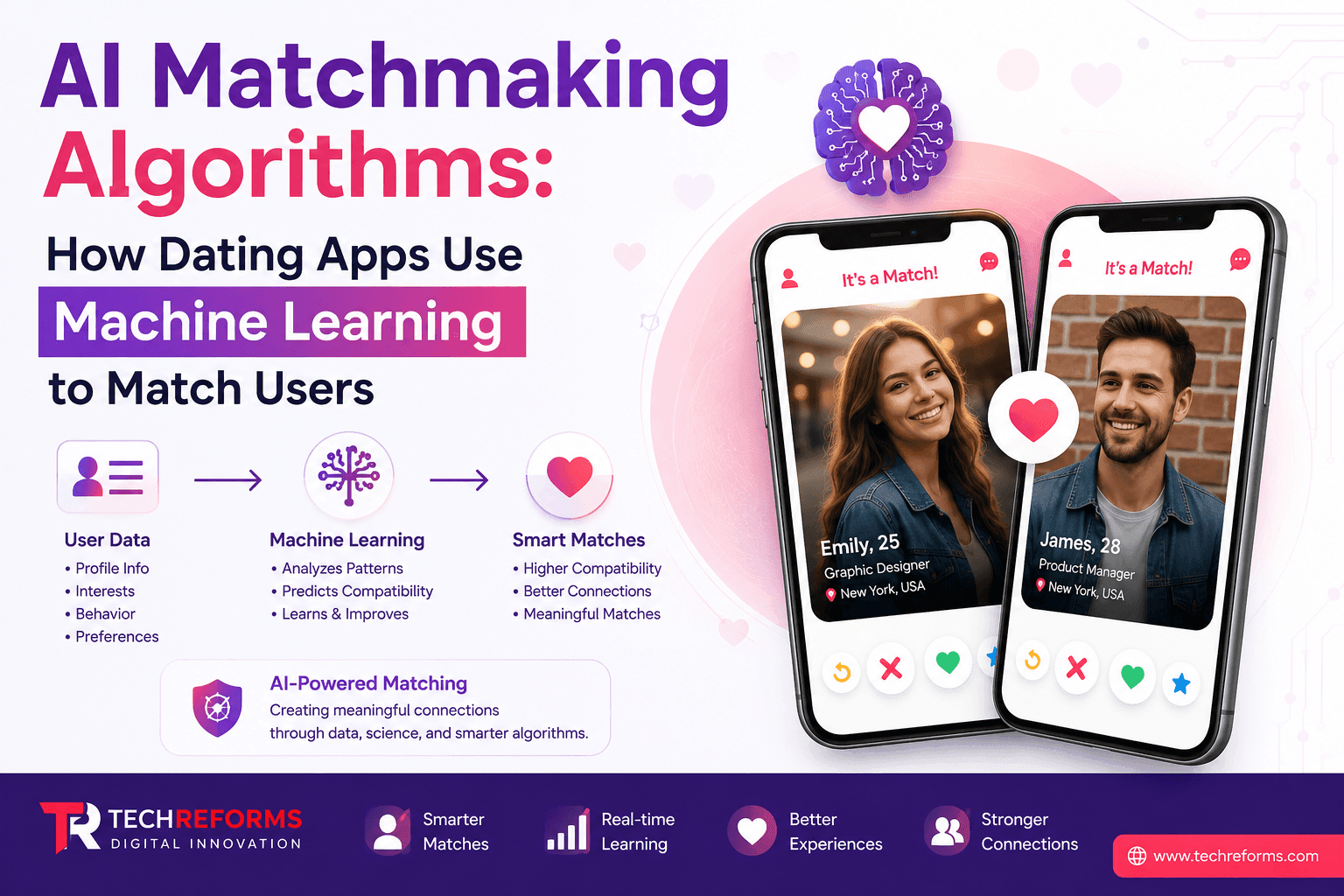
Every dating app makes the same promise: show me someone I'll actually like. Delivering on that promise at the scale of millions of users is not a UX problem, it's a machine learning problem. The stack behind a modern dating app now looks closer to a recommendation engine at a streaming platform than a simple filter-and-swipe directory.
This guide breaks down the actual AI and ML systems powering today's matchmaking apps, including the models Hinge, Tinder, and Bumble have publicly confirmed using, the data pipelines that feed them, where these systems fail, and what it takes to build one if you're planning to enter this market.
1. What Is an AI Matchmaking Algorithm?
An AI matchmaking algorithm is a system that predicts compatibility and mutual interest between two users, then ranks or filters the pool of potential matches accordingly. Instead of a static rule ("show me everyone within 25 miles who is 28-35"), the algorithm continuously learns from behavior: who you like, who likes you back, who you message, and who you ignore, then updates its predictions in real time.
Technically, this sits at the intersection of three disciplines: recommendation systems (the same category powering Netflix and Spotify), stable matching theory (a branch of game theory and combinatorics), and behavioral modeling (using implicit signals rather than stated preferences to predict outcomes).
Expert Insight
The biggest misconception founders bring to us is that "matching" and "ranking" are the same problem. They are not. A ranking model decides which profiles enter your queue and in what order. A matching model decides which pairings are mutually stable. Most successful dating apps run both, not one.
2. From Rule-Based Filters to Machine Learning: A Quick Evolution
Early dating platforms (2000s-era Match.com, eHarmony's original engine) relied on rule-based filtering: users filled out long questionnaires, and a scoring formula compared attributes against attributes. This worked, but it was static, expensive to maintain, and blind to real behavior. Someone could say they wanted a "homebody" and consistently swipe right on nightlife-heavy profiles, and the system would never notice the contradiction.
The swipe-based generation (Tinder, 2012 onward) introduced a critical shift: every swipe became a labeled data point. That unlocked collaborative filtering and, later, deep learning models trained directly on interaction data instead of self-reported surveys. This is the same shift streaming and e-commerce platforms went through a decade earlier, and it's why dating app engineering teams increasingly hire from recommendation-systems backgrounds rather than pure mobile development backgrounds.
3. The Core ML Techniques Behind Modern Dating Apps
Most production matchmaking systems combine several of the following techniques rather than relying on a single model.
Collaborative Filtering
Collaborative filtering predicts your preferences based on the behavior of users who behave similarly to you, without needing to understand why. If users with a swiping history like yours consistently match with a certain profile type, that profile type gets surfaced to you too. This is the same logic behind "customers who bought this also bought." It's powerful because it captures patterns humans can't articulate about themselves, and it's the technique Hinge has referenced when it talks about identifying users whose liking history converges on the same people.
Content-Based Filtering and Profile Vectorization
Content-based models convert a profile (bio text, interests, prompts, stated preferences) into a numerical vector, then compare vectors using similarity measures like cosine similarity. Two profiles that mention hiking, a specific coffee order, and similar humor styles will sit closer together in vector space than two profiles with no overlap. This technique matters most for new users, where there isn't enough interaction history yet for collaborative filtering to work well, a known limitation called the "cold start" problem.
Natural Language Processing (NLP) for Bios and Conversations
NLP models extract structured meaning from unstructured text: bios, prompt answers, and, in some apps, the tone and content of early conversations. This is used to detect shared interests, communication style, humor compatibility, and increasingly, red flags like manipulative or aggressive language patterns for safety moderation. Voice and video prompts add another modality, and apps are now applying speech and sentiment analysis to those clips as well.
Computer Vision for Photo Analysis and Verification
Computer vision serves two very different purposes on dating apps. First, safety: photo verification systems use facial recognition and liveness detection to confirm a user's photos match a live selfie, reducing catfishing and bot accounts. Second, ranking: some platforms use image-quality and composition scoring to understand which photos perform better, though public commentary from Photofeeler-style analyses suggests photo quality remains one of the single heaviest factors in swipe decisions across nearly all swipe-based apps.
Graph Neural Networks and Stable Matching Models
This is where hire dating apps developer diverge most from generic recommendation engines. A shopping recommendation only needs to predict what you'll like. A dating match needs mutual interest on both sides simultaneously, which is a two-sided matching problem, not a one-sided ranking problem. Hinge has publicly confirmed it runs a variant of the Gale-Shapley algorithm (the Nobel Prize-winning stable matching model originally built for problems like medical residency placement) layered under a machine learning system that predicts each side's ranked preferences before the stable matching logic runs.
In practice, this means the app builds a predicted preference list for you and a predicted preference list of you for everyone else, then looks for pairings where neither side would rather be matched with someone else in the pool. That's a materially different (and generally higher-satisfaction) outcome than simply showing you the most popular profiles.
Reinforcement Learning and Engagement Optimization
Reinforcement learning models treat each shown profile as an action and each swipe, match, or conversation as a reward signal, continuously adjusting what gets shown to maximize a defined outcome. The critical design decision here is what outcome the model is trained to maximize. An app optimizing purely for swipes and time-in-app will produce a very different (often worse) user experience than one optimizing for successful, mutually reported dates. This is one of the more scrutinized parts of dating app AI, since engagement-maximizing objectives can conflict directly with a user's actual goal of leaving the app for a real relationship.
4. How Real Dating Apps Use AI Matching: Hinge, Tinder, Bumble, OkCupid
Public statements from these companies give a useful, if incomplete, picture of how production systems differ in practice.
| Dating App | Core Matching Model | Primary Signal Used | Design Philosophy |
|---|---|---|---|
| Hinge | Machine learning layered on a variant of the Gale–Shapley stable matching model | Likes, comments, prompt engagement, and post-date feedback | Optimizes for mutually compatible, long-term pairings rather than popularity |
| Tinder | Dynamic multi-signal ranking model (Elo-based scoring retired in 2019) | User activity, mutual interest, proximity, and engagement patterns | Optimizes for rapid discovery and a high volume of mutual matches |
| Bumble | Behavioral and preference-based ranking with women-first messaging rules | Response rates, conversation initiation, and stated preferences | Prioritizes safety, quality interactions, and reduced unsolicited messaging |
| OkCupid | Vector-based compatibility scoring using structured questionnaire responses | Compatibility questions weighted by user-defined importance | Focuses on shared values, interests, and lifestyle compatibility over appearance |
Hinge has been the most transparent about its stable-matching approach, explicitly citing Gale-Shapley in interviews and its own "Most Compatible" feature explanation, layered with machine learning that reads liking and commenting behavior rather than relying on explicit rankings from users. Its post-date feedback prompts ("Did you meet up?" and "Would you go out again?") feed a longer-term accuracy loop back into the model.
Tinder retired its original Elo-style desirability score in 2019, replacing it with what the company describes as a dynamic, multi-signal model weighing recency of activity, mutual interest patterns, and engagement rather than a single hierarchical rating. The underlying philosophy shifted from "rank by popularity" toward "rank by predicted mutual action," reducing the winner-take-all effect that concentrated attention on a small percentage of profiles.
Bumble layers its algorithm on top of a structural rule (women message first in heterosexual matches, by default) and reports response and initiation behavior back into its ranking model, which shapes both discovery and long-term visibility.
OkCupid's model traces back furthest to explicit compatibility scoring, using large banks of user-answered questions weighted by stated importance to compute a percentage match score, then blending that with behavioral signals over time.
Business Takeaway
None of these platforms rely on a single algorithm. They run layered systems: a candidate-generation model narrows millions of profiles to a manageable pool, a ranking model orders that pool, and, in Hinge's case, a stable-matching layer decides the final pairing. If you're building a competitor, replicating just one of these layers will produce a noticeably weaker product.
5. What Data Actually Trains a Matchmaking Algorithm
The quality of a matchmaking model is a direct function of the data pipeline behind it. The categories that matter most are:
- Explicit signals: stated preferences, filters, answers to prompts or compatibility questions
- Implicit behavioral signals: swipe patterns, time spent viewing a profile, message response latency, conversation length
- Outcome signals: matches, unmatches, block/report events, and, where collected, post-date feedback
- Profile content: bios, photos, prompt responses, verification status
- Contextual signals: location, time of day and app-usage patterns, device and session data
- Network signals: overlap between your liking history and other users' liking history
Outcome signals are the hardest to collect and the most valuable, because they're the closest proxy to real-world success. Most apps solve for the absence of ground-truth relationship data by treating matches and sustained conversations as a reasonable stand-in, which is one reason algorithm accuracy plateaus without deliberate feedback mechanisms built into the product.
6. Business Benefits of AI Matchmaking
For companies building or operating a dating platform, a well-built matching engine is not a nice-to-have feature, it is the core product differentiator and retention driver.
- Higher match quality reduces churn: users who get relevant matches early stay longer and refer others
- Personalization increases monetization: apps can layer premium features like curated daily picks or expanded compatibility insights on top of the same underlying model
- Behavioral data compounds: every interaction improves the model, creating a defensible moat that's hard for competitors to replicate quickly
- Safety AI reduces support and legal risk: automated fraud, bot, and harassment detection lowers the operational burden and protects brand trust
- Segmentation supports niche expansion: the same ML architecture can power multiple niche apps (professional, faith-based, senior, LGBTQ+-focused) with different weighting on the same signal types
7. Limitations, Bias, and Ethical Challenges
Matchmaking AI has real, well-documented failure modes, and any serious development plan needs to account for them upfront rather than patch them after launch.
Feedback Loop Bias
If historical swipe data reflects human bias (racial, body-type, or age bias, for example), a model trained naively on that data will reproduce and can amplify it. Academic researchers studying Gale-Shapley-style systems have noted this directly: the math is neutral, but it inherits whatever bias exists in the underlying preference rankings it's given.
Filter Bubbles
Collaborative filtering can over-optimize for what generated engagement in the past, narrowing the range of profiles a user sees over time and reducing serendipity.
Engagement vs. Outcome Misalignment
A model rewarded for time-in-app or swipe volume can drift toward keeping users active rather than helping them leave the app successfully, which is the opposite of what most users actually want from the product.
Privacy and Data Sensitivity
Dating apps process some of the most sensitive personal data that exists: sexual orientation, religious and political views, health status in some profile fields, and precise location history. This raises the compliance bar significantly above a typical consumer app, requiring GDPR, CCPA, and increasingly state-level biometric privacy law compliance (particularly for facial-recognition-based verification).
Catfishing, Bots, and Romance Scams
As matching gets smarter, so do bad actors. AI-generated profile photos and chatbot-driven romance scams have made photo verification, liveness detection, and behavioral anomaly detection a mandatory part of the stack rather than an optional add-on.
8. How to Build an AI-Powered Dating App: A Step-by-Step Framework
This is the framework we walk clients through when scoping dating app development services, whether the goal is a general-audience app or a niche vertical.
Step 1: Define Your Matching Philosophy Before You Write a Line of Code
Decide explicitly what your algorithm is optimizing for: match volume, match quality, long-term relationship outcomes, or a specific niche's compatibility criteria. This decision drives every model choice downstream, and changing it later is expensive.
Step 2: Choose the Right Tech Stack
For the client-facing app, cross-platform frameworks like Flutter and React Native let most teams ship iOS and Android from a single codebase, which is usually the right call for an MVP given time-to-market pressure in this category. Apps with heavy camera, AR filter, or advanced biometric verification requirements sometimes justify native iOS and Android development instead, since those modules benefit from tighter platform-level access. On the backend, teams typically pair a scalable API layer (Node.js, Python/Django, or Go) with a dedicated ML serving layer, since training pipelines and inference need to scale independently from the core app logic.
Step 3: Build the MVP Matching Engine
Start with content-based filtering plus basic collaborative filtering; this is enough to launch and start collecting the behavioral data that later models need. Trying to launch with a fully custom deep learning stack before you have user data is a common and expensive mistake.
Step 4: Layer in Safety and Verification AI
Photo verification, bot detection, and content moderation should be part of the MVP, not a post-launch addition. Regulatory scrutiny and user trust expectations in this category have both risen sharply, and retrofitting safety infrastructure onto a live user base is significantly harder than building it in from day one.
Step 5: Test, Calibrate, and Build Feedback Loops
Instrument the product to capture outcome signals, not just interaction signals. Post-match and post-date feedback prompts, even simple ones, materially improve model accuracy over time and should be planned as core product features, not afterthoughts.
Step 6: Plan for Scale and Compliance from Day One
Cloud infrastructure choices (auto-scaling inference endpoints, geo-distributed data storage for latency and compliance, encrypted storage for sensitive profile fields) need to be architected early. Retrofitting scalability and compliance after a viral growth spike is one of the most common (and costly) technical debt scenarios in this category.
9. Common Mistakes Businesses Make When Building Dating App Algorithms
- Launching with a purely rule-based filter and calling it "AI matching" for marketing purposes, then facing user disappointment when match quality doesn't hold up
- Optimizing the model for engagement metrics (session length, swipe count) instead of match and outcome quality, which erodes trust once users notice
- Ignoring the cold-start problem, leaving new users with poor early matches and high day-one churn
- Underinvesting in safety and verification AI until after a public trust incident forces reactive spending
- Treating data privacy as a legal afterthought instead of an architectural requirement from day one
- Building the matching engine and the mobile app as tightly coupled systems, making it painful to iterate on the model independently of app releases
10. Best Practices for a Smarter, Fairer Matching System
Separate your ranking model from your matching model architecturally, even if they share features
Build explicit feedback loops (post-match, post-date) into the core product experience, not as optional surveys
Audit training data periodically for demographic bias and correct for known feedback-loop amplification
Use hybrid filtering (content-based plus collaborative) to solve cold start without sacrificing personalization depth
Treat verification and moderation AI as core infrastructure, budgeted and staffed at the same priority level as the matching engine
Design the model's objective function around a metric closer to the user's real goal (successful dates, sustained conversations) rather than raw engagement
11. Cost and Team Required to Build an AI Dating App
Costs vary widely based on scope, but a realistic MVP with a working ML-based matching engine, verification AI, and cross-platform apps typically requires a small multidisciplinary team: a product manager, UI/UX designer, 2-3 mobile/backend engineers, at least one ML engineer or data scientist, and QA support, generally over a three-to-six-month build cycle before public launch. Niche or highly regulated verticals (health-adjacent, faith-based apps requiring extensive verification, or enterprise matchmaking platforms) typically extend both timeline and budget due to added compliance and data-handling requirements.
Working With a Development Partner
Because the matching engine is the core differentiator, most experienced dating app development company bring pre-built recommendation and verification frameworks that can be customized rather than built from zero, which materially reduces both cost and time-to-market compared to a fully custom build.
12. Future of AI Matchmaking: 2026 and Beyond
- Generative AI icebreakers and conversation-starter suggestions personalized to both profiles, reducing first-message drop-off
- Voice and video-first profile analysis becoming standard rather than optional, as apps lean into authenticity signals
- AI dating assistants/co-pilots that help users refine profiles and messaging strategy based on their own performance data
- Deeper post-date outcome tracking feeding directly back into ranking models, closing the loop between prediction and real-world success
- Stronger biometric and liveness verification standards as regulators and users both push back harder on AI-generated fake profiles
- Growth of niche vertical apps built on shared ML infrastructure, since the underlying matching technology generalizes well across audiences even when the UI and positioning differ sharply
Conclusion
AI matchmaking has moved well past simple filters and swipe mechanics. The apps winning user trust and retention today are the ones treating matching as a genuine two-sided recommendation problem, backed by layered machine learning systems, real feedback loops, and safety infrastructure built in from the start rather than bolted on after growth.
Whether you're building a general-audience app or a focused niche platform, the technical bar has risen significantly, and the businesses that treat their matching engine as the core product, not a feature, are the ones building a defensible, long-term platform.
Ready to Build Your AI-Powered Dating App?
Our team designs and builds custom dating app development in usa, from MVP matching engines to full-scale recommendation systems with verification, safety AI, and compliance built in from day one. If you're evaluating what it takes to bring an AI-driven dating platform to market, we'll map out the architecture, timeline, and cost specific to your concept.
Contact us today to schedule a free consultation and get a tailored roadmap for your dating app development project.