
Dating App Monetization Strategies 10 Revenue Models That Actually Work in 2026
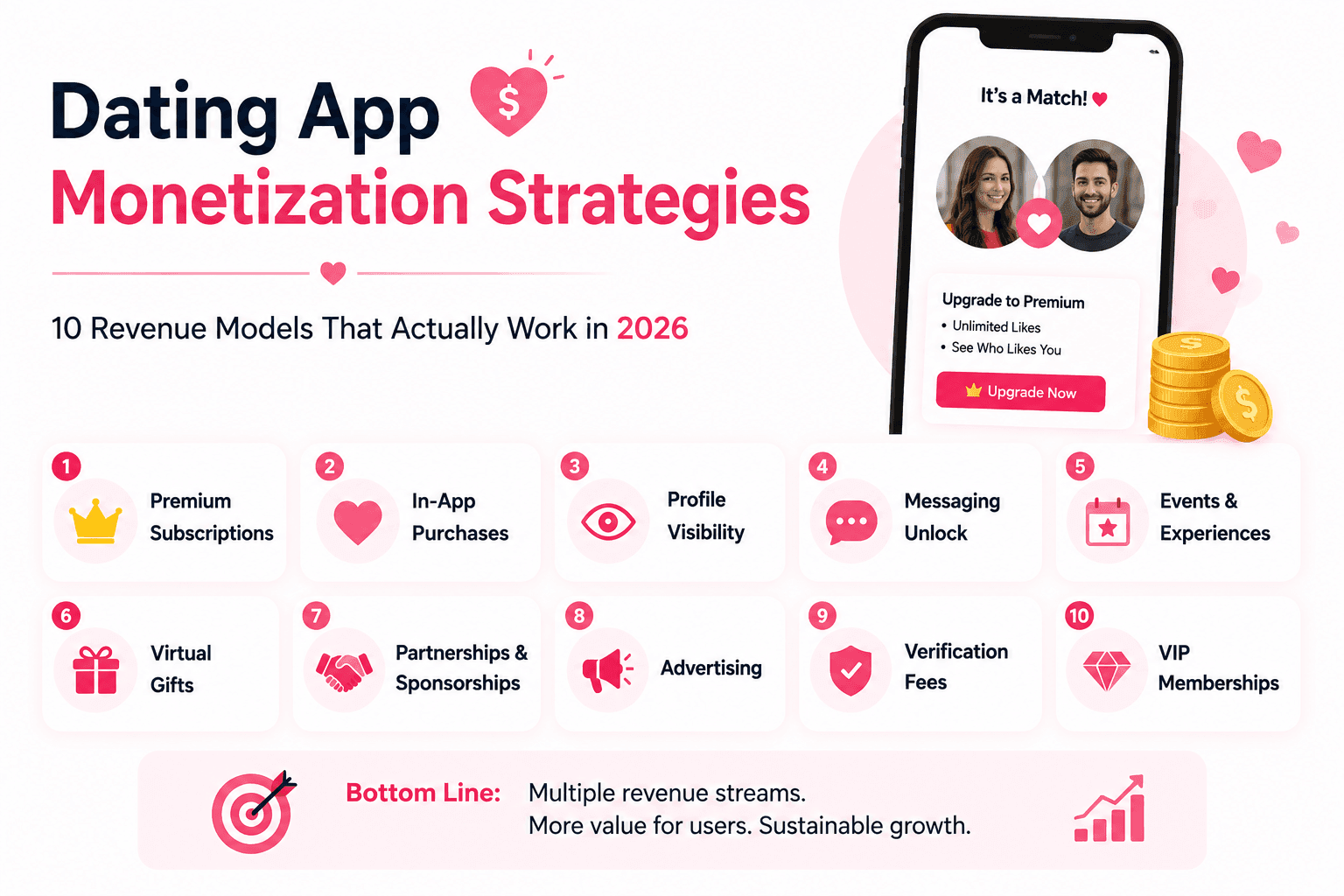
How the Most Profitable Apps Generate Revenue in 2026
Most dating apps die broke — not because they lacked users, but because they picked the wrong way to make money.
The global dating app market is projected to hit $12.52 billion in 2026, yet the industry just recorded its first-ever annual revenue decline in 2025. Tinder's revenue dropped 5.2%. Bumble fell 9.5%. Meanwhile, Hinge grew 25%, and niche apps like PURE hit $100M in annual revenue.
The lesson? Monetization strategy matters more than downloads.
If you're building a dating app development services — or considering it — the revenue model you choose on day one will determine whether you have a real business or an expensive side project. This guide breaks down every major dating app monetization model, what each one actually earns, where the industry is heading in 2026, and what smart founders are doing differently.
1. The State of Dating App Revenue in 2026
Before choosing a monetization strategy, you need to understand the market reality — not the hype.
The dating app market is maturing. The era of 'grow fast, monetize later' is over. Here's what the data shows:
| App | 2025 Revenue | Paying Users | Key Strategy |
|---|---|---|---|
| Tinder | ~$1.7B (down 5.2%) | 9.8M subscribers | Freemium + Subscriptions + In-App Purchases |
| Bumble | $866M | 2.4M paying users | Tiered Subscriptions + In-App Purchases |
| Hinge | $689M (up 25%) | 1.95M paying users | Premium Tiers + Roses (In-App Purchases) |
| Grindr | Growing YoY | Niche user base | Subscriptions + Targeted Advertising |
| PURE | ~$100M | Niche user base | Feed-Based Freemium + Premium Plans |
What these numbers tell you is straightforward. Subscription revenue is not automatically growing. Aggressive monetization backfires. And niche apps outperforming giants is not a coincidence — it's a structural shift in user behavior.
Users in 2026 are more selective, more privacy-conscious, and significantly more resistant to pay-walls they find unfair. Apps that respect users while still converting them win. Apps that milk users lose them to competitors.
2. Freemium Model: The Foundation of Every Successful Dating App
The freemium model isn't a monetization strategy by itself — it's the structure that makes every other strategy possible.
How it works
Core features (swiping, matching, basic messaging) are free. Premium features that save time, increase visibility, or improve results sit behind a paywall.
Why it works
You remove acquisition friction entirely. Users sign up without hesitation. Once they're emotionally invested — they've matched with someone, had a good conversation, or almost gotten a date — they're far more willing to pay.
The key psychological insight: people don't pay for features. They pay for outcomes they already want.
What to gate and what to keep free
Free features should demonstrate the app's core value. If users can't see that your app works before paying, they won't pay.
Gate features that improve results — unlimited likes, seeing who liked you, advanced filters, profile boosts, and read receipts. Don't gate basic communication entirely unless your niche is built on exclusivity.
Conversion rate benchmarks
- Mass-market apps: 5–10% free-to-paid conversion
- Niche apps: 10–20% (users are more motivated)
- Apps with aggressive friction: 2–4% (and high churn)
3. Subscription Tiers: The #1 Revenue Driver
Subscriptions generate 60–80% of revenue for mature dating apps. They're the backbone of every serious dating app business model.
How to structure subscription tiers
Most successful apps run 2–3 tiers. Here's a practical framework:
| Tier | Price / Month | Key Features |
|---|---|---|
| Free | $0 | Limited swipes, standard matching, basic messaging |
| Premium / Gold | $9.99–$19.99 | Unlimited swipes, see who liked you, weekly profile boost, advanced filters |
| Platinum / Elite | $24.99–$34.99 | All Premium features + priority profile placement, message before matching, AI-powered suggestions, incognito mode |
Real examples from top apps
- Tinder Gold: ~$14.99/month
- Tinder Platinum: ~$29.99/month
- HingeX (Hinge's top tier): ~$49.99/month
- Bumble Premium+: ~$24.99/month
The annual plan conversion play
Monthly plans work as the trial. Annual plans are where you build LTV. Offer a 30–40% discount on annual subscriptions. Users who commit annually churn far less and generate significantly more revenue.
What actually converts users to subscriptions
Not features. Timing. The best conversion moment is immediately after a match — when emotional investment peaks. A 'See who else liked you' prompt with a 3-day trial converts at 3–5x the baseline rate.
4. In-App Purchases: Monetizing the Impatient User
In-app purchases (IAPs) layer on top of subscriptions and extract additional revenue from your most engaged users.
Top-performing IAPs in dating apps
- Profile Boosts: Temporarily put your profile at the top of discovery for 30 minutes to a few hours. Users see match count spike in real time.
- Super Likes / Roses: A signal of strong interest before matching. Hinge's Roses are their highest-revenue IAP.
- Rewind / Undo: Take back an accidental left swipe. Sounds minor — generates real revenue at scale.
- Read Receipts: Know when someone read your message. High perceived value in active conversations.
- Incognito Mode (per-session): Browse profiles without appearing in discovery. Appeals to privacy-conscious users.
IAP pricing psychology
Price IAPs at micro-transaction levels ($0.99–$4.99 per unit). Bundle them in packs (5 Boosts for $12.99 vs. $3.99 each). Create urgency with expiring credits. Users who buy once are 60% more likely to buy again within 30 days.
5. Virtual Credits / Coin Economy
The coin economy is the highest-risk, highest-reward monetization model in dating apps. Done right, it generates exceptional revenue per user. Done wrong, it destroys trust.
How it works
Users buy a virtual currency (coins, tokens, credits). Every high-value action — sending a message, viewing a profile, sending a gift — costs coins. The app sets the price per action.
The risk
If users feel manipulated, you get chargebacks, negative reviews, and a reputation problem that kills organic growth. This model works only when users feel the value is fair.
Where it works well
- Niche platforms with high-intent users
- Apps where every interaction carries real social risk
- International markets where subscription pricing creates friction but micro-transactions do not
6. Advertising and Sponsored Content
Advertising generates 10–20% of dating app revenue — never the majority, but a meaningful contribution to overall monetization.
Ad formats that work in dating app developement cost
- Native Sponsored Profiles: Brands appear as 'sponsored' cards within the discovery feed. Higher click-through rates than banner ads.
- Incentivized Ads: Users watch a 30-second ad in exchange for a free Boost or extra likes. Borrowed from mobile gaming.
- Targeted Banner Ads: Shown only to free users. Programmatic networks like Google AdMob deliver $2–$10 CPM.
Who should use advertising
Advertising as a primary strategy only makes sense at significant scale (millions of monthly active users). For early-stage apps, ads create a cheap-feeling product and distract from the user experience.
Use advertising as a conversion tool — show ads to free users, then show them what they'd get without ads if they subscribed. Done correctly, advertising accelerates premium conversion rather than replacing it.
7. Affiliate Marketing and Brand Partnerships
Affiliate and brand partnerships are an underutilized revenue stream that fits naturally into the dating context.
Why this works in dating
Dating app users are planning dates. They need restaurants, florists, travel options, gift ideas, and experiences. They're buyers in the consideration stage of purchases that fit perfectly with affiliate revenue.
Revenue models available
- Commission per booking: Partner with OpenTable, Airbnb, or local event organizers.
- Sponsored content: A local events company pays to be featured as a 'suggested first date' in-app.
- Relationship courses and coaching: Premium users often convert to coaching products via referral commissions.
Bumble has partnered with local events brands to offer users exclusive access to singles events, earning commission per ticket while increasing in-app engagement simultaneously.
8. Event-Based Monetization
Speed dating nights, singles mixers, virtual group dates, and skill-sharing events are becoming a legitimate revenue stream — and a major competitive differentiator.
Revenue models
- Ticket sales through the app (10–30% margin after venue costs)
- Premium event access as a subscription perk for higher tiers
- Brand-sponsored events where a partner co-funds in exchange for visibility
Emerging trend: AI-curated group experiences
Apps like Les Amis are pairing AI matching with real-world activities (pottery classes, wine tastings). The event is the product, and the app earns on every booking. Particularly relevant for serious-relationship apps targeting users 28–40 who are tired of endless swiping with no real-world outcome.
9. AI-Powered Premium Features
AI is rapidly becoming a cost of entry. But smart implementation creates genuine premium monetization opportunities.
Match Group allocated $60 million toward AI and product development at Tinder in 2025–2026. AI-powered features are things users will pay for because they demonstrably improve outcomes.
High-converting AI premium features
- Smart Match Suggestions: Free users get algorithmic swiping. Paid users get AI-curated Top Picks based on behavioral patterns.
- Conversation Starters / Icebreaker AI: Generate personalized opening messages based on a match's profile.
- Profile Optimization AI: Analyze a user's photos and suggest improvements based on match-rate data.
Voice-Based Onboarding: Startup Known replaced text profiles with voice notes. 80% of introductions led to in-person dates in beta testing.
Compatibility Scoring: Dynamic compatibility analysis that updates as users interact.
When building these features, your development team needs serious ML infrastructure, not just a GPT API wrapper. The quality of AI features directly determines their perceived value and conversion rate.
10. Niche Access and Hard Gate Models
The hard gate model is the philosophical opposite of freemium. Users pay to access any communication at all. It filters for intent and creates a completely different user experience.
Why it works for specific niches
eHarmony charges $50+/month and has some of the highest marriage rates of any dating app. The paywall isn't a barrier — it's a signal. If you're willing to pay, you're serious. That creates an environment where serious users find each other faster, which justifies the price, which attracts more serious users. A self-reinforcing loop.
Niche apps where hard gates perform
- High-net-worth / elite dating (The League, Inner Circle)
- Relationship-focused serious dating (eHarmony, EliteSingles)
- Sugar dating / arrangement platforms (Seeking.com)
- Professional-only networks (where verification is the value)
The emerging opportunity: safety-first premium access
Romance scam losses hit $1.14 billion in 2023 and grew in 2024. Apps that combine identity verification, photo verification, and background screening as core premium features are capturing a growing segment of users who have been burned by mainstream apps.
11. Hybrid Monetization: The Strategy That Actually Scales
No single revenue model scales a dating app to profitability. The apps generating real revenue in 2026 use layered monetization stacks.
The hybrid model that works
- Base Layer: Freemium (acquire users at zero friction)
- Revenue Layer 1: Subscription tiers (recurring, predictable income)
- Revenue Layer 2: In-app purchases (convert high-engagement users)
- Revenue Layer 3: Advertising (monetize non-payers without alienating them)
- Revenue Layer 4: Partnerships/Affiliates (add value while earning)
Design principle for hybrid monetization
Each layer should feel like an upgrade, not a punishment. Users who never pay should still find value. Users who pay a little should see a clear benefit. Users who pay a lot should feel like insiders, not just high spenders.
12. Which Monetization Model Is Right for Your App?
| App Type | Primary Model | Secondary Revenue |
|---|---|---|
| Mass-Market Casual Dating | Freemium + Subscriptions | In-App Purchases + Advertising |
| Serious Relationship App | Tiered Subscriptions | AI Features + Events |
| Niche / Community App | Hard Paywall or High-Value Subscription | Affiliate Partnerships + Events |
| Elite / Luxury Dating | Premium Membership Only | Sponsored Experiences |
| LGBTQ+ / Community-Focused | Freemium + Targeted Advertising | Subscriptions + Community Events |
| Regional / Local App | Freemium + Local Partnerships | Events + Advertising |
Three questions to answer before you build
- What demographic am I targeting, and what are they actually willing to pay for?
- What is my user's core frustration with existing apps — and can I monetize the solution to that frustration?
- What is my cost per acquired user, and which monetization model produces enough LTV to make CAC profitable?
- A dating app that costs $8 per install and generates $12 LTV is not a business. The monetization model needs to produce $25–$50+ LTV for the unit economics to support growth.
13. Monetization Mistakes That Kill Dating Apps
Mistake 1: Gating features users need to evaluate the product
If users can't see that your app works before paying, they won't pay. Never gate basic matching or the ability to read messages on the first connection.
Mistake 2: Dynamic pricing without transparency
Charging different users different prices for identical subscriptions is generating significant backlash. Tinder faced a class-action lawsuit over age-based pricing. Transparency builds trust.
Mistake 3: Choosing a model that conflicts with your niche
A coin economy on a serious relationship app destroys the trust environment. A hard gate on a casual hookup app eliminates the audience. The model must match the user's mindset.
Mistake 4: Adding monetization after launch
Monetization that's engineered into the product from day one converts better, feels more natural, and generates higher LTV. Apps that add it later often create friction where none existed.
Mistake 5: Ignoring retention in favor of acquisition
Apps that pour budget into downloads without fixing 30-day retention are filling a leaky bucket. A user who churns before paying generates zero revenue.
Mistake 6: Over-monetizing free users into leaving
Users who hit a paywall every three swipes don't upgrade — they uninstall. The conversion window is real, but it requires patience. Users need to feel value before they pay for more of it.
14. How Your Tech Stack Affects Your Revenue Potential
Your monetization architecture is only as good as the development infrastructure supporting it.
Subscription billing
Apple's in-app purchase system and Google Play Billing handle subscription management natively. Your backend needs to validate receipts in real time, handle failed payments gracefully, and trigger correct access changes on plan upgrades and downgrades.
A/B testing monetization
The difference between a 6% and 9% free-to-paid conversion rate can be found through proper A/B testing of paywall placement, pricing, trial lengths, and messaging. Your tech stack must support experimentation at the user cohort level.
Analytics for monetization optimization
Revenue per user by cohort, conversion funnel drop-off, paywall hit rates, and churn by subscription plan are non-negotiable metrics. Build this instrumentation from day one.
AI feature infrastructure
If you plan to monetize AI features — and you should — the ML pipeline needs to be production-ready before launch, not a prototype. AI features that are slow or inaccurate convert at low rates and generate negative reviews.
These are all decisions made at the development stage. If you're working with a dating app development services team, they should be advising on monetization architecture, not just feature delivery.
Conclusion
Dating app monetization in 2026 isn't about extracting the maximum amount of money from every user. It's about building a system where paying feels like a natural decision, not a forced one.
The apps winning right now — Hinge growing 25% while Tinder and Bumble decline — are doing so because their monetization respects users. Features behind the paywall are genuinely better. The free tier is genuinely useful. The jump from free to paid feels like an obvious upgrade, not a hostage situation.
Get your revenue model right from the start. Layer it thoughtfully. Test it continuously. And build it with a team that understands both the product and the business.
The difference between a dating app development that closes in 18 months and one that becomes a real business almost always comes down to one thing: how seriously the founders treated monetization during development — not after it.
Ready to Build a Dating App That Generates Real Revenue?
Our dating app developer team builds revenue-generating products across iOS, Android, and cross-platform — with monetization architecture designed from day one, not as an afterthought.