
Future of Mobile App Development: Top 7 Trends Shaping 2026
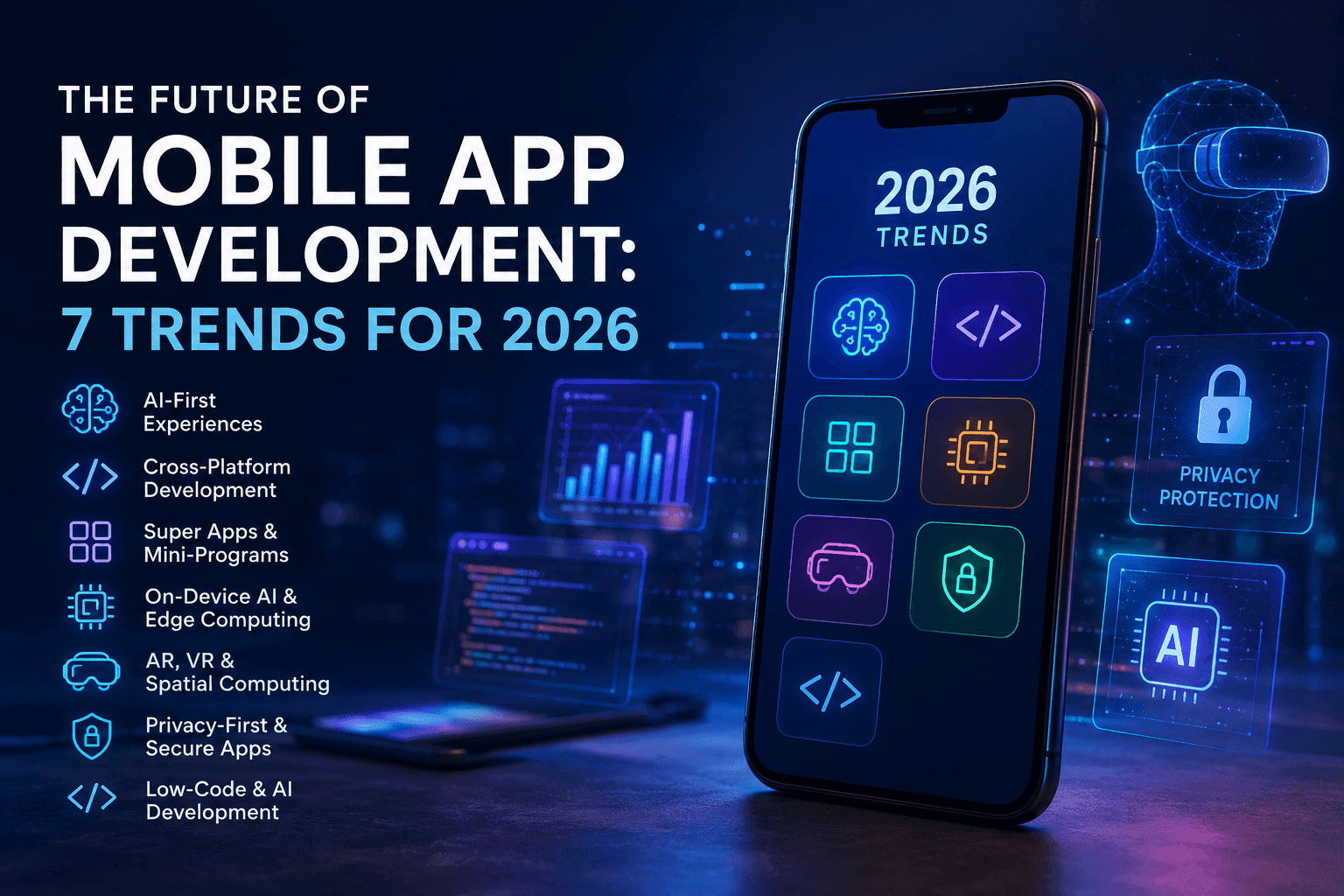
Ten years ago, mobile app development meant choosing between iOS and Android and hoping users would find you in a crowded store. In 2026, the game has changed completely. Apps now anticipate what users want before they tap, run seamlessly across phones, watches, cars, and headsets, and are often built in half the time they once took.
If you're a founder, product manager, or developer, the shifts happening right now will decide whether your app thrives or quietly disappears from home screens. At Tech Reforms, we've watched dozens of product teams adapt (and a few stumble) over the past year, and one thing is clear: the winners aren't chasing every shiny tool. They're betting on a handful of durable trends.
Here are the seven that matter most in 2026 and how to act on each one.
Quick Overview: 7 Trends at a Glance
| # | Trend | Why It Matters | Adoption Difficulty |
|---|---|---|---|
| 1 | AI-First App Experiences | Personalization is now the baseline, not a bonus | Medium |
| 2 | Cross-Platform Frameworks Maturing | One codebase with near-native performance | Low |
| 3 | Super Apps & Mini-Programs | Users prefer fewer apps that offer more services | High |
| 4 | On-Device AI & Edge Computing | Faster, private, and offline-capable intelligence | Medium |
| 5 | AR, VR & Spatial Computing | Headsets and AR glasses are becoming mainstream | High |
| 6 | Privacy-First & Secure-by-Design Apps | Growing regulations and user trust make security essential | Medium |
| 7 | Low-Code & AI-Assisted Development | Enables faster releases with smaller development teams | Low |
What Each Trend Means for Your Business
1. AI-First App Experiences Become the Standard
The biggest shift in mobile app development company this year isn't a new framework; it's a new mindset. Apps are no longer designed and then "sprinkled" with AI. They're designed around it.
What this looks like in practice:
- Hyper-personalized interfaces that rearrange content, features, and notifications based on individual behavior patterns.
- Conversational layers where users can simply ask the app to do something ("book my usual Tuesday slot") instead of navigating menus.
- Predictive features in fitness apps adjust plans before you plateau, and finance apps flag unusual spending in real time.
The practical takeaway: users now expect apps to know them. Generic, one-size-fits-all experiences feel dated, and retention numbers reflect it. Teams that treat intelligent features as core architecture, not a plugin, are seeing measurably better engagement.
2. Cross-Platform Development Reaches Near-Native Quality
The old debate, native versus cross-platform, is effectively over for most use cases. Frameworks like Flutter, React Native, and Kotlin Multiplatform have matured to the point where performance gaps are negligible for the majority of consumer and business apps.
Why teams are consolidating on a single codebase:
- Cost efficiency: one team ships to iOS, Android, web, and increasingly desktop.
- Faster iteration: a feature built once appears everywhere, which matters when release cycles have shrunk to weeks.
- Talent flexibility: developers no longer need deep platform-specific expertise for every project.
Native development still wins for graphics-heavy games, hardware-intensive features, and apps squeezing every millisecond of performance. But for everything else, cross-platform is now the sensible default, and choosing wrongly here is one of the most expensive mistakes a product team can make.
3. Super Apps and Mini-Programs Go Global
The "super app" model, one app hosting payments, messaging, shopping, and dozens of mini-services, dominated Asia for years. In 2026, the model is finally spreading westward, reshaping how businesses think about distribution.
Instead of asking users to download yet another standalone app, companies are increasingly building mini-programs, lightweight experiences that live inside larger ecosystems (messaging platforms, payment apps, marketplaces).
Key implications:
- App store discovery matters less; ecosystem presence matters more.
- Smaller businesses can reach millions of users without the cost of a full standalone build.
- User experience design must adapt to constrained, embedded environments.
For many brands, the strategic question in 2026 isn't "should we build an app?" but "where should our app experience live?"
4. On-Device AI and Edge Computing Change the Rules
Cloud-based AI is powerful, but it comes with latency, cost, and privacy trade-offs. The 2026 breakthrough is that modern smartphone chips can now run genuinely capable AI models directly on the device.
What on-device intelligence unlocks:
- Instant responses — no round trip to a server for translation, image recognition, or text generation.
- Offline functionality — smart features that work on a plane or in a dead zone.
- Privacy by default — sensitive data (health metrics, photos, messages) never leaves the phone.
- Lower running costs — fewer cloud inference bills as usage scales.
Combined with edge computing and widespread 5G coverage, this enables a class of real-time applications, such as AR navigation, instant medical triage tools, and on-the-spot document analysis, that simply weren't feasible before. Expect "works offline, thinks locally" to become a genuine selling point.
5. AR, VR, and Spatial Computing Enter the Mainstream
With lighter headsets and AR-capable glasses finally reaching consumer-friendly prices, spatial computing has moved from novelty to roadmap item. The mobile phone remains the anchor, but experiences increasingly extend beyond the rectangle.
Where the traction is real (not hype):
- Retail: virtual try-ons for furniture, eyewear, and clothing are now conversion drivers, not gimmicks.
- Training and field work: technicians using AR overlays for repairs and inspections report faster job completion and fewer errors.
- Navigation and travel: AR wayfinding inside airports, malls, and hospitals is quietly becoming an expectation.
The lesson from teams shipping in this space: start with one narrow, high-value use case. Full immersive worlds are expensive; a single well-executed AR feature inside an existing app often delivers the best return.
6. Privacy-First and Secure-by-Design Development
Between tightening global regulations, high-profile breaches, and users who actively read permission prompts, privacy has shifted from a compliance checkbox to a competitive advantage.
What secure-by-design means in 2026:
- Data minimization — collecting only what a feature genuinely needs, and being able to prove it.
- Transparent permissions — explaining why the app needs access, in plain language, at the moment of the request.
- Modern authentication — passkeys and biometrics replacing passwords as the default.
- Encrypted-by-default storage and transit, with regular third-party security audits.
Apps that treat user data respectfully are earning trust, and trust converts. Surveys consistently show users are willing to abandon apps over vague data practices, which makes privacy engineering one of the highest-ROI investments a team can make this year.
7. Low-Code Tools and AI-Assisted Development Compress Timelines
Finally, the way apps get built is transforming as fast as the apps themselves. AI coding assistants now handle boilerplate, generate tests, and catch bugs before review. Low-code platforms let non-developers assemble internal tools and MVPs in days.
The realistic picture:
- Prototyping is dramatically faster — ideas can be validated in a week instead of a quarter.
- Small teams punch above their weight, shipping features that once required triple the headcount.
- Developers aren't being replaced — they're moving up the stack, focusing on architecture, performance, and the hard 20% that automation can't touch.
For businesses without in-house engineering, this is also changing the buying decision. A good mobile app development company in 2026 isn't just selling code, it's selling judgment: knowing which trends fit your product, which tools genuinely accelerate delivery, and where cutting corners will hurt later. That judgment is exactly what we've built our process around at Tech Reforms.
How to Prepare: A Practical Checklist
- Audit your app's personalization. Is it genuinely adaptive or just cosmetic?
- Re-evaluate your tech stack; if you're maintaining two native codebases without a strong reason, run the numbers on consolidation.
- Identify one on-device AI or AR feature that solves a real user problem.
- Schedule a privacy and security review before regulators (or users) force one.
- Pilot AI-assisted development on a low-risk project to build team fluency.
Ready to Build for 2026? Let's Talk
The trends above aren't theory for us, they're the daily work. Whether you need an AI-first product built from scratch, an existing app migrated to a modern cross-platform stack, or a security and performance audit before your next release, Tech Reforms can help you move faster with fewer missteps.
Get a free consultation with our team, and we'll map these trends to your product roadmap, no jargon, no obligation. Contact Tech Reforms today and turn 2026's biggest shifts into your competitive edge.
Final Thoughts
The future of mobile experiences belongs to teams that pair new technology with old-fashioned discipline: solving real problems, respecting user data, and shipping fast without shipping sloppy. The seven trends above aren't predictions anymore; they're the operating environment of 2026. The only real question is how quickly you adapt.