
How Businesses Can Develop a Secure Travel Safety Mobile App
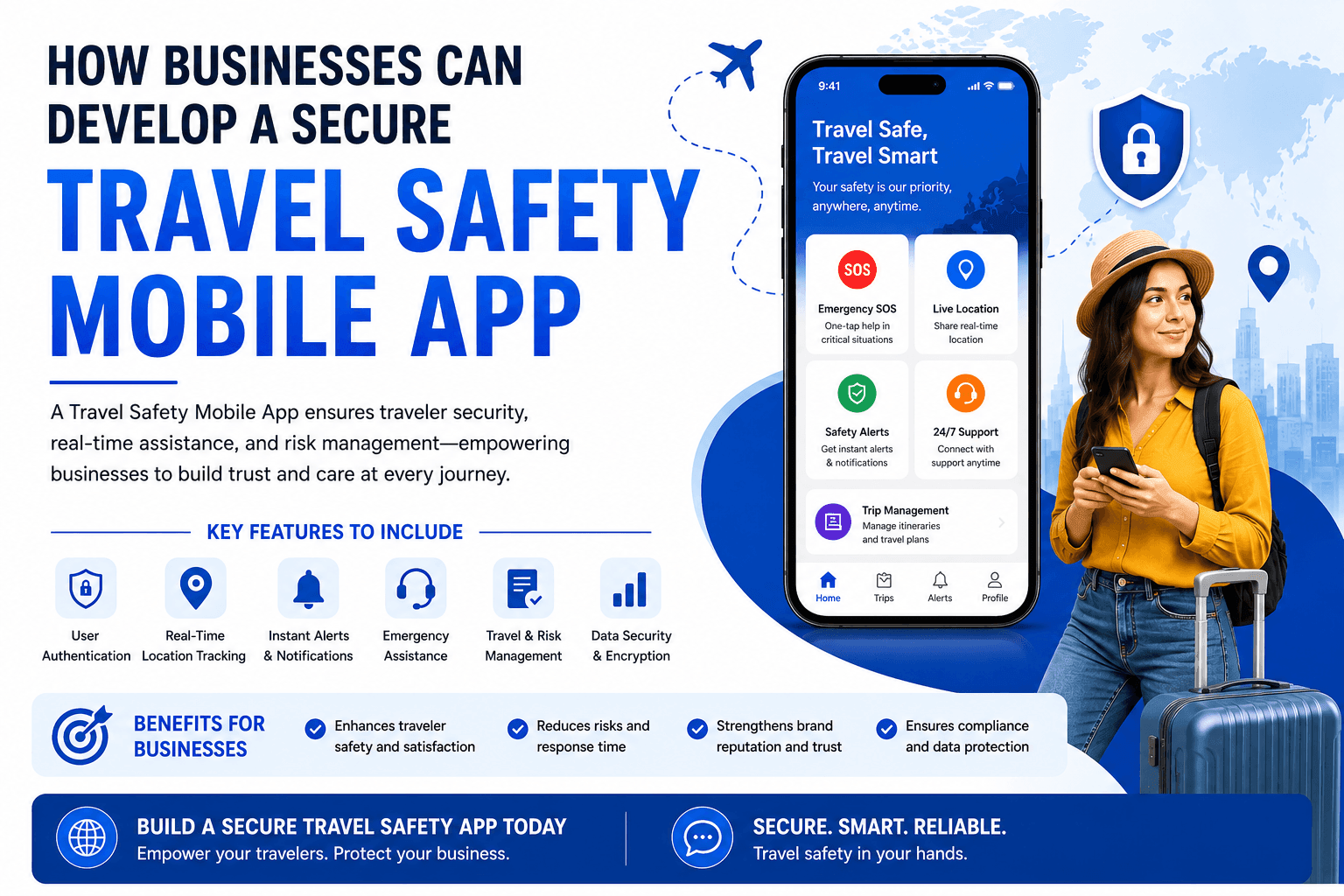
Every enterprise travel safety app lives or dies on one foundational question: how do you protect employees without surveilling them? Getting this balance wrong — either direction — creates legal exposure and erodes trust before the app ever launches.
"It's not about tracking travelers, it's about tracking incidents… employers only need to know where staff are in the event of an emergency." — Alex Laidlaw, World Travel Protection
A solid travel app development guide starts with architecture decisions made long before a single line of code is written. Engaging HR and Legal early ensures compliance with international privacy frameworks like GDPR and local labor laws across your travel regions.
Follow these foundational steps:
- Identify Duty of Care obligations specific to your industry vertical and the countries your employees visit.
- Design a privacy-first location layer that defaults to a masked 3-mile radius — only escalating to exact coordinates when a defined emergency trigger fires.
- Map emergency escalation triggers — such as an SOS activation.
- Review compliance requirements with Legal before selecting any mobile app development services or third-party data processors.
With this privacy architecture locked in, the next critical layer is ensuring the data your app collects stays protected end-to-end through robust encryption and authentication.
Implement Multi-Layered Security and Encryption
With your duty-of-care framework in place, the next critical task is hardening the app itself. Cryptographic weaknesses affect 43% of the top 100 enterprise mobile apps, exposing sensitive traveler data to interception — a risk no enterprise can afford. When you hire mobile app developers for this project, ensure they're well-versed in the following non-negotiable security controls:
- AES-256 encryption for all data stored locally on the device, including itineraries, emergency contacts, and location history
- TLS 1.3 enforced across every API call between the app and your enterprise backend — no fallback to older protocol versions
- Elimination of hardcoded credentials and deprecated algorithms (MD5, SHA-1) from the codebase, validated through automated security scanning
- Multi-Factor Authentication (MFA) required at every session login, particularly on untrusted networks common in international travel
In practice, these layers work together. Strong encryption protects stored data even if a device is lost, while TLS 1.3 and MFA defend against interception and unauthorized access in transit. Understanding why security-first architecture matters is essential before writing a single line of code.
With the app's security foundation solid, the next challenge is equipping it with live intelligence — which brings us to real-time risk monitoring.
Integrate Real-Time Risk Assessment and AI Monitoring
With your security architecture locked down, the app needs intelligence — the ability to sense danger before it reaches your traveler. The global corporate travel risk management market is projected to reach $8 billion by 2035, driven largely by AI-powered risk assessment tools. This is where custom mobile app development services become mission-critical: building a proactive monitoring layer that responds in real time.
A well-architected risk engine should include:
- Global risk feed integration — Connect to live data sources covering weather emergencies, political unrest, disease outbreaks, and State Department travel advisories to keep alerts current.
- Proximity-based AI filtering — An intelligent notification engine that suppresses irrelevant alerts and surfaces only risks within the traveler's geographic radius, reducing alert fatigue.
- One-tap SOS functionality — A single-button trigger that instantly connects employees to the corporate security operations center, with location data pushed automatically.
- Offline safety access — Critical emergency contacts, evacuation protocols, and medical documents cached locally so employees stay informed even without connectivity.
AI transforms the app from a passive alert tool into a dynamic safety companion that anticipates risk rather than simply reacting to it.
Designing this intelligence layer correctly demands the right development team — which is exactly what the next step addresses.
Hire Mobile App Developers with Enterprise Expertise
With your AI monitoring layer operational, the final technical challenge is choosing the right build partner. Choosing the wrong team can be costly — 62% of organizations experienced a mobile app breach in the past year, averaging nine separate incidents per company. Strong mobile app development for enterprises demands a partner who treats security as architecture, not an afterthought.
Evaluate candidates across these four criteria:
- System integration experience — Verify hands-on work with HRMS and Workforce Risk Management platforms. Shallow integrations create data gaps that compromise duty-of-care compliance.
- High-compliance industry track record — Partners with FinTech, Healthcare, or government project history understand regulatory rigor. Request case studies that demonstrate secure, growth-oriented mobile builds specifically.
- Staff augmentation capability — Rapid deployment windows shrink fast. A partner who can scale engineering teams on demand keeps your timeline intact without sacrificing quality.
- Architecture documentation — Ask for evidence of modular, scalable design. Generic portfolios aren't enough; you need proof of security-first thinking from day one.
Pro Tip: Staff augmentation flexibility matters more than upfront team size. A partner who can expand specialized talent quickly lets you respond to scope changes mid-build without renegotiating entire contracts.
Choosing thoughtfully here sets the foundation for long-term success — which the final section will break down in full.
How to Ensure Long-Term Success: Key Takeaways
Applying mobile app security best practices from day one is what separates a travel safety app that delivers genuine ROI from one that creates a false sense of protection. To make your build count, keep these priorities front and center:
- Prioritize employee trust. Enforce transparent, incident-based tracking policies so staff feel protected — not surveilled. Adoption collapses without it, as misconceptions around privacy remain a top barrier.
- Adopt security-by-design. Build protections into every layer from the start. 93% of organizations believed their security was sufficient before a breach — a gap that architectural discipline closes before it opens.
- Invest in custom development. Off-the-shelf tools rarely map cleanly to enterprise workflows. A purpose-built solution ensures seamless integration with your HR, travel management, and incident-response systems.
- Choose the right build partner. You need a team that understands both custom engineering and flexible staff scaling — not just one or the other.
The stakes are real: your people are in the field, and their safety depends on decisions made long before they board a flight. Build deliberately, partner wisely, and let sound architecture do the protecting.