
How to Choose the Right Food Delivery App Development Company
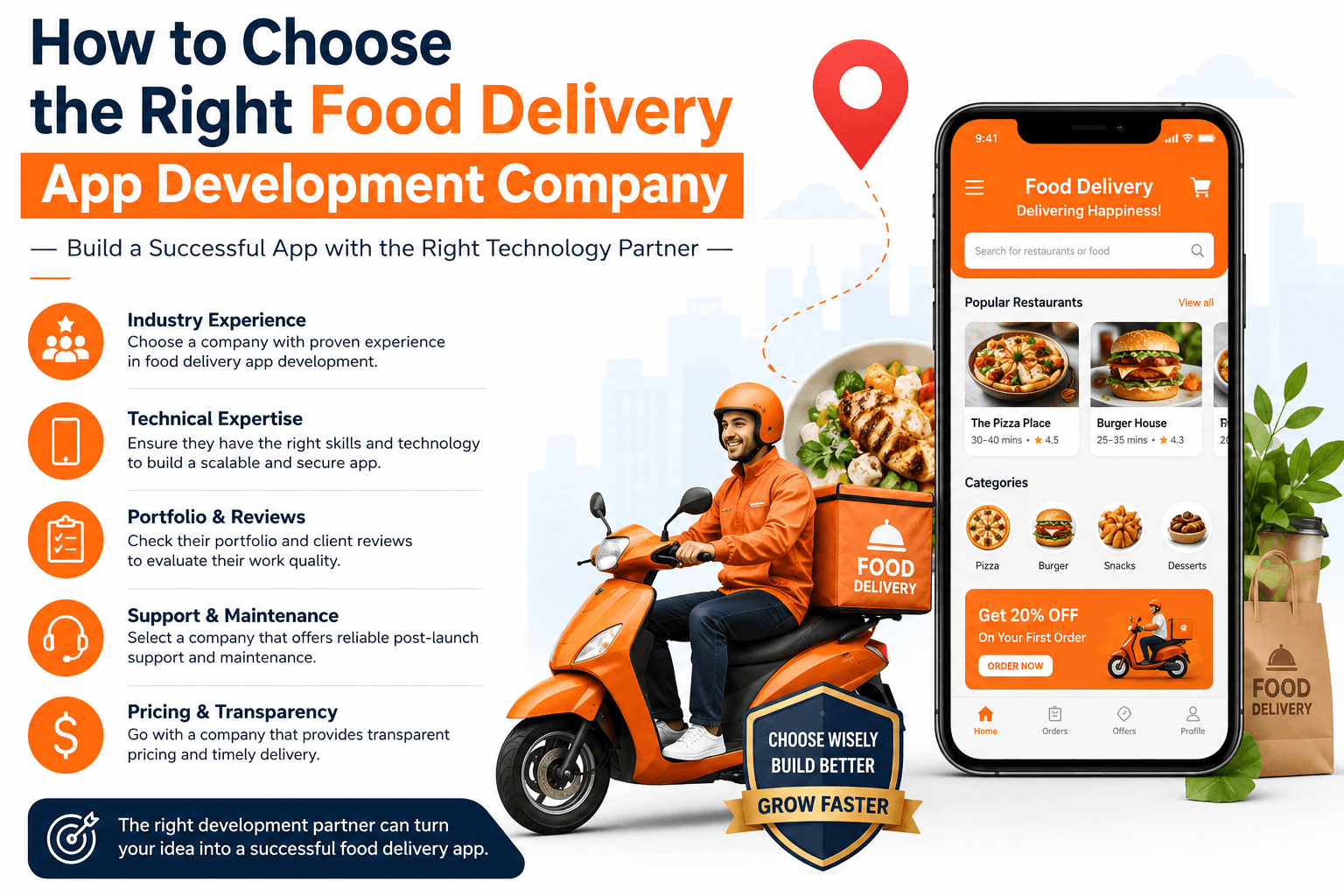
Food delivery has outgrown its roots as a convenience feature — it is now mission-critical infrastructure for restaurants, retailers, and logistics operators alike.
The global online food delivery market is projected to reach $173.57 billion by 2025, growing at a CAGR of 10.7% — and the platforms capturing that growth aren't built on off-the-shelf code. They're engineered for scale.
What's driving the urgency? The nature of delivery itself has fundamentally changed. What once meant a simple digital menu and a "place order" button now involves real-time driver tracking, dynamic pricing, multi-vendor coordination, and predictive inventory logic. Generic mobile app development services weren't architected for that complexity. In practice, they buckle under the weight of peak-hour demand, fail to surface actionable data, and create friction at every handoff between customer, kitchen, and courier.
As mobile apps reshape the foodservice industry, forward-thinking CTOs are recognizing that an off-the-shelf solution is no longer a cost-saving shortcut — it's a potential risk. The question has shifted from whether to invest in purpose-built technology to how quickly that investment can be made.
That urgency leads directly to a more pointed debate: why custom-built solutions consistently outperform white-label shortcuts when the stakes are this high.
Why Custom Mobile App Development Services Outperform White-Label Shortcuts
White-label platforms trade long-term capability for short-term convenience — and for enterprise food delivery operations, that tradeoff is increasingly untenable.
The core problem with off-the-shelf solutions is their predefined feature ceiling. When your business needs change — and in delivery logistics, they always do — white-label apps can't flex to meet them. You're locked into another vendor's product roadmap, not your own.
The contrast becomes sharper when you examine what's actually at stake:
| Dimension | Custom Build | White-Label |
|---|---|---|
| Scalability | Architected for your growth curve | Capped by vendor tier limits |
| Data Ownership | Full proprietary access | Shared or restricted by vendor |
| Integration Depth | Native ERP, CRM, inventory sync | Shallow APIs, limited connectors |
As Decode Agency highlights, custom-built apps offer superior scalability and ownership compared to white-label solutions that carry predefined feature limits.
Here's what enterprises consistently require that white-label platforms can't reliably deliver:
- Real-time inventory sync across multiple fulfillment locations
- CRM integration for personalized loyalty and reorder flows
- ERP connectivity to unify finance, operations, and delivery data
Data ownership is the competitive moat most operators overlook — your customer behavior patterns, peak-demand signals, and churn indicators are irreplaceable assets that belong in your infrastructure, not a vendor's database.
Investing in scalable, purpose-built solutions also means choosing the right delivery architecture — whether that's cross-platform app development services targeting iOS and Android simultaneously, or a hybrid approach tailored to your customer base.
Choosing the right partner to build that architecture, however, requires its own scrutiny.
Vetting a Top Mobile App Development Company for Logistics Expertise
Selecting a partner for custom mobile app development company is ultimately a business decision — one that determines how reliably orders move from checkout to doorstep.
"Choosing the best food app development company is a business decision, not a technical one... You are choosing a partner who will shape how orders flow." — LowCode Agency
Peak-hour resilience is the first stress test. A qualified partner should demonstrate a clear understanding of traffic spikes — Friday dinner rushes, holiday surges — and how order cancellation logic behaves under load. Ask for specifics, not generalities.
Real-time tracking and refund workflows reveal whether a team has built logistics apps or just delivery-themed UIs. In practice, these two systems carry the highest user trust risk. A delayed location ping or a broken refund path costs more in churn than any UI shortcoming.
Key vetting criteria to apply:
- Domain fluency — Can they explain edge cases around driver reassignment and partial refunds?
- Infrastructure thinking — Do they design for failure states, not just happy paths?
- Post-launch ownership — Is SLA-based support part of the engagement?
The right partner shapes operational outcomes, not just app features. Before finalizing any engagement, explore how their development and delivery process maps to your release cadence — a question that leads naturally into the platform strategy decisions covered next.
The Cross-Platform Advantage: Balancing Reach and Performance
Choosing between native and cross-platform development is one of the highest-leverage technical decisions a CTO makes — and for food delivery, the decision depends on where performance bottlenecks actually live.
Cross-platform frameworks are a strategic choice for most food delivery applications, particularly when speed-to-market and budget efficiency are primary constraints. A single shared codebase deploys simultaneously to iOS and Android, which matters when you're racing competitors to a new market. According to industry consensus, enterprise CTOs increasingly favor this approach to eliminate duplicated engineering effort.
Key advantages of cross-platform for delivery ecosystems:
- Reach: Launch on both platforms from one build cycle, reducing time-to-market by weeks
- Maintenance: A single codebase means bug fixes and feature releases propagate everywhere simultaneously — significantly cutting long-term upkeep costs
- Cost efficiency: Fewer platform-specific engineers on payroll, lower testing overhead, and streamlined CI/CD pipelines
However, one important caveat applies: driver-side apps are the exception. Background GPS tracking, real-time location updates, and battery optimization require platform-level APIs that cross-platform frameworks handle inconsistently. Any top hire app developer will recommend a hybrid strategy — cross-platform for the customer-facing layer, native precision where operational reliability demands it.
That technical foundation matters most when the goal shifts from acquisition to retention — which brings us to the loyalty and engagement features that keep customers ordering repeatedly.
Engineering for Retention: Loyalty and Engagement Features
Retention is where long-term revenue is built — and the right food delivery app development company knows that loyalty features aren't optional add-ons, they're core infrastructure.
The business case is hard to ignore. Starbucks saw an 80% revenue surge after launching its integrated loyalty program, according to a reliable source — a benchmark that underscores how deeply personalized engagement drives repeat purchases. In practice, the same principle applies directly to food delivery platforms competing for habitual users.
What separates high-retention apps from forgettable ones is the depth of their engagement mechanics. A generic build typically offers a basic punch-card model. A purpose-built solution implements layered systems that respond to user behavior in real time.
Must-Have Retention Features:
- Reward points engine — accumulates value per order, redeemable across menu items or delivery fees
- Cashback triggers — time-sensitive offers that activate during low-order windows to smooth demand
- Personalized promos — ML-driven recommendations surfaced based on order history and browsing patterns
- Tiered loyalty tiers — Bronze/Silver/Gold structures that incentivize higher spend thresholds
- Push notification personalization — contextual messages, not batch blasts
However, these features only deliver ROI when they're deeply integrated with your order management and analytics stack — not bolted on post-launch. The decisions made at the architecture stage ultimately determine which of these capabilities are even possible, a point that leads directly into the broader strategic takeaways for technical leaders.
The Bottom Line: Key Takeaways for Technical Leaders
Enterprise food delivery success hinges on four strategic choices — and getting even one wrong can cost months of rebuilding and millions in lost retention revenue.
As covered throughout this article, the technical decisions CTOs make early in a food delivery project compound over time. Here's what the evidence consistently points to:
- Prioritize specialized logistics partners over generalists. A development team that understands dispatch algorithms, driver availability windows, and real-time route optimization delivers measurably better outcomes than one adapting generic mobile templates.
- Custom builds are non-negotiable for enterprise integration. Enterprise scalability demands deep connectivity with internal systems — inventory management, ERPs, and HRMS platforms. Off-the-shelf solutions routinely hit hard ceilings when these integration layers grow complex.
- Retention features drive long-term ROI. Loyalty programs, personalization engines, and push-notification logic aren't cosmetic additions. They are the primary revenue multipliers after initial user acquisition costs are absorbed.
- Data ownership is foundational, not optional. Businesses that retain full control of their behavioral and transactional data scale faster, personalize better, and avoid dangerous vendor lock-in.
In practice, the difference between a food delivery app that plateaus and one that compounds growth often comes down to the engineering partner behind it — their depth of expertise, their integration capabilities, and their long-term alignment with your operational goals. That's precisely where the right development partner changes everything.
Scaling Your Delivery Vision with Techreforms
Building a competitive food delivery platform requires more than good code — it demands an engineering partner who understands enterprise complexity from the ground up.
Custom expertise matters. Techreforms excels in building enterprise-grade tools — including Workforce Resource Management (WRM) and HRMS systems — that mirror the operational depth food delivery platforms demand. That same architectural thinking applies directly to multi-restaurant dashboards, driver management systems, and real-time order orchestration layers.
Flexible scaling is a competitive advantage. Growing technical teams quickly is one of the hardest operational challenges CTOs face. Techreforms' staff augmentation model lets organizations expand engineering capacity on demand — without the overhead of full-time hiring cycles. Teams can scale up for critical launches and right-size during stabilization phases, keeping budgets aligned with actual delivery milestones.
Long-term efficiency drives the partnership. What separates Techreforms from generic development vendors is alignment between expert engineering and operational goals. Every technical decision — from API architecture to loyalty system design — is mapped against sustainable, long-term performance rather than short-term delivery speed.
For CTOs ready to move beyond off-the-shelf limitations, the path forward starts with a clear technical strategy. Schedule a digital transformation consultation with Techreforms and build the delivery platform your operations actually need.