
Taxi App Development Cost in 2026: Native vs Hybrid Tech Stack Compared
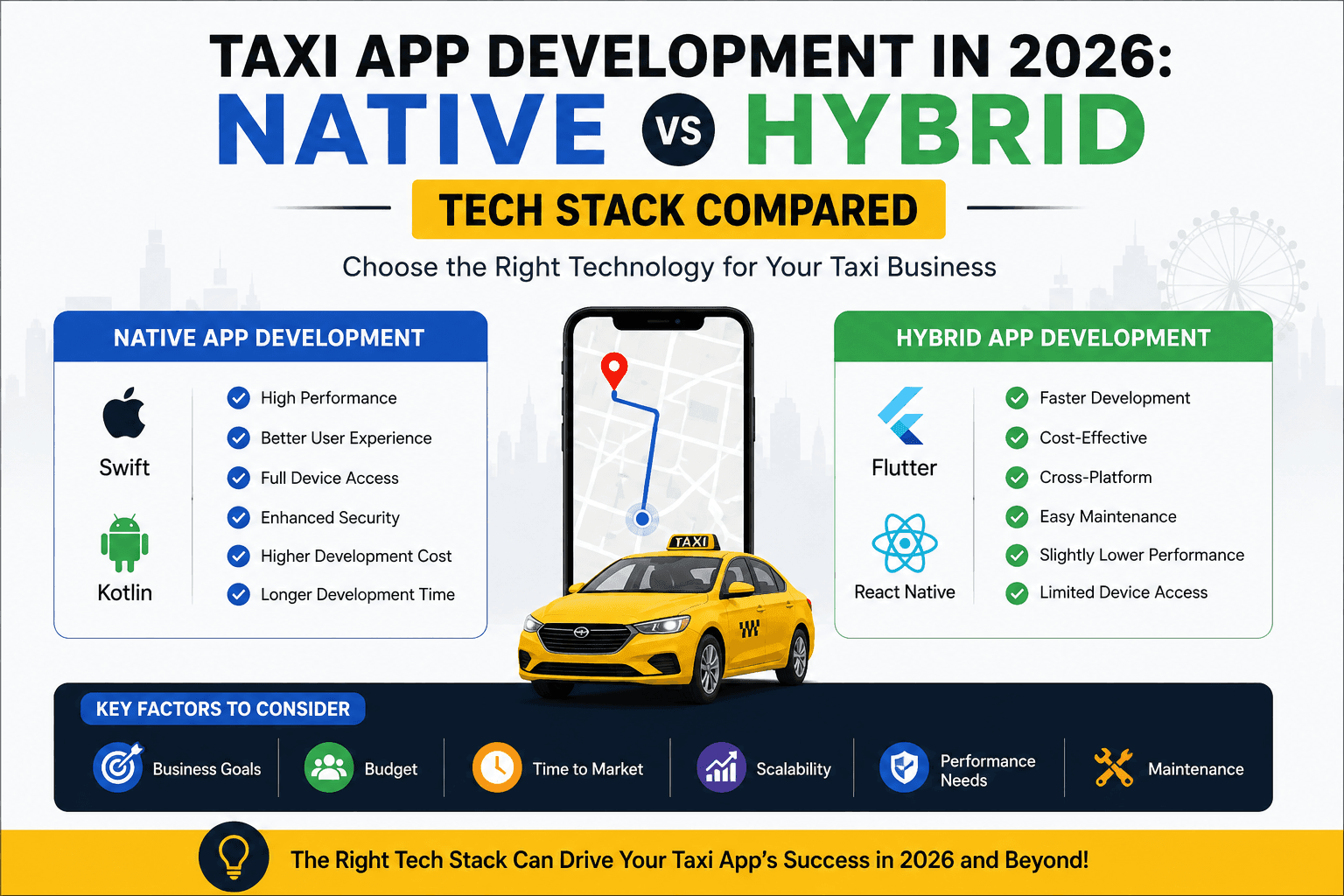
If you're scoping a taxi booking app, the honest range for taxi app development cost in 2026 runs from roughly $18,000 for a stripped-down MVP on a hybrid stack to $180,000+ for a fully native, multi-city ride-hailing platform with real-time dispatch, automated driver payouts, and enterprise-grade infrastructure. That's a ten-fold spread, and almost all of it traces back to one decision founders often make too early and with too little context: native or hybrid.
This isn't a generic "it depends" answer. The tech stack you choose shapes your development timeline, your hiring cost, your app's performance ceiling, and — critically — how much you'll spend maintaining the app over the next three years. Get this decision wrong and you either overpay for performance headroom you don't need yet, or you underinvest and hit a scalability wall exactly when ride volume starts to matter.
This guide breaks down taxi app development cost by tech stack, by feature, by development stage, and by the mistakes that quietly inflate budgets by 30-40%. Whether you're building a regional Uber-like competitor or a niche taxi app for a single city, you'll leave with a defensible budget range and a framework for choosing native vs hybrid based on your actual business model — not internet averages.
Understanding Taxi App Development Cost: What Actually Drives the Price
A taxi app isn't one app — it's a minimum of three connected products: the passenger app, the driver app, and the admin/dispatch panel, all backed by a real-time backend handling GPS tracking, ride matching, payments, and notifications. Quotes that mention "a taxi app" without specifying which of these components are included are the single biggest source of budget confusion in this industry.
Five variables move the price more than anything else:
- Tech stack — native, hybrid, or progressive web app
- Feature scope — MVP, full-scale launch, or enterprise platform
- Backend architecture — monolithic vs microservices, self-hosted vs managed cloud
- Third-party integrations — payment gateways, maps, OTP/SMS, push notifications
- Development team location and engagement model — in-house, agency, freelance, or offshore
Real scenario: A regional taxi operator in the Middle East approached a development partner with a "simple Uber clone" brief. The actual spec included live tracking, four payment methods, Arabic/English localization, and a driver loyalty program. That "simple" app scoped to roughly $95,000 on a native stack — not because of scope creep, but because the initial request undercounted what "simple" ride-hailing genuinely requires. This gap between assumed and actual scope is where most taxi app budget overruns start.
Native vs Hybrid Development — The Technical Foundation
What Native Development Means for Taxi Apps
Native development means writing separate codebases for iOS (Swift/SwiftUI) and Android (Kotlin/Jetpack Compose). Each platform gets code built specifically for its OS, which is why native apps consistently win on GPS accuracy, background location tracking, battery efficiency, and animation smoothness — all of which matter enormously for a driver app that runs for 8-10 hours a shift with the screen mostly locked.
What Hybrid / Cross-Platform Means
Hybrid development (Flutter, React Native) uses a single shared codebase compiled to run on both platforms. The core logic is written once; platform-specific code is limited to native modules where necessary — background location services and payment SDK bridges being the most common examples in taxi apps.
Why This Distinction Matters More for Taxi Apps Than Most App Categories
Taxi and ride-hailing apps depend unusually heavily on background processes: continuous GPS pings, real-time socket connections for order matching, and battery-conscious location tracking that has to survive the OS killing background apps. Native apps handle these OS-level constraints more predictably. Flutter has closed much of this gap since its platform-channel improvements, but React Native still typically requires more native bridging work for background location — and that extra bridging work shows up directly in your budget, not just in app performance.
Taxi App Development Cost by Tech Stack (Comparison Table)
Figures below assume a passenger app, driver app, and basic admin panel, built by a mid-tier development team at a blended rate of $30-45/hour. US/UK-based teams typically run 1.8x-2.5x higher; boutique offshore teams can run 20-30% lower but usually extend timelines.
| Tech Stack | Best For | Timeline | MVP Cost | Full-Scale Cost |
|---|---|---|---|---|
| Native (Swift + Kotlin) | High-volume, multi-city, enterprise ride-hailing platforms | 5–8 months | $35,000–$55,000 | $90,000–$180,000+ |
| Flutter | Startups, single-city launches, and rapid product iteration | 3–5 months | $22,000–$38,000 | $55,000–$95,000 |
| React Native | Teams with existing JavaScript/React expertise | 3–5 months | $20,000–$36,000 | $50,000–$90,000 |
| Progressive Web App (PWA) | Budget-constrained pilots without app store dependency | 6–10 weeks | $10,000–$18,000 | $25,000–$40,000 |
Why Native Costs More
Native means two parallel codebases, two QA cycles, and usually two distinct skill sets — a Swift/iOS specialist and a Kotlin/Android specialist — instead of one cross-platform team. You're not paying twice for "the same app"; you're paying for platform-specific optimization that hybrid frameworks abstract away, for better or worse.
Why Hybrid Isn't Automatically Cheaper Long-Term
Hybrid saves money on the initial build. It doesn't always save money on maintenance. When a taxi app needs deep OS-level integration — Apple CarPlay, Android Auto, advanced background location tracking, or platform-specific payment SDKs — hybrid teams end up writing native modules anyway, which erodes the "one codebase" cost advantage. Budget an extra 10-15% contingency on any hybrid taxi app that plans to support CarPlay/Android Auto down the line.
Cost Breakdown by App Component
Rather than accepting a single number, budget each component of your taxi app separately:
| Component | What It Covers | Approx. Cost Range |
|---|---|---|
| Passenger App | Ride booking, live tracking, fare estimation, in-app payments, ride history, and ratings | $12,000–$40,000 |
| Driver App | Trip acceptance, navigation integration, earnings dashboard, document verification, and in-app chat | $12,000–$38,000 |
| Admin / Dispatch Panel | Fleet management, live dispatch map, driver onboarding, analytics, and fare configuration | $10,000–$30,000 |
| Backend & APIs | Real-time matching engine, geolocation services, notifications, and payment gateway integration | $15,000–$45,000 |
| Third-Party Integrations | Maps APIs, OTP/SMS services, payment gateways, and push notification providers | $3,000–$12,000 |
Expert tip: Google Maps Platform billing (per API call for directions, distance matrix, and places lookups) is routinely underestimated. A mid-size taxi app running 50,000 rides a month can generate $2,000-$6,000 a month in Maps API costs alone at scale. That's an operating cost, not a development cost — but founders frequently conflate the two when comparing agency quotes, and get blindsided in month two post-launch.
Cost by Development Stage
MVP — Validate the Model, Single City
Scope: booking flow, live tracking, one payment method, basic driver app, manual dispatch override.
Cost range: $18,000-$45,000 depending on stack. Timeline: 8-14 weeks.
This is the stage where hybrid — Flutter in particular — earns its reputation. You're testing product-market fit, not building for scale yet, so the maintenance-cost trade-off matters less than speed to launch.
Full-Scale Launch — Multi-Payment, Multi-Language, Automated Dispatch
Cost range: $45,000-$120,000. Adds an automated ride-matching algorithm, surge pricing logic, multiple payment gateways, a driver incentive/wallet system, push notification infrastructure, and in-app support chat.
Enterprise / Multi-City Platform
Cost range: $120,000-$300,000+. Adds a microservices backend, multi-tenant architecture for franchise or city operators, advanced analytics and BI dashboards, fraud detection, dedicated DevOps/SRE support, and load-tested infrastructure for concurrent ride spikes such as event-driven surge.
Factors That Push Cost Up or Down
What Increases Cost
- A real-time ride-matching algorithm built in-house instead of adapted from an existing engine
- Multiple payment gateways per region — common in markets with fragmented digital payment adoption
- In-app voice/video support and chat translation
- Advanced safety features — SOS button with live location sharing, driver background-check integration, ride audio recording
- Multi-language and RTL layout support (Arabic, Hebrew, Urdu markets add genuine QA overhead)
- Scalable backend built for multi-region deployment from day one
What Decreases Cost Without Hurting Quality
- Starting with Flutter or a PWA for market validation before committing to native
- Using established SDKs (Google Maps Platform, Firebase) instead of custom-building tracking infrastructure
- Phased feature rollout — launch with a manual dispatch fallback, automate matching after initial traction
- Modular backend design that lets you swap vendors (payment gateway, SMS provider) without a rebuild
Native vs Hybrid — Which Should You Choose
Choose Native If
- You're targeting enterprise fleet contracts or government tenders that mandate platform-specific compliance
- Driver retention depends on flawless background GPS tracking and battery efficiency (long-haul, high-volume fleets)
- You plan to add CarPlay/Android Auto integration within 12 months
- You have runway for a 6-8 month build and an $80,000+ budget
Choose Hybrid If
(Flutter is generally the stronger recommendation over React Native for taxi apps in 2026, given its more mature handling of background services.)
- You're validating a new city or market and need to launch in under four months
- Your budget for MVP-to-full-scale is under $60,000
- Your team plans to iterate fast based on real post-launch user feedback
- You don't need deep OS-level integrations in year one
Real scenario: A South Asian taxi startup launched on Flutter for $28,000, validated demand in one city within four months, then raised funding and rebuilt the driver app's core tracking module natively in Kotlin — while keeping the passenger app on Flutter. This mixed-stack approach, choosing the framework per app rather than committing the whole platform to "all native" or "all hybrid," is increasingly common in 2026 and worth raising with your development partner before you lock in a single stack.
Common Mistakes That Inflate Taxi App Budgets
- Treating "MVP" and "clone of Uber" as the same scope — Uber's feature set took a decade and billions of dollars to build; an MVP should validate one core workflow, not replicate the market leader
- Ignoring ongoing Maps API and SMS/OTP costs when comparing development quotes — these recur monthly and sit outside the one-time build cost
- Choosing hybrid purely for cost, then adding CarPlay/Android Auto mid-build — this forces expensive native module retrofits later
- Skipping a proper dispatch and matching-algorithm design phase — many teams jump straight to code and end up rebuilding the matching logic twice
- Underestimating admin panel complexity — fleet managers need real operational tooling, not an afterthought dashboard
- Not budgeting for post-launch iteration — set aside 15-20% of build cost for the first three months of fixes and feature tuning based on real usage data
Best Practices to Control Cost Without Cutting Corners
- Ask for a component-level quote, not a single number — any credible taxi app development services should break down passenger app, driver app, admin panel, and backend separately
- Prototype the dispatch and matching logic before full development — this is the highest-risk, highest-rework part of any taxi app
- Use API-based mapping and payment services rather than building custom infrastructure at MVP stage
- Negotiate a fixed-scope, fixed-price contract for the MVP, then move to time-and-materials for post-launch iteration where scope naturally evolves
- Get a maintenance cost estimate upfront — typically 15-20% of build cost annually — so total cost of ownership is visible before you sign
2026 Industry Trends Affecting Cost
- AI-based dynamic pricing and demand forecasting are increasingly requested even at MVP stage, adding roughly $5,000-$15,000 to backend scope
- EV fleet-specific features — charging station routing, battery-aware trip assignment — are emerging in green-mobility markets and carry specialized integration cost
- In-app safety compliance (mandatory SOS features, ride-sharing with trusted contacts) is becoming a regulatory requirement in several markets, not just a nice-to-have
- Super-app convergence — taxi operators bundling food delivery or courier services into one app — increases initial backend architecture cost but reduces the long-term cost of building a second app from scratch
Why Work With a Specialized Taxi App Development Company
Generic app development shops can build a booking flow. Building a taxi app that survives real-world dispatch load, payment failures, and driver churn requires specific experience: matching-algorithm tuning, surge pricing logic that doesn't alienate riders, and admin tooling built by people who've actually operated a fleet dashboard under pressure.
When evaluating an on-demand taxi app development company, ask for case studies with ride-volume numbers, not just app store screenshots. A company that can show you how their matching algorithm performed at 500 concurrent ride requests tells you far more about production readiness than a polished portfolio ever will.
This is the difference between a taxi booking app development company that ships a demo, and a ride hailing app development company that ships infrastructure your business can run on for the next five years.
Conclusion
Taxi app development cost isn't a single figure you can pull off a rate card — it's the sum of your tech stack decision, your feature scope, your backend architecture, and how disciplined you are about phasing the build. Native buys you performance and platform depth at a real price premium; hybrid buys you speed and a lower entry cost, with a maintenance trade-off you need to plan for honestly rather than discover later.
The businesses that get this right don't start by asking "how much does a taxi app cost" — they start by asking which stage they're actually building for: validating a market, launching a full-scale product, or scaling an already-proven model across cities. Match your tech stack and your budget to that stage, and the cost conversation stops being a guessing game.
Ready to get an accurate, component-level quote for your taxi app? Talk to our team for a free scoping session — we'll break down native vs hybrid cost for your specific market, city count, and feature list before you commit to a stack.