
Why Taxi App Quotes Range From $5K Clone Scripts to $250K Custom Builds
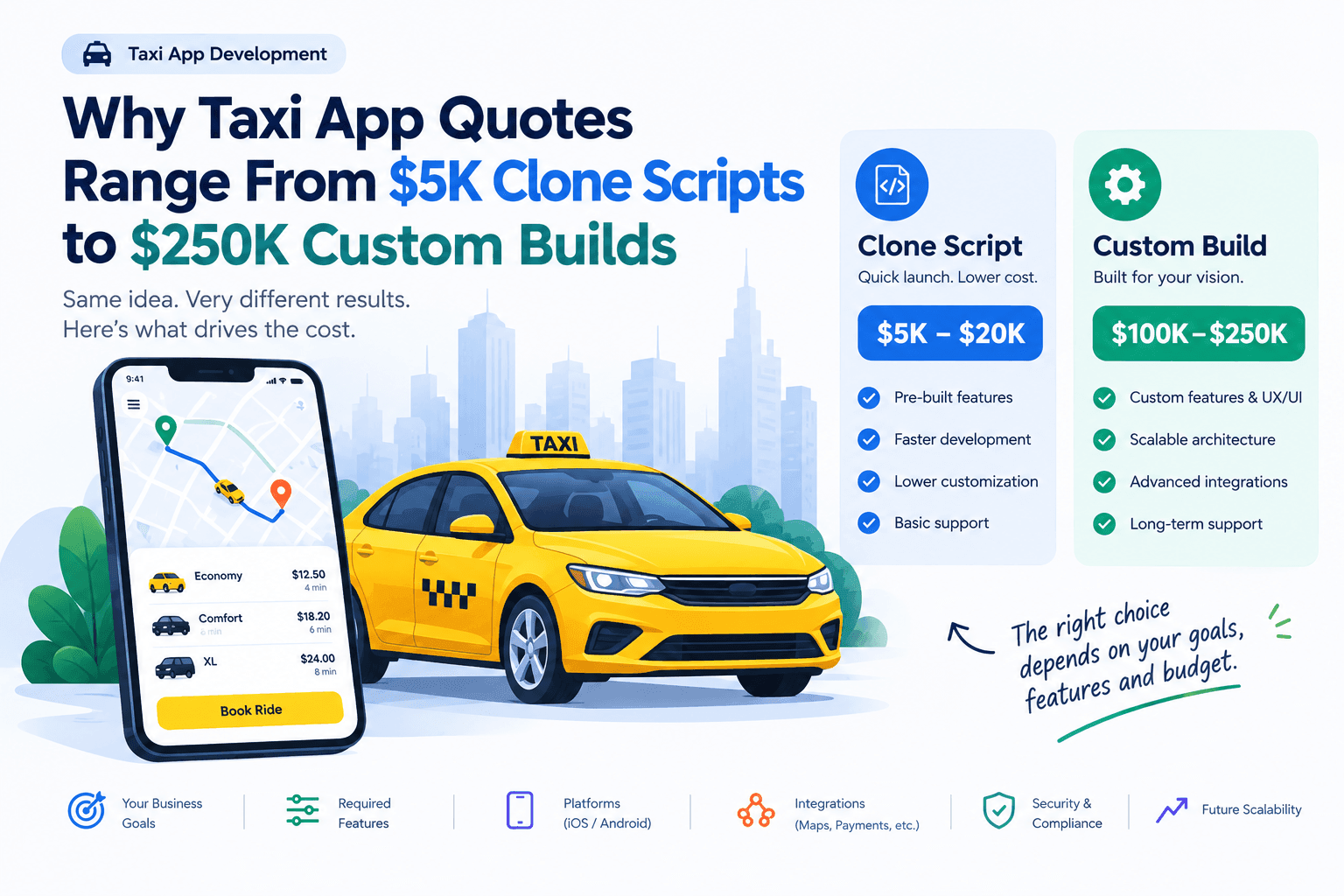
You ask three vendors for a price on the same ride-hailing idea. One says $5,000. Another says $48,000. The third sends a proposal north of $200,000. Nobody is lying, and that is the confusing part.
If you are comparing a taxi app development company for the first time, this gap can feel like a trap. It is not. The numbers differ because the products behind them are completely different things, even when the pitch sounds identical. This guide explains what each price actually buys, where the hidden costs sit, and how to pick the route that fits your business instead of your wallet's first reaction.
So what if the quote you got actually matched your business? That is how TechReforms works. Instead of handing you a template with your logo on it, our team builds around your city, your pricing rules and your growth plans. With 350+ live apps, a 5.0 Clutch rating and fixed-price options starting at $5K, we put every cost on the table before you sign. Your MVP is guaranteed in 4 to 8 weeks, and the code is yours when we finish. The sections below show exactly where the numbers come from, so you can judge any proposal, ours included.
What Are You Really Buying? The Three Types of Taxi Apps
Most quotes fall into one of three buckets. Once you can spot which bucket a proposal belongs to, the price range stops looking random.
- 1. Taxi app clone script. This is pre-built source code, usually modeled on Uber or a similar service. You get a rider app, a driver app and an admin panel with standard features. Your logo and colors go on top. It is fast and cheap because the engineering was done once and is being resold many times.
- 2. White-label taxi app. Very close to a clone, but typically delivered as a hosted product. You rent or license it, apply your branding and launch. The upfront cost is low, though you may pay recurring fees and have limited control over the code.
- 3. Custom taxi app development. Everything is designed and built around your business: your pricing rules, your vehicle types, your dispatch logic, your city. You own the code at the end. It takes longer and costs more because a team is writing it for you alone.
A fourth option sits in the middle, a lean MVP. You build only the core loop (book, match, track, pay) as a custom product, then expand once real riders are using it.
How Taxi App Pricing Works: Why the Range Is So Wide
A taxi booking app development cost is not one line item. It is the sum of several pieces, and each approach handles those pieces differently.
A ride-hailing platform is really three products stitched together:
- A rider app for booking, tracking and paying
- A driver app for accepting trips, navigating and tracking earnings
- An admin panel for dispatch, pricing, payouts and reports
Under those sits a backend that does the heavy lifting like live location streaming, ride matching, fare calculation, payment processing and notifications. That backend is where much of the budget disappears. Screens are the visible part. Reliable real-time infrastructure is the expensive part.
A clone script keeps costs low by reusing all of this. A custom build pays for it from scratch. That single difference explains most of the distance between $5K and $250K.
Typical price ranges
These are broad market ranges, not a promise. Your final number depends on scope.
| Approach | Typical Cost | Typical Timeline | Best Suited For |
|---|---|---|---|
| Clone Script or White-Label | $5,000–$25,000 | Days to 6 Weeks | Testing a Local Market Quickly |
| Customized Clone or Lean MVP | $15,000–$60,000 | 4–12 Weeks | Startups Validating a Specific Model |
| Full Custom Platform | $60,000–$250,000+ | 3–12 Months | Multi-City Operators and Funded Teams |
At TechReforms, for example, a focused MVP covering booking, live tracking and payments usually starts in the $15K to $25K range, while advanced dispatch, multi-city support and analytics push the budget higher.
What Actually Drives Taxi App Development Cost
The taxi app development price factors below are the ones that move a quote the most. When two proposals for the same idea differ wildly, the gap is almost always hiding in this list.
Features and complexity
Basic booking and GPS are cheap. Surge pricing, scheduled rides, split fares, in-app chat, driver ratings and corporate accounts all add engineering time. Automated dispatch that weighs driver distance, demand zones and availability is a serious chunk of work on its own.
Platforms and technology
Native iOS and Android apps cost more than one cross-platform codebase such as Flutter or React Native. Cross-platform is a perfectly good choice for most launches. Native makes sense when you need very fine control over maps and background location behavior.
Design quality
A rider should be able to open the app, enter a destination and confirm within seconds. Getting that feel right takes research and testing. Template design is cheaper, but riders notice.
Third-party services
Maps, SMS verification, push notifications and payment gateways are rarely free at scale. Map usage in particular can become a real monthly expense as trip volume grows, so it is worth reading the Google Maps Platform pricing before you set a budget. For marketplace-style payouts to drivers, services like Stripe Connect are common, and each one has its own fee structure.
Team location and experience
Hourly rates differ by region, but experience with real-time systems matters more than geography. A team that has shipped dispatch software before will avoid mistakes that a general app agency learns on your budget.
Security and compliance
If you handle card payments, you need to follow card-industry rules. The PCI Security Standards Council publishes the requirements, and a good development partner builds around them from the start.
Indicative Taxi App Development Cost Breakdown
Here is roughly how a custom mid-range build divides up. Treat the shares as a guide rather than a formula.
- Discovery and planning: 5% to 8%
- UI and UX design: 8% to 12%
- Rider app: 15% to 20%
- Driver app: 15% to 20%
- Admin panel and dashboards: 10% to 15%
- Backend, dispatch and real-time tracking: 20% to 25%
- Payments and integrations: 5% to 10%
- Testing and launch: 8% to 12%
Notice how the backend and the two mobile apps take the largest slices. A cheap quote usually trims the backend, which is why it struggles the moment real traffic arrives.
Clone Script vs Custom Taxi App: A Fair Comparison
| Factor | Clone / White-Label | Custom Build |
|---|---|---|
| Upfront Cost | Low | High |
| Speed to Launch | Very Fast | Slower |
| Code Ownership | Often Limited or Licensed | Full Ownership |
| Unique Features | Restricted | Unlimited |
| Scalability | Depends on the Base Code | Designed for Your Growth |
| Recurring Fees | Common | Usually Hosting and Support Only |
| Differentiation | Looks Like Many Other Apps | Built Around Your Brand |
When a clone makes sense you run a small local service, want to test demand in one city, and can live with standard features.
When custom makes sense you have unusual pricing rules, corporate or airport workflows, plans for several cities, or investors who will ask who owns the code.
A quick example. Imagine an operator with 20 cars in one town who simply wants customers to stop calling the dispatcher. A white-label app can solve that in a few weeks. Now imagine a founder planning airport transfers with flight-delay tracking and fixed-fare pre-booking across three cities. A clone will fight them at every step, and custom is the safer long-term bet.
The Middle Path: Start With a Taxi App MVP
Many founders feel forced to choose between a $5K shortcut and a $200K gamble. There is a third way. A taxi app MVP includes only what a rider and driver need to complete a trip like sign-up, booking, matching, live tracking, payment and a basic admin view.
You launch in one zone, learn how people actually behave, and add features that real users ask for. This keeps early spending sensible without locking you into someone else's code. If this sounds like your situation, TechReforms offers MVP development for startups built around exactly this idea.
Scalability and Maintenance: The Costs After Launch
This is the part most proposals bury in a footnote. A live taxi app needs ongoing care, operating system updates, bug fixes, server scaling, security patches, map and payment API changes, and new features.
A common planning rule is to set aside roughly 15% to 20% of the original build cost each year for taxi app scalability and maintenance costs. Add hosting, which grows with ride volume, and per-use fees for maps and messaging.
Scalability matters just as much. An app built for one city can crumble when you open a second, especially if pricing zones, driver pools and tax rules are hard-coded. Choosing architecture that expands without a rebuild saves far more than the few thousand dollars you might trim at the start. A dedicated app maintenance and support plan keeps small issues from becoming expensive outages.
Benefits of Hiring TechReforms for Your Taxi App
Choosing the right approach matters, and so does choosing the right partner. Here is what working with TechReforms gets you:
- Clear, fixed pricing: every cost is broken down line by line before anything is signed, so there are no surprise invoices
- A launch you can count on: a focused MVP is guaranteed in 4 to 8 weeks
- Full ownership: source code and data belong to you, with no licensing fees or vendor lock-in
- Built to grow: multi-city architecture lets you add zones, pricing models and driver pools without a rebuild
- Reliable live tracking: real-time GPS with sub-second location updates, so riders trust the ETA
- Payments riders trust: encrypted, PCI-compliant checkout across cards, wallets and cash reconciliation
- Ready for what is next: EV dispatching, charging station mapping and range-aware routing from day one
- Proven experience: taxi, airport shuttle, corporate commute and carpooling platforms already running in US cities
- Support after launch: ongoing maintenance so your app keeps up with demand
Ready for a Quote You Can Actually Trust?
If you are weighing a clone script against a custom build, you do not have to guess. Tell us about your fleet, your city and your timeline, and we will map out the right route with a clear estimate.
- Free consultation, no pressure
- A tailored plan and estimate within 24 hours
- Honest advice, even if that means starting smaller than you planned
Contact TechReforms to start the conversation.
Frequently Asked
Questions
It depends on scope. A clone script or white-label product can start around $5,000, a custom MVP often lands between $15,000 and $60,000, and a full multi-city platform can pass $250,000.
For a small, single-city service with standard needs, yes. The risks appear when you need custom features, want full ownership of the code, or expect rapid growth
A lean MVP can be ready in roughly 4 to 8 weeks. A production-ready platform with rider app, driver app, admin panel and payments usually takes 3 to 5 months, and larger multi-city builds take longer.
Plan for hosting, map and SMS usage, payment processing fees, app store accounts, bug fixes, updates and support.