
Taxi App Pricing Breakdown by Region: Singapore, Canada, US & UK
Ask five taxi app development companies “how much does it cost to build a taxi app?” and you'll get five different numbers — usually somewhere between $15,000 and $250,000. None of them are lying. They're just answering a different question than the one you asked.
The real cost of a taxi booking app isn't set by “features.” It's set by where you're launching, not where you're building. A ride-hailing app deploying in Singapore has to budget for LTA (Land Transport Authority) compliance and PDPA data rules before a single line of Swift or Kotlin gets written. The same app launching in Texas answers to a completely different rulebook — TNC (Transportation Network Company) permits that vary city by city. Launch in London, and TfL's private hire licensing framework adds its own cost layer. Canada splits the difference across provinces, each with its own insurance and driver-vetting requirements.
This is the piece most “uber clone app development cost” articles skip entirely — they hand you a flat number and call it a day. This guide breaks the cost down the way an actual delivery team scopes it: by region, by compliance layer, by feature module, and by build approach (native vs. cross-platform, in-house vs. outsourced). By the end, you'll have a defensible budget range instead of a guess.
1. What Actually Drives Taxi App Development Cost
Before comparing regions, you need the underlying cost model. Every taxi app development services quote is built from five variables, and regional differences amplify or shrink each one differently.
1. App complexity tier
- MVP — rider app, driver app, basic dispatch, cash/card payment, GPS tracking. Enough to test a market.
- Mid-tier / Standard — adds fare estimation, in-app wallet, ratings, promo engine, admin dashboard, basic analytics.
- Enterprise / Uber-like — AI-based dispatch and surge pricing, multi-service (taxi + delivery + rentals), fraud detection, real-time analytics, SOS safety features, multi-language and multi-currency support.
2. Regulatory and licensing layer
This is the variable most cost calculators ignore, and it's the single biggest reason a “simple” taxi app can cost 40% more in one country than another. Driver background-check integrations, insurance verification APIs, data residency requirements, and local transport authority reporting all add development hours before you touch UI.
3. Tech stack decision
Native (Swift/Kotlin) vs. cross-platform (Flutter, React Native) changes both cost and timeline — more on this in Section 8.
4. Team model and location
This is separate from your launch region. A US-based company can build for the UK market; a Singapore-based team can build for Canada. Developer hourly rates follow the team's location, not the app's.
5. Third-party integrations
Payment gateways (Stripe, PayNow, Interac, GoCardless), mapping (Google Maps vs. Mapbox), SMS/OTP providers, and background-check APIs all carry per-region licensing and transaction fees that compound over the app's lifetime — not just at launch.
Expert insight: Most first-time founders budget for development and forget compliance. In regulated ride-hailing markets, legal and compliance-driven engineering work (KYC flows, insurance API hooks, audit logging) can add 15–25% to the base build cost. Budget for it upfront — retrofitting compliance after launch is always more expensive.
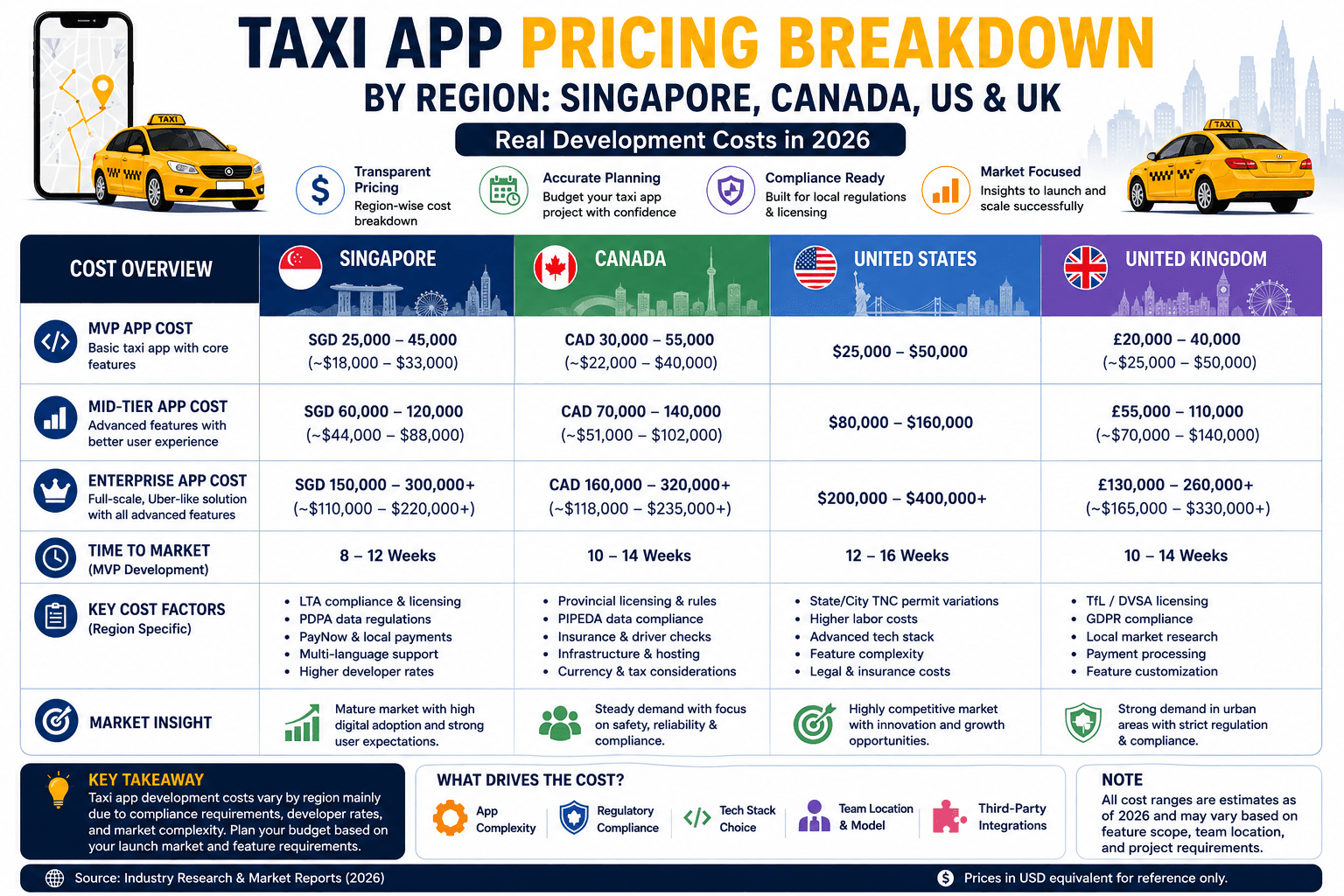
2. Taxi App Development Cost: Singapore vs Canada vs US vs UK (Quick Comparison)
| Region | MVP Cost | Mid-Tier Cost | Enterprise (Uber-Like) Cost | Avg. Local Dev Rate / hr | Compliance Body |
|---|---|---|---|---|---|
| Singapore | SGD 25K–45K (~$18K–$33K) | SGD 60K–120K (~$44K–$88K) | SGD 150K–300K+ (~$110K–$220K+) | SGD 60–120 | LTA, PDPC (PDPA) |
| Canada | CAD 30K–55K (~$22K–$40K) | CAD 70K–140K (~$51K–$102K) | CAD 160K–320K+ (~$118K–$235K+) | CAD 70–150 | Provincial Transportation Authorities + PIPEDA |
| United States | $25K–50K | $80K–160K | $200K–400K+ | $50–180 | State & City TNC Permits |
| United Kingdom | £20K–40K (~$25K–$50K) | £55K–110K (~$70K–$140K) | £130K–260K+ (~$165K–$330K+) | £40–100 | TfL, DVSA |
Ranges reflect typical market rates as of 2026 and vary based on team location, feature scope, and whether you build in-house or outsource. Use these as planning bands, not fixed quotes.
The pattern that matters: notice the US has the widest spread of any region. That's not inconsistency — it's because US ride-hailing regulation is fragmented at the city level (NYC's TLC rules differ sharply from what you'd need in Austin or Phoenix), so the same app can cost dramatically different amounts depending on which cities you launch in first.
3. Singapore Taxi App Development Cost — Deep Dive
Singapore is one of the most mature ride-hailing markets in Asia, and that maturity cuts both ways for founders: infrastructure (payment rails, mapping data, smartphone penetration) is excellent, but regulatory expectations are high from day one.
What drives cost here specifically:
- LTA compliance — Third-party ride-hailing platforms must meet LTA's Third Party Taxi Booking Service Provider licensing framework. Driver-verification and vehicle-registration flows need to support audit reporting, not bolted on later.
- PDPA (Personal Data Protection Act) — Rider and driver data handling needs explicit consent flows and data-minimization logic baked into the backend. Underestimating this is the #1 reason Singapore-bound builds go over budget.
- PayNow and local payment rails — Card payments alone won't cut it; PayNow integration is close to a user expectation, adding integration and testing time.
- Multi-language support — English, Mandarin, Malay, and Tamil support is common for competitive apps, affecting UI work and content management architecture.
| Module | Singapore-Specific Cost Driver | Approx. Added Cost |
|---|---|---|
| Driver Onboarding | LTA license and document verification API integration | SGD 8,000–15,000 |
| Payments | PayNow and card payment gateway integration | SGD 6,000–12,000 |
| Data & Privacy | PDPA-compliant consent management and secure data storage architecture | SGD 5,000–10,000 |
| Localization | Multi-language UI (3–4 languages) with RTL-ready design system | SGD 4,000–8,000 |
Practical example: A Singapore-based startup we've seen in this space typically budgets an extra 4–6 weeks purely for compliance QA before an LTA-facing pilot — that's calendar time most founders don't price into their launch runway.
4. Canada Taxi App Development Cost — Deep Dive
Canada's cost complexity comes from provincial fragmentation, similar in spirit to the US but with fewer, larger jurisdictions. Ontario, British Columbia, Quebec, and Alberta each regulate ride-hailing differently — insurance minimums, driver background-check requirements, and municipal licensing all shift by province.
What drives cost here specifically:
- Provincial insurance API integration — Ontario's ride-hailing insurance model differs from BC's; multi-province launches need configurable insurance-verification logic, not a single hardcoded flow.
- Bilingual requirement (English/French) — Especially non-negotiable for Quebec. Date formats, currency display, and legal disclaimer text all need localization review, not just translated strings.
- Interac integration — Canadians expect Interac e-Transfer and Interac Debit support alongside Stripe/major cards, an integration non-Canadian dev teams often underestimate.
- Cold-climate operational features — Winter surge logic, driver safety check-ins, and weather-based ETA recalibration are common asks from Canadian operators.
| Module | Canada-Specific Cost Driver | Approx. Added Cost |
|---|---|---|
| Insurance & Compliance | Multi-province insurance verification and compliance logic | CAD 10,000–20,000 |
| Payments | Interac and Stripe dual payment gateway integration | CAD 7,000–14,000 |
| Localization | Full English and French-Canadian bilingual experience | CAD 6,000–12,000 |
| Driver Safety | Check-in, SOS, and emergency features tailored to provincial regulations | CAD 5,000–10,000 |
Expert tip: If you're only launching in one province initially (common strategy — usually Ontario or BC), don't build the multi-province insurance abstraction layer yet. Scope it in as a planned Phase 2 module instead.
5. US Taxi App Development Cost — Deep Dive
The US is the most expensive region on this list — and the most misleading if you only look at a single number. TNC regulation in the US is set state-by-state and often city-by-city, which is why “taxi app development cost in USA” searches return such wildly different answers.
What drives cost here specifically:
- City-level TLC/TNC permitting — NYC's Taxi and Limousine Commission has some of the strictest driver-vetting and vehicle-inspection data requirements in the country.
- Fragmented insurance requirements — Minimum liability coverage during app-on/app-off/en-route states differs by state, requiring real backend state-transition logic.
- ADA accessibility compliance — WCAG-compliant UI work is close to mandatory for any serious US launch, given accessibility expectations and litigation risk.
- Higher developer rates — US-based senior mobile engineers run $100–180/hr; many founders offset this by hiring offshore or nearshore teams while keeping product/compliance strategy in-house.
| Module | US-Specific Cost Driver | Approx. Added Cost |
|---|---|---|
| Compliance | State-specific insurance and regulatory state-machine logic | $15,000–30,000 |
| City Onboarding | TLC-style driver, vehicle, and document verification for each city | $10,000–20,000 |
| Accessibility | WCAG 2.2 AA-compliant UI/UX implementation | $8,000–18,000 |
| Payments | Stripe integration with PCI DSS compliance and multi-state tax handling | $10,000–20,000 |
Real scenario: A founder launching only in one mid-size US city (say, Austin or Columbus) can realistically stay near the lower end of the mid-tier band. A founder targeting NYC, LA, and Chicago simultaneously should budget toward enterprise-tier from day one.
6. UK Taxi App Development Cost — Deep Dive
The UK sits closer to Singapore in regulatory maturity — a single national framework (TfL for London, DVSA/local councils elsewhere) rather than the US's fragmentation, which makes budgeting more predictable.
What drives cost here specifically:
- TfL private hire licensing (London specifically) — shapes how you architect driver document expiry tracking, DBS renewal reminders, and vehicle MOT/insurance status checks.
- Open Banking payment integration — UK riders increasingly expect Open Banking payment options (via GoCardless or TrueLayer) alongside cards.
- GDPR (not PDPA/PIPEDA) — The UK's post-Brexit GDPR framework affects data-residency architecture if using cloud infrastructure hosted outside the UK.
- Congestion charge and ULEZ logic — Fare engines that factor in congestion zones and low-emission zone surcharges are now close to standard for London-focused apps.
| Module | UK-Specific Cost Driver | Approx. Added Cost |
|---|---|---|
| Licensing | TfL/DVSA document expiry tracking and DBS renewal management | £8,000–16,000 |
| Payments | Open Banking and card payment gateway integration | £6,000–12,000 |
| Data Residency | UK GDPR-compliant hosting and data storage architecture | £5,000–10,000 |
| Fare Engine | Congestion Charge and ULEZ-aware pricing logic for London | £4,000–9,000 |
Expert insight: Founders targeting UK cities outside London (Manchester, Birmingham, Glasgow) often overbuild for TfL-specific rules they don't need yet. Scope the licensing module to your actual launch city's regulator first.
7. Feature-Wise Cost Breakdown for an Uber-Like App
Regardless of region, these modules make up the bulk of any serious on-demand taxi app development budget. Use this as your feature-to-cost map when scoping with a ride-hailing app development company.
| Feature Module | What It Includes | Typical Cost Range (USD) |
|---|---|---|
| Rider App Core | Registration, booking, live tracking, fare estimate | $8,000 – 18,000 |
| Driver App Core | Trip acceptance, navigation, earnings dashboard | $10,000 – 20,000 |
| Admin Panel | Fleet management, analytics, dispute resolution | $12,000 – 25,000 |
| Real-Time Dispatch Engine | Matching algorithm, ETA calculation | $15,000 – 35,000 |
| Payment Gateway Integration | Multi-provider, wallet, payouts | $8,000 – 18,000 |
| In-App Chat & Notifications | Push, SMS, in-app messaging | $5,000 – 10,000 |
| Ratings & Reviews | Two-way rating system, fraud flags | $3,000 – 6,000 |
| Safety Features | SOS button, trip sharing, driver verification | $10,000 – 20,000 |
| AI Surge Pricing / Demand Prediction | ML-based dynamic pricing engine | $20,000 – 45,000 |
| Multi-Service Expansion | Taxi + delivery + rentals in one app | $25,000 – 60,000 |
Why this matters more than a flat “total cost” number: when you scope by module, you can sequence your MVP intelligently — launch with Rider App Core, Driver App Core, basic Payment Gateway, and Ratings, then layer in AI surge pricing and multi-service expansion once you have real trip volume data to justify the investment.
8. Native vs Cross-Platform: Cost Impact by Region
This decision affects cost more than almost any regional factor, and it interacts with region in a specific way: markets with high iOS usage (US, UK, Singapore) justify native investment sooner; markets with more Android-dominant usage often favor cross-platform first.
| Factor | Native (Swift + Kotlin) | Cross-Platform (Flutter/React Native) |
|---|---|---|
| Upfront Cost | Higher — two separate codebases | Lower — single codebase for both platforms |
| Time to Market | Slower (2 parallel builds) | Faster (unified build) |
| Performance | Best-in-class, ideal for real-time GPS/dispatch | Very good, occasional native-bridge overhead |
| Long-Term Maintenance | Two codebases = higher ongoing cost | One codebase = 30–40% lower maintenance cost |
| Best For | Enterprise apps, top-tier UX markets (US, UK, SG) | MVPs, budget-conscious launches, multi-market rollouts |
Our take, based on delivery experience: for a true MVP validating demand in one city, Flutter or React Native is almost always the right call — you save 25–35% on initial build cost. Once you're past 10,000+ monthly active trips and dispatch-engine performance starts mattering at scale, migrating performance-critical modules to native (while keeping the rest cross-platform) is a proven middle path — not an all-or-nothing decision.
9. Hidden Costs Most Budgets Miss
- Third-party API costs at scale — Google Maps, SMS/OTP, and background-check APIs are cheap during development but scale with trip volume post-launch.
- App Store and Play Store compliance reviews — Ride-hailing apps face extra scrutiny (background location use, driver identity verification) and can face multiple rejection cycles.
- Post-launch maintenance — Budget 15–20% of your initial build cost annually for maintenance, OS updates, and security patching.
- Payment processing and payout infrastructure — Ongoing transaction fees (typically 1.5–3% per transaction) and driver payout infrastructure carry real operational cost.
- Localization beyond translation — Currency formatting, date/time formats, and address formats require real design and QA time, not just a translation swap.
- Legal review — Terms of service, driver contracts, and privacy policies need region-specific legal review, separate from the development budget.
10. Common Mistakes When Budgeting a Taxi App
- Treating “taxi app development cost” as a single number — the same feature set costs meaningfully different amounts depending on target region and compliance layer.
- Skipping compliance scoping before development starts — retrofitting LTA, TfL, or state-level compliance after the fact is consistently more expensive than architecting for it from day one.
- Over-building for markets you haven't launched in yet — the “we might expand to Quebec eventually” instinct leads to paying for logic you won't use for a year or more.
- Choosing the cheapest quote without checking domain experience — a company that has shipped dispatch engines and payment reconciliation logic will scope your project more accurately.
- Ignoring post-launch cost in the initial budget — the most common cause of underfunded on-demand taxi app development projects.
11. How to Choose a Taxi Booking App Development Company
When evaluating a custom taxi app development partner, cost should be the third question you ask — not the first.
Ask these first:
- Have they built dispatch/matching logic before, or only CRUD-style booking forms?
- Can they show compliance-aware architecture experience relevant to your target region (LTA, TfL, TLC, provincial insurance)?
- What's their post-launch support model, and is it priced separately or bundled?
- Do they build in Flutter/React Native and native, or only one — and does that match your scaling plan?
Then evaluate cost, structured like this:
- Fixed-price for MVP scope (clear deliverable, lower risk for first-time founders)
- Time-and-materials for ongoing feature development (better for iterative, data-driven roadmaps post-launch)
- Dedicated team model (best for founders planning aggressive multi-region expansion)
A development partner who pushes back on unrealistic timelines or flags compliance gaps in your spec is a stronger signal of expertise than one who agrees to every requirement without question.
12. 2026 Trends Affecting Taxi App Pricing
- AI-based dispatch and dynamic pricing are now baseline expectations rather than premium add-ons, increasing the overall cost of mid-tier taxi app development. Learn more about emerging technologies in our Taxi App Development Trends in 2026 guide.
- EV-specific taxi fleet features, including battery-range-aware dispatch and charging station routing, are becoming essential for operators in Singapore, the UK, and parts of Canada.
- Super-app convergence is driving demand for platforms that combine taxi booking, food delivery, courier services, and micro-mobility into a single application, even for MVP launches.
- On-device fraud detection and AI-powered identity verification are becoming increasingly important as regulators in Singapore and the UK strengthen driver onboarding and compliance requirements.
Conclusion & Next Steps
There's no single honest answer to “how much does it cost to build a taxi app” — and any company that gives you one number without asking where you're launching is guessing, not scoping. What actually determines your budget is the intersection of three things: your feature tier, your launch region's compliance layer, and your tech stack decision. Get those three right, and your cost estimate stops being a range and starts being a plan.
If you're currently comparing taxi app development services and want a scoped estimate specific to your target region — Singapore, Canada, the US, the UK, or a multi-region rollout — we'd rather give you an accurate number based on your actual compliance and feature requirements than a generic quote pulled from an average.
Ready to scope your taxi app build with real numbers, not guesswork? Talk to our team for a free technical consultation and region-specific cost estimate — we'll map your feature list to a realistic budget and timeline before you commit to anything.