
How to Monetize a Game in 2026: 8 Proven Revenue Models & Strategies
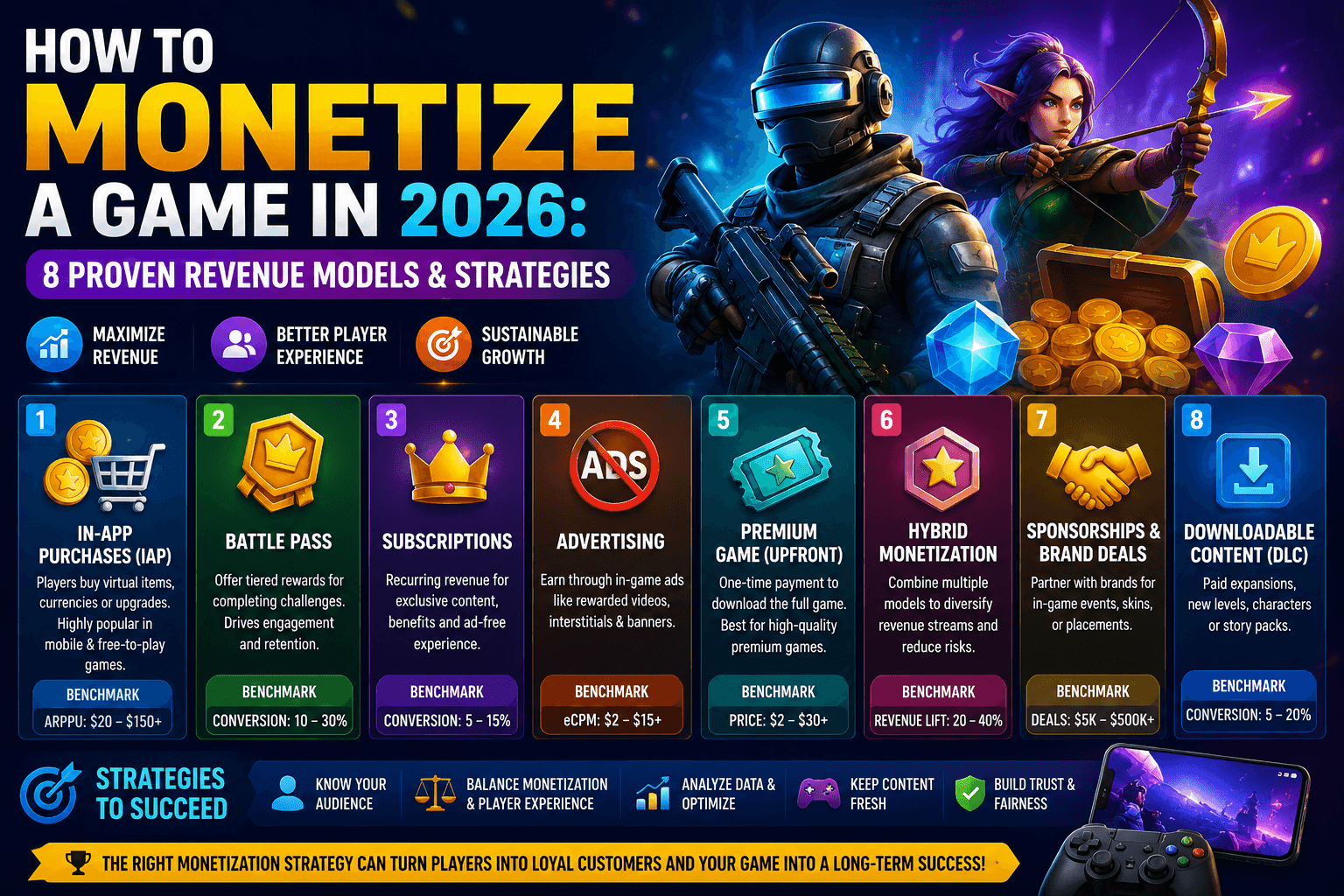
Mobile and PC games generated over $187 billion in global revenue in 2025, according to Newzoo's Global Games Market Report — and the studios capturing the largest share aren't necessarily those with the biggest budgets. They're the ones with the smartest monetization strategy built into their games from day one.
Yet most game developers treat monetization as an afterthought — something bolted on after launch. That single decision costs studios millions in avoidable revenue loss every year. Custom Game Development solves this at the root by embedding monetization logic into the game's architecture from the very first sprint, not as a patch applied after the fact.
This guide breaks down the 8 proven game monetization models driving revenue in 2026, explains how to choose the right one for your game type, and covers the technical decisions that determine whether your monetization actually works. If you're new to the process, it helps to first understand what game design and development actually involves before mapping a revenue strategy on top of it.
What Does Game Monetization Mean in 2026?
Match the Model to Your Genre and Audience
Game monetization is the strategy by which a studio converts player engagement into sustainable revenue. In 2026, it's no longer a single choice — it's a layered architecture of multiple revenue streams working together.
The old model — charge upfront, done — accounts for less than 12% of total mobile game revenue today, per data.ai's State of Mobile Gaming Report. The market has shifted toward engagement-first, revenue-second models that build long-term player lifetime value (LTV) rather than relying on front-loaded sales.
Key insight: Monetization in 2026 is not a feature you add after launch. It's a design decision you make before development begins. Studios that integrate monetization logic into their core game loop from the start consistently outperform those that retrofit it later.
The 8 Core Game Monetization Models (With 2026 Data)
1. In-App Purchases (IAP): Cosmetics, Power, and Progression
In-App Purchases remain the dominant monetization model for mobile games, generating roughly 48% of total app store revenue globally, according to Sensor Tower's Mobile Market Estimates. IAP breaks into three distinct categories:
- Cosmetic IAP (skins, emotes, character customization): Highest player acceptance, lowest churn risk. Fortnite generates over $1B annually on cosmetics alone.
- Power IAP (weapons, upgrades, stat boosts): Higher short-term revenue but carries significant pay-to-win backlash risk if not balanced carefully.
- Progression IAP (energy refills, skip timers, unlock keys): Works best in casual and mid-core genres. Requires careful economic design to avoid disrupting natural gameplay flow.
- The average IAP conversion rate is 2–5% of the total player base — but top-performing studios achieve 8–12% by optimizing purchase friction, price anchoring, and contextual offer timing.
Subscription Models: Battle Pass vs. Monthly Access
Subscriptions are the fastest-growing monetization segment in gaming, up 67% year-over-year as of Q4 2025, per Newzoo's Games Market Report.
Battle Pass — popularized by Fortnite and now standard across genres — sells a seasonal progression track that rewards consistent play. It delivers predictable recurring revenue while driving daily active use. Average revenue per paying user (ARPPU) for Battle Pass models ranges from $8–$12 per season.
Monthly access subscriptions (like Xbox Game Pass) deliver a catalog of content for a fixed fee. These work best at platform scale unless your game has exceptionally high content output.
Ad-Based Monetization: Rewarded, Interstitial, and Playable Ads
Ad monetization is the primary revenue model for hyper-casual and casual games, where IAP conversion is typically below 1%. Three formats dominate:
Rewarded Video Ads: Player-initiated, opt-in. CPMs range from $12–$28 in Tier 1 markets. Deliver 2–4× higher revenue per impression than non-rewarded formats.
Interstitial Ads: Full-screen, shown between sessions. Effective when frequency-capped (max 1 per 3–5 minutes). Overuse is the most common cause of player churn in casual games.
Playable Ads: Interactive mini-game format. 3–5× higher engagement rate than standard video, per AppLovin network benchmarks.
The critical technical requirement here is ad mediation — connecting multiple ad networks (Google AdMob, IronSource, AppLovin, Unity Ads) through a single SDK layer that dynamically selects the highest-bidding network per impression. This alone can increase ad revenue by 30–45% versus single-network setups.
Ad performance also ties closely to how the game backend is architected. Studios leveraging generative AI in their mobile app development are seeing faster iteration on ad placement logic and smarter user segmentation that improves CPMs.
Premium Pricing: When the Upfront Model Still Works
Premium pricing has a narrower market in 2026 but remains highly profitable in specific contexts. PC and console genres — RPGs, strategy games, narrative adventures — where players expect a complete experience, still support $15–$60 price points effectively.
On mobile, premium pricing above $4.99 sees significant conversion drop-off. The exception: niche, high-intent audiences on the App Store or Google Play willing to pay upfront for a friction-free experience.
A useful reference point here is the AAA end of the spectrum. Rockstar's approach to GTA 6 — covered in detail in this GTA 6 cost and game development strategy breakdown — shows how premium pricing at scale is supported by massive production investment, brand equity built over decades, and a built-in global audience. Most studios won't operate at that level, but the underlying principle holds: premium pricing requires a complete, polished experience that justifies the upfront cost to the player.
Licensing and IP Partnerships
Games with strong IP — distinctive characters, settings, or mechanics — can generate meaningful licensing revenue through merchandise deals, media adaptations, crossover partnerships, and white-label agreements. This model typically activates once a game has an established player base and recognizable brand equity.
DLC and Expansion Packs
Downloadable Content works best for PC and console titles with strong narrative foundations. The model sells significant content additions — new story chapters, maps, character classes — to an existing player base.
Top titles on Steam achieve 35–55% DLC attach rates. Below 15% signals either a content-value mismatch or insufficient player investment in the base game.
NFT and Blockchain Integration: The Honest Assessment
Blockchain-based monetization experienced a sharp correction between 2022 and 2024. Over 90% of play-to-earn titles launched in 2021–2022 saw player bases decline by more than 80% within 18 months, per DappRadar's Blockchain Gaming Report.
In 2026, viable use cases are narrower: provable digital ownership of cosmetics in games with established communities and cross-game asset portability within closed ecosystem platforms. Building a primary monetization strategy around blockchain mechanics without a clear retention plan carries significant risk.
Game-as-a-Platform (GaaP): Events, Creator Economy, and Crossovers
The most sophisticated monetization model in 2026 treats the game as a platform rather than a product. Roblox's creator economy — generating $923 million in developer revenue in 2024 — is the benchmark. The model enables user-generated content, in-game brand crossovers, and creator monetization tools with revenue sharing.
This model requires significant technical infrastructure and is viable only for games with very large active player bases. For studios building the right foundation early, it offers the highest long-term LTV ceiling of any monetization model.
How to Choose the Right Monetization Model for Your Game
| Genre | Primary Model | Secondary Revenue |
|---|---|---|
| Hyper-Casual Mobile | Rewarded Ads + Interstitials | Cross-promotion |
| Mid-Core Mobile (RPG, Strategy) | Battle Pass + Cosmetic IAP | Rewarded Ads |
| PC / Console (Narrative) | Premium + DLC | Licensing / IP |
| Live Service / Multiplayer | Season Pass + Cosmetic IAP | Brand crossovers |
| Casual Puzzle | Ad Monetization + Energy IAP | Subscription (ad-free tier) |
Free-to-Play vs. Premium: A Quick Framework
The F2P vs. premium decision comes down to one question: can your game generate enough revenue from 2–5% of players to compensate for giving the experience away free to the other 95–98%?
- High replayability, daily engagement loops → F2P with IAP/ads
- Finite, content-driven experience → Premium with DLC
- Strong community and social mechanics → F2P with Battle Pass
- Niche, high-intent audience → Premium pricing
The Technical Foundation Behind Monetization Success
Monetization Must Be Built Into Game Architecture — Not Added Later
This is where most developers go wrong. Monetization models are not plugins — they are architectural decisions that affect your game's core loop, backend infrastructure, analytics stack, and server costs from the first line of code.
Consider IAP implementation. Doing it correctly requires: server-side purchase validation against App Store and Google Play APIs, real-time virtual currency management, anti-fraud mechanisms, and A/B testing infrastructure for price optimization. None of these are bolt-on features.
Studios that retrofit monetization infrastructure post-launch typically spend 3–4× more in development time than studios that spec it into the original build — and still ship a less robust implementation.
Custom Architecture vs. Standard Engine Defaults
One of the most consequential decisions in game development company is whether to build a custom backend or rely on standard engine defaults. This is essentially the same trade-off covered in detail in custom software development vs. off-the-shelf solutions — and for monetization-heavy games, the custom path almost always delivers better long-term ROI.
Custom game architecture allows studios to build the economy system, ad mediation layer, and purchase flow precisely around their monetization requirements. The backend can be built for real-time economy adjustments, dynamic pricing experiments, and personalized offers at scale.
Standard engine implementations (Unity asset store, Unreal marketplace) provide faster initial build times but introduce constraints that become expensive to work around as monetization complexity grows. For hyper-casual titles with simple ad monetization, the trade-off often favors speed. For mid-core and live service games with complex economic systems, it frequently doesn't.
Why the Right Development Partner Matters
The quality of your monetization implementation is directly tied to the team building it. A development partner that understands game economy design, backend architecture, and platform-specific billing APIs will build a system that scales cleanly. One that doesn't will create technical debt that compounds every time you want to run a promotion, adjust pricing, or add a new revenue stream.
Choosing the right custom game development in usa partner means finding a team that treats monetization as an engineering discipline — not an afterthought. The right partner brings deep knowledge of game economy design, platform billing APIs, and backend scalability, so your revenue systems are architected correctly before a single line of production code is written. Studios that invest in this kind of specialized expertise consistently ship cleaner implementations and hit their revenue targets faster than those that rely on generalist developers retrofitting monetization logic post-launch.
If you're evaluating your options, Tech Reforms delivers end-to-end game development services built around revenue-aware engineering — covering 2D/3D mobile games, PC, and console titles. With 20+ years of experience, 150+ in-house experts, and 350+ live apps delivered, their team manages the full development cycle: from economy design and backend architecture to IAP integration, ad mediation, and post-launch performance optimization.
2026 Game Monetization Benchmarks
Use these industry benchmarks — sourced from Sensor Tower, data.ai, and GameAnalytics — when projecting revenue and evaluating post-launch performance:
- Average IAP conversion rate (mobile): 2–5% | Top performers: 8–12%
- Average ARPPU for Battle Pass: $8–$12 per season
- Rewarded video CPM, Tier 1 markets: $12–$28
- Healthy Day-1 retention (casual): 35–45%
- Healthy Day-7 retention (mid-core): 15–25%
- DLC attach rate — good: 30%+ | Excellent: 50%+
- Ad mediation uplift vs. single network: 30–45% average revenue increase
- Player LTV payback window (UA-funded games): 90–180 days for profitability
Always validate against your own cohort data using tools like AppsFlyer, Amplitude, or GameAnalytics before making major monetization decisions.
Common Monetization Mistakes That Kill Revenue
- Retrofitting monetization post-launch: The most expensive mistake in game development. Plan the architecture before the first sprint — not after.
- Over-relying on one revenue stream. Single-model monetization creates brittle revenue. Platform policy changes from Apple or Google can wipe out 80% of your income overnight. Layer your models.
- Ignoring regional pricing variance: A price point that converts in the US may not work in Southeast Asia or Brazil. Successful studios implement dynamic pricing adjusted to local purchasing power — this requires deliberate architecture, not a settings toggle.
- Optimizing for Day-1 revenue over LTV, Aggressive early monetization (energy gates, IAP prompts in the first 5 minutes) consistently damages retention. Every 1% drop in Day-7 retention typically translates to 8–12% lower 90-day LTV.
- Not A/B testing price points: Studios using systematic price point A/B testing via RevenueCat report 15–30% revenue improvements from optimization alone.
Conclusion: Monetization Is an Architecture Decision
Game monetization in 2026 is not a marketing problem or a post-launch optimization problem. It is a technical decision that must be made before development begins and validated at every stage of the build.
The studios generating consistently high revenue per user treat economy design, backend infrastructure, and data-driven optimization as first-class engineering concerns — not features to be added later. Understanding the full game design and development process from the start is what separates studios that monetize by design from those that scramble to retrofit revenue mechanics after launch.
Whether you're planning a new launch or reassessing an existing title's revenue performance, the most important step is evaluating your monetization architecture honestly before more development budget is committed. That includes engine selection — a decision that directly impacts your backend scalability, licensing costs, and long-term technical debt. If you're at that stage, the Godot vs Unity breakdown for enterprise game development is a practical next read. Ready to Build a Game That Monetizes From Day One?
Most revenue problems in gaming are architecture problems in disguise. If you're starting a new project or rearchitecting an existing one, the decisions you make in the next few weeks will determine your revenue ceiling for the next few years.
Tech Reforms' game development team works with studios and founders to design, build, and scale games with monetization built into the core — not bolted on after launch. From economy system design and backend infrastructure to IAP integration, ad mediation, and post-launch optimization, every engagement is structured around long-term revenue performance.
Book a free strategy session today — and get a clear picture of what your monetization architecture should look like before a single line of production code is written.