
How to Develop a Mobile App in 10 Easy Steps
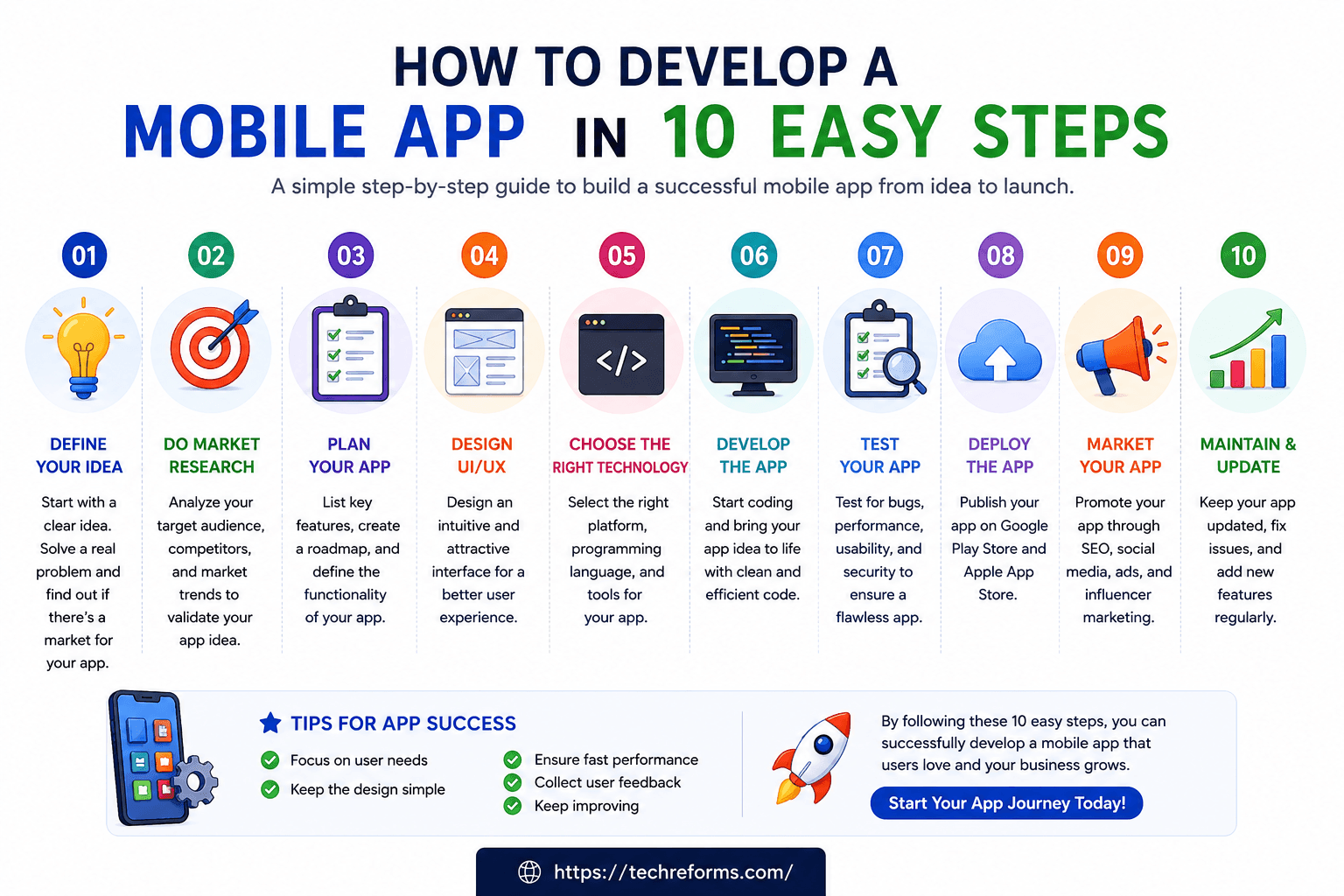
Many mobile apps fail to deliver value, not due to technical errors, but because of inadequate strategy from the start.
According to Localytics, 21% of mobile apps are only opened once during their lifespan. This statistic serves as a stark reminder for every CTO and product lead, highlighting a harsh truth: the "build it and they will come" mentality not only fails but also squanders the entire budget.
A poor strategy significantly inflates mobile app development costs beyond initial creation. Without proper planning, costs for rework, repositioning, and hasty marketing efforts build up. Teams that bypass the discovery phase often end up solving the wrong problems efficiently — resulting in sleek interfaces that do not retain users.
A frequent error is prioritising aesthetics over business logic. A stunning UI is worthless if the app does not achieve measurable growth targets or address user needs. CTOs must base every product decision on business outcomes, not just visual appeal.
This is where a structured, engineering-focused partner becomes vital, aligning technical execution with long-term business strategy from the outset.
The question is how to achieve that alignment — and it starts with a disciplined, step-by-step development framework.
The 10-Step Framework for Custom Enterprise App Development
A structured development lifecycle distinguishes an app that scales from one that fails post-launch With strategic foundations laid — as discussed in the previous section — the build process itself demands equal diligence.
The Forbes Technology Council states: "The success of a mobile app is not just in the code, but in how well it resolves a specific friction point in the user's daily workflow." This principle underlies every step below.
- Ideation and market research: Identify a specific friction point your target users encounter daily, validated through competitor analysis and user interviews.
- Define the tech stack: Weight native performance against the speed and cost benefits of cross-platform app development frameworks like Flutter or React Native.
- Architecture planning: Plan for scalability, security, and integration needs before any code is written.
- UX and wireframing: Convert user requirements into low-fidelity prototypes to test flows early.
- MVP scoping: Focus on the core value proposition; deliver the minimum that resolves the issue.
- Sprint-based development: Build iteratively in short cycles, maintaining momentum and reducing risk. This method is effective for enterprise-grade custom builds on any budget.
- QA and testing: Automate regression tests; manually validate edge cases across devices.
- Feedback loops: Release to a beta group, gather behavioural data, and refine thoroughly before full launch.
- Staged rollout: Deploy incrementally to assess performance under real-world conditions.
- Post-launch iteration: Treat launch as a milestone, not the end; continuous improvement is the product strategy.
With this framework in place, the next crucial question is: how do users actually find your app?
Efficiency at Scale: The Case for Cross-Platform Frameworks
Selecting the right technical architecture is one of the most crucial decisions in creating a mobile app that delivers value without overspending. Flutter and React Native have become leading frameworks in the enterprise space as they solve the classic dilemma: native performance or development efficiency. With cross-platform frameworks, you no longer have to choose.
A single codebase serving both iOS and Android is the primary advantage here. Instead of maintaining two parallel builds, engineering teams work from a unified source — reducing duplication, simplifying version control, and dramatically shortening timelines. According to Adobe Experience Cloud, cross-platform frameworks can cut development time by up to 40–50% compared to native builds. This is a substantial competitive edge, especially for enterprises under tight release schedules.
The performance gap between cross-platform and fully native has significantly narrowed in practice. Flutter's compiled Dart code and React Native's new architecture both offer near-native rendering speeds, making the trade-off far less significant than it was just a few years ago.
Staff augmentation fits naturally into this model. Enhancing your in-house team with specialists in Flutter or React Native — rather than hiring permanent staff — allows you to scale velocity without long-term overhead. For complex builds, such as those involving custom integration requirements, this flexibility is particularly valuable.
Of course, the right framework only addresses the technical efficiency issue. The next challenge enterprises often face is whether that efficiency translates into proportional financial returns — which is why development costs and long-term value must be honestly assessed.
Flutter vs React Native vs Native App Development: Side-by-Side Comparison
| Feature | Flutter | React Native (iOS/Android) | Native (iOS/Android) |
|---|---|---|---|
| Code Reuse | Up to 95% shared codebase | Up to 90% shared codebase | Separate codebase required |
| Performance | Near-native rendering speed | Near-native with new architecture | Best-in-class performance |
| Development Speed | Fast — single codebase for both platforms | Fast — large developer community | Slower — two separate builds |
| Cost Efficiency | Low — reduced development hours | Low — widely available talent | High — double the resources |
| UI Consistency | Pixel-perfect on iOS and Android | Platform-dependent components | Fully native UI per platform |
| Best For | Enterprise apps, MVPs, startups | Social apps, e-commerce, SaaS | Performance-critical applications |
| Time to Market | Up to 40–50% faster | Up to 40% faster | Standard timeline |
Choosing the right framework directly impacts your development cost, timeline, and long-term scalability. Here's how the three leading approaches compare:
Real-World Example: How Techreforms Powers Cross-Platform Delivery
At Techreforms, cross-platform development is not a shortcut — it is a deliberate strategy:
- Single codebase deployed on both iOS and Android — cutting development time by up to 40%
- Real-time tracking, loyalty systems, and ERP integrations built natively — not bolted on
- Food delivery platforms engineered for peak-hour resilience and multi-vendor coordination
- Staff augmentation model lets teams scale fast without long-term hiring overhead
- Post-launch SLA support included — not an afterthought
The result: faster time-to-market, lower maintenance costs, and enterprise-grade architecture that grows with the business. Learn how Techreforms approaches food delivery app development from strategy to deployment.
Calculating the Real ROI: Mobile App Development Costs vs. Value
Investing in custom mobile app development services only makes sense when you understand the complete cost picture — not just the build, but everything that follows.
The variables in custom app pricing are far more extensive than most budgets initially consider. Complexity, platform choice, API integrations, and compliance needs all significantly affect the final cost. What seems affordable at the proposal stage often expands once real-world requirements emerge.
"Cheap development creates expensive problems." Technical debt accumulates quietly — poor architecture, inadequate testing, and shortcuts in UX design lead to costly rework cycles that can exceed the original build cost.
Consider three cost dimensions that technical leaders frequently underestimate:
- Short-term savings vs. long-term debt: Low-cost builds often compromise code quality, resulting in apps with fragile foundations that resist scaling.
- UX failure costs: Poor user experience leads to abandonment before conversion, undermining the return the investment was intended to generate.
Market context is crucial here. The global mobile app market is projected to reach $777.4 billion by 2032, according to Allied Market Research — a trajectory that makes a well-funded digital transformation strategy a competitive necessity rather than a luxury.
Conversely, inflated budgets without strategic direction are equally wasteful. The goal is proportionate investment aligned with measurable business outcomes. Understanding where costs truly create value — and where they don't — is the discipline that separates successful app programmes from expensive lessons. The next section outlines precisely what that disciplined approach looks like in practice.
The Bottom Line: Key Takeaways for Technical Leaders
Building a successful mobile app in 2026 means integrating design and engineering into a unified discipline — not treating them as separate workstreams.
As discussed throughout this article, the decisions made early in your mobile app development process compound significantly over time. Technical leaders who adopt a strategic mindset from the start consistently outperform those who add discoverability as an afterthought.
Here are the critical principles to carry forward:
- Prioritise user-centric design from the outset. A poorly structured UX leads to a 21% bounce rate, signalling low quality to search algorithms and diminishing organic reach before your app gains traction.
- Leverage cross-platform frameworks to accelerate delivery. As noted in the previous section, the right architecture can reduce time-to-market by up to 50%, freeing budget for growth initiatives rather than technical rework.
- Choose partners with enterprise workflow expertise. Agencies skilled in complex systems — such as WCRM and HRMS integrations — minimise costly scope gaps and deliver production-ready solutions faster.
These aren't isolated best practices; they form an interconnected framework. Achieving success in one area while neglecting others limits your overall return. The next question, then, is who can help you execute across all of them simultaneously.
Digitising Your Business Through Strategic Innovation
The gap between a technically sound app and a commercially successful one is almost always strategic — bridging that gap requires partners who are fluent in both languages.
In practice, the most effective mobile app projects succeed because engineering decisions are made with business outcomes in mind from the outset. Aligning custom deployment and iterative development with measurable commercial goals — not just clean code — is key.
Flexible team scaling is a genuine advantage for enterprise projects, where requirements shift and timelines compress unexpectedly. Whether you need a lean discovery team or a full-stack crew across design, engineering, and strategy, the ability to scale without rebuilding trust or context is invaluable. As mobile app development strategy continues evolving through 2026, agility at the team level directly translates to agility in the product.
The path forward is straightforward:
- Ideation — Define goals, users, and discovery strategy together
- Architecture — Build with performance integrated
- Deployment — Launch with visibility, not just functionality
- Iteration — Scale what works using real data
Ready to build an app that ranks, retains, and grows? Consider how strategic alignment can turn your next brief into a market-ready product.